
Your Custom Text Here
A Pastoral Letter (in 3 parts)

Near-full moon over CTR last night
This is Thomas hijacking Amy’s blog again! I wanted to post the 3-part Pastoral Letter that we wrote to the community. Amy wrote the first two sections, and I wrote the third. We hope it’s helpful to you in these days of political polarization.
1 - Why?
Dear Friends,
It has now been a year since thirty-five of us publicly committed ourselves to pursue Jesus’s prayer from John 17 - that we might be one as He and the Father are one. I believe the desire expressed in the Statement of Personal Devotion pleases the Trinity. Since we made this commitment, the underlying divisions in society have become more visible and strident. It seems most everyone in our country feels under attack in some way or another. Whether we are Protestant or Catholic, whatever opinions we hold concerning the current pandemic or the best way to pursue racial justice, we find there are many in the media, perhaps some in our own churches and families, who are loudly hostile to our beliefs. How do we live as ministers of reconciliation in such a charged, challenging environment? This is a question I would like to explore in the next two weeks as we consider signing the Statement of Personal Devotion for another year.
I would like to propose that we begin by remembering that we are citizens of a different kingdom. We are strangers and aliens on this earth. All the kingdoms of this world will pass away, and that includes our own nation - whether we are Americans, Germans, or some other nationality. This does not mean that we should take no interest in the world around us. It does not imply that we can be indifferent to the welfare of our native land. May it never be! We are sent to our families and neighbors, to our workplaces and our nation, as ambassadors of the Great King. Our work is to prepare His way. We are sent to spread the good news that He is coming soon. We model the Kingdom of God for all to see by living according to its laws within our spheres of influence. We invite others into the glory of this Kingdom by doing justice and loving mercy. By speaking the truth with grace. By caring for the widows and orphans. By feeding the hungry and clothing the naked. By praying for those in distress. We represent the Kingdom most visibly by loving one another.
“By this shall all men know that you are My disciples,” Jesus said, “if you love one another.” The love that Jesus desires for His friends goes deeper than we dare imagine. It takes us into the very heart of the Trinity – to the unity shared between Father, Son and Spirit. This kind of unity is born of the Spirit of God; thus it exists only within the Kingdom of God. This is why Jesus can pray unity only for His disciples. As citizens of the Kingdom, we should seek this unity as a priceless treasure. Our unity will bear a powerful witness to a hurting world, just as Jesus promised.
In order to serve as ambassadors of this Kingdom, we must be at peace with the King. We must remember that He holds the times in His hand. Both blessing and judgment come from Him, and both are right and good. Peter assures us, “the Lord knows how to deliver the godly out of temptations and to reserve the unjust under punishment for the day of judgment.” The King of the Universe knows our names. He numbers the hairs of our heads. Whether America is strong or weak, whether we know freedom or persecution, whether we live or die, we are held firmly in His hand. He is coming soon to make all things new!
Next week I will explore some practical ways to apply the Statement of Devotion to daily life. This week, let us meditate on the joy of being a citizens and ambassadors of God’s Kingdom!
May the peace of Christ guard our hearts and minds,
Amy
2 - What?
Dear Brothers and Sisters,
Today I would like to take up a question from my previous letter - What does it look like to practice our Statement of Personal Devotion in these politically charged days?
In other words, how do we manifest our love for one another while disagreeing about important matters? All of us, I think, are grappling with this question. We feel the pain of division within our churches, and perhaps within our families. Even within CTR, we are not immune from strife. The current crises have exposed differences close to our hearts. Sometimes conversations leave us feeling misunderstood, unheard, or discounted - and this is true regardless of where we fall on the political spectrum.
We strive to walk as Jesus did, full of grace and truth, but the path is not always clear to us. Here are a few practical suggestions for navigating these waters.
Be Slow to Anger
The King of the Universe is slow to anger. Hallelujah! In We represent our King well when we are secure in His love, not easily rattled.
Be Humble
Our King is so humble that He submitted Himself to insults, lies, mockery, beatings and even death on behalf of His enemies.
Believe the Best, Protect and Defend
These are qualities of love. (I Cor. 13) We must be careful to honor our fellow humans made in God's image, even when opposing their ideas or actions. Recognize what is good in others. Choose words carefully. Satan is known as the Accuser of the Brethren. We must be careful not to play his game.
Be Humble Again
Paul ends his chapter on love by reminding us that we see through a mirror dimly what shall soon be revealed. None of us fully understands the complex issues of our days. None of us can predict the future, or read the human heart the way Jesus can. Let's be open to hearing the concerns of our brothers and sisters and learning from their experiences.
Remember the Battle Belongs to the Lord
He is in control, no matter what. We are not responsible for outcomes, only for faithfulness.
Be Childlike
Ask the Lord for His comfort. Ask Him what He would do in your situations. Ask yourself, “What would I say if Jesus were in the room?” He is near those who call on Him!
Let me end this meditation by saying how very grateful I am for each person in the CTR community! Each of you receiving this letter has loved me in tangible ways. I am more like Christ because of your witness, your kindness, your wisdom and generosity. The Lord has prepared us for such a time as this, to be His witnesses. Though we come from different church traditions, experiences and viewpoints, we all long for the Coming King. The Holy Spirit will help bind us in love as we cry together, "Come Lord Jesus!"
In the love of Christ,
Amy
PS: Next week look for the final installment of this three-part pastoral letter, which addresses the question, "OK ... so how exactly do I become the kind of person who is slow to anger, humble, ...?"
3 - How?
Dear Brothers and Sisters,
Today we will finish our reflections on the question - What does it look like to practice our Statement of Personal Devotion in these politically charged days?
In Part 2, Amy made several practical suggestions for navigating these difficult waters: Be Slow to Anger, Be Humble, ...
But what if these actions and attitudes don't come naturally? All of us have had the experience of aspiring to a kingdom culture, but falling short. The logical question is then -- how do you become the kind of person who is slow to anger, humble, childlike, and so forth?
The answer is simple ... but difficult. It is through the process of spiritual formation that we become this kind of person.
All of us have been formed by our lives to this point. And all of us have mostly been malformed. Our family dynamics; our neighbors and friends; our educational institutions; our jobs; our media consumption - very few of these intentionally formed us to follow the ways of the King. Most of them formed us in the opposite patterns - to be proud; to assert our rights; to loudly defend our opinions; to "elevate" ourselves by "putting down" others.
Of course, much has been written and said about the process of spiritual formation. What can we add? Perhaps just a few thoughts of how to apply a few of the classic spiritual disciplines to this particular problem of living out John 17 in the midst of politically charged rhetoric.
Solitude
Calm your body down; breathe slowly and pray as you breathe; cut off ungodly / unhelpful inputs into your mind and emotions
Silence
Don't speak; don't react; don't post
Prayer
Pray for your enemies
Almsgiving
Give to the poor, give as the Spirit directs; you can even give money to those your heart is struggling to love! (where your treasure is, there will your heart be)
Study
Read from different perspectives (not just the ones that reinforce your current views); seek to understand the heart, historical strengths, and legitimate concerns of each
Fasting
From food certainly; also possibly from social media and news sources that feed your hostility
Submission
Consider making yourself accountable to someone, asking them to help you guard your words (for example, Amy and I daily submit potentially sensitive communication to each other for review before sending)
Confession
Confess to a priest / pastor / trusted friend, when the Holy Spirit convicts you of crossing the line
Reconciliation
When you've offended someone, or been offended, practice the actions of reconciliation* - especially the actions of grieving, and going to them (privately)
*For more, see Appendix 4 of the Study Guide and listen to teachings #6 & #7
Please don't try doing all of these at once! Consider choosing one or two of these for a "long-term obedience in the same direction." That is the method God has provided to gradually and permanently change you into the kind of person who responds like Jesus to the insanity of our world.
We have a glorious calling! Each of you has worked for reconciliation in significant ways, pleasing the heart of God. Let's press on to walk worthy of our calling, in new ways in these days!
In the love of Christ,
Thomas
(and Amy, who of course I submitted this letter to :-)
Dominic and Friends
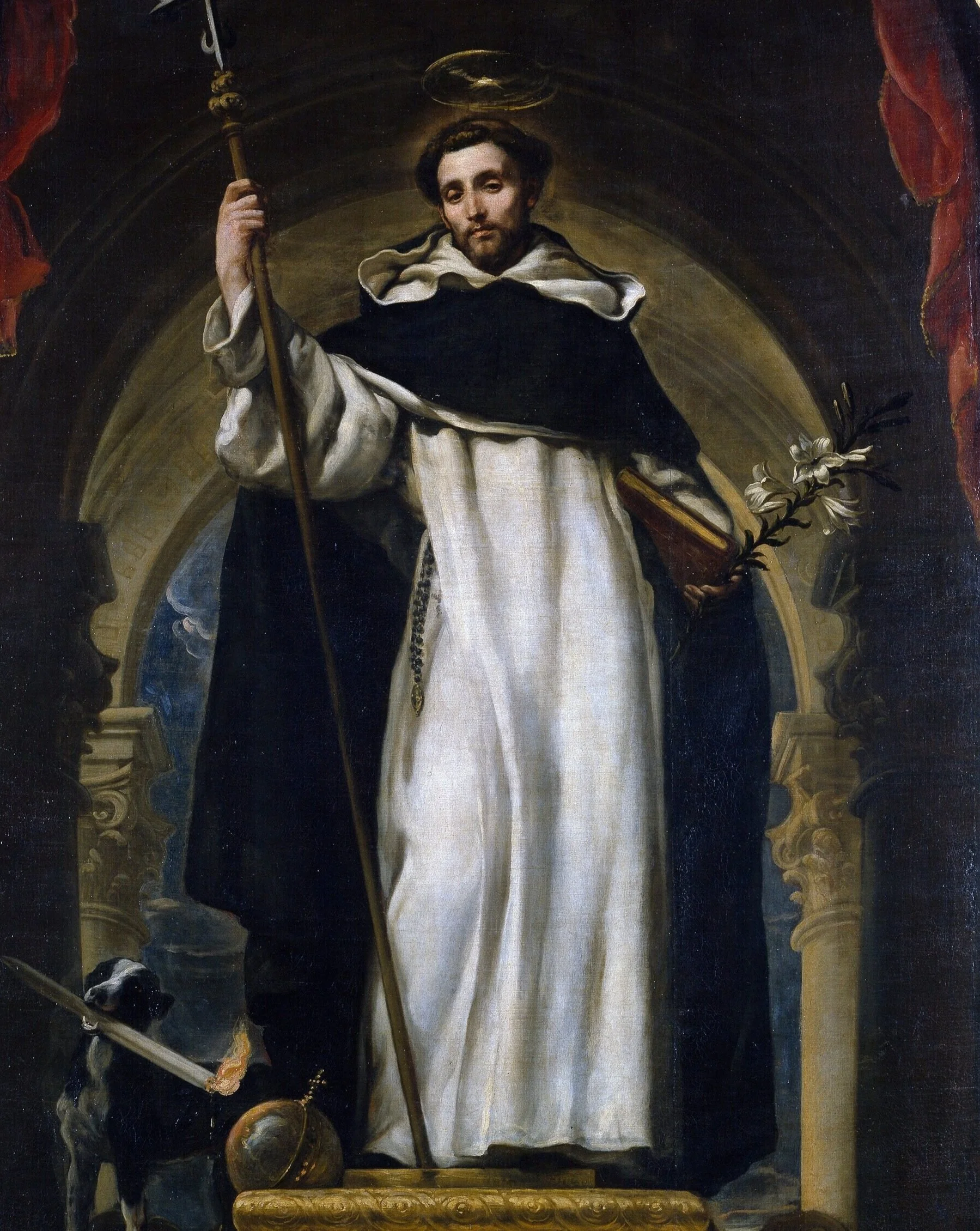
A painting of St. Dominic by Claudio Coello, circa 1685.
Today is the feast of St. Dominic. For the first 40 years of my life, I knew nothing about the man. Most Christians are unfamiliar with his story; nonetheless, this saint changed the world in which we live. Dominic was born in 1170 AD during Europe’s Middle Ages. At that time, the Church had already grown old, complacent, even corrupt in places. She was in need of renewal. Legend has it that Dominic’s barren mother made a pilgrimage to a nearby monastery before his birth. There she had a dream in which a dog leapt from her womb with a flaming torch in its mouth. As the dog ran, the torch set the world on fire; and so it was with Dominic. The fire of God’s love burned hot in his heart, compelling him to preach the gospel throughout Italy, Spain and France. Many who heard found their hearts set aflame as well. Both men and women joined his preaching order, spreading revival throughout Europe. For the past 800 years Dominicans have continued to bear witness to Christ through their schools and universities, their monasteries and hospitals and their preaching.
I have a friend who belongs to St. Dominic’s order. She is a preacher too. I will never forget the first time I heard her speak, some twenty-five years ago now. My heart burned at her words! She spoke with an authority born of intimacy with God . Her love drew me into His presence. I cannot recall many of her words she spoke that day for I felt God speaking directly to me in my own heart - stretching my soul with longing, faith, hope. Telling me things about myself and my walk with Him. I experienced a touch of eternity impossible to capture in words.
I’ve heard this Dominican sister teach several times since with similar effect on her audience. Her words and her friendship have made a profound impact on my life. . She does not preach in public often because the Lord has her engaged in many other works. She prays; she cares for her family; she writes letters; she helps run a business. In all these works, she carries the Light of Christ, she burns with love for the Father. The Trinity, I know, is moved by her love. If the heavens are stirred by the prayers of a saint, then the world cannot help but be changed.
I have a brother who lives alone with few physical comforts. He reminds me of St. Francis in his simplicity and in his joy. He rises early each morning to sing praises to God. He eats his portion of lentils with thanks. He serves the weak with a merry heart. And he possesses a great secret – a treasure hidden in heaven. Through his generosity, hundreds of children in poor nations are fed and educated. Someday he will meet them all. Those children will rise up and call my brother blessed, and their mutual joy will be great!
I know many other saints in the making – men, women, even young children who carry the Light of Christ. They have been blessed with gifts of worship, wisdom, healing, hospitality, cooking, writing, counsel, love. At times, those gifts flare up, warming my heart and lighting my path. How I wish each of us would tend our sparks, our gifts from the Holy Spirit, stoking them with the fuel of worship, contemplation, godly fellowship and good works. How I long to see the whole Church aflame with love, a fitting Bride for her Lord!
Dominic’s torch burned brightly in his age, and it was passed down to subsequent generations Roughly two hundred years after his birth, that torch fell into the hands of a young woman named Catherine, a lay Dominican from the town of Siena. Despite the fact that her life was short, spent largely in isolation and prayer, Catherine also changed the world. She penned letters which stirred the heart of a pope, catalyzing his move from France back to Rome. She negotiated peace between warring city states. She carried a burden for the unity of the Church during a crisis of schism, preaching in several cities and meeting with individuals to bind the wound of division. Catherine was a writer, one of only four women recognized as doctors by the Catholic Church. One of her most famous quotes is a challenge to all of us who love the Lord.
“Be who God meant you to be and you will set the world on fire.”
May it be so for each of us!

By Thomas, on our 30th Anniversary
This is Thomas, hijacking Amy’s blog to post about our 30th wedding anniversary - which is today. I love you, Amy!

Last Friday night, Amy and I were enjoying the afterglow of Mark John West’s marriage to his new bride Maria. Everyone else had left for the reception, except for the two of us, and Jayson Knox – who had performed the ceremony.
Amy turned to me, her eyes sparkling. “Thomas, let’s renew our vows.” I suddenly saw the brilliance of her realization of the unexpected opportunity God had afforded us. We were in a beautiful outdoor wedding chapel, with the setting sun lighting up the openings and the cracks in the tall wooden door. Our 30th anniversary was only four days away. And we were alone with Jayson, who had also married us on July 21, 1990.
“Let’s do it!”
We stood hand-in-hand, staring steadily into each other’s eyes. Jayson graciously prompted each vow –
I Thomas, take you Amy …
I, Amy, take you Thomas …
for better or for worse …
for richer or for poorer …
in sickness and in health …
until death do us part.
This is my solemn vow.
We sealed it with a kiss, just as we had those thirty years earlier in the sanctuary of Hope Chapel.
Three days later, on our anniversary eve, we sat at a picnic table with a bottle of Becker wine, waiting for our Texas steaks to arrive. Amy suggested we share memories of the last thirty years. She started:
“I remember back in 1989, the night in Big Bend when you spoke to me about covenant. That’s the moment I really fell in love with you. What did you tell me about covenant?”
“I don’t remember, Amy … but I’m glad I said it, whatever it was.”
“What do you think about covenant, now?”
A good question. One that I didn’t have an answer to last night.
But today I began thinking about the renewal of our vows.
In one sense, we said the same words – so it could be considered to be the same vow. But neither of us are the same person we were back in our youth. Then the daring words we spoke were like a leap of faith. Now, they are more of an embrace of joyful pain. I am much more aware of my own weakness, and of Amy’s glory. She has seen my better, and my worse. We are both facing the turn from the rosy years of health, into the sunset years where our physical bodies begin to break down. We both expect poorer, not richer.
So our solemn vow on Friday was not an old vow, rote-repeated.
But nor was it a new vow, cut from whole cloth. We committed to each other, again. We have come through complexity and found simplicity on the other side. We are flesh of flesh and bone of bone, a mystery of unity mirroring the unity of the Trinity. We have seen the goodness of the Lord in the land of the living. “Give us our daily bread, forgive us our sins.” We have seen, heard, smelled, tasted and touched the kingdom, the power and the glory.
Our vow is not an old vow. Our vow is not a new vow.
Our vow is a renewed vow.
My thoughts turn to the prophet Jeremiah:
“The days are coming,” declares the Lord,
“when I will make a new covenant
with the people of Israel
and with the people of Judah.
It will not be like the covenant
I made with their ancestors
when I took them by the hand
to lead them out of Egypt,
because they broke my covenant,
though I was a husband to them,”
declares the Lord.
“This is the covenant I will make with the people of Israel
after that time,” declares the Lord.
“I will put my law in their minds
and write it on their hearts.
I will be their God,
and they will be my people.
No longer will they teach their neighbor,
or say to one another, ‘Know the Lord,’
because they will all know me,
from the least of them to the greatest,”
declares the Lord.
“For I will forgive their wickedness
and will remember their sins no more.”
What is this new covenant?
It is a renewed covenant. It has history now. The leap of faith was Abraham passing through the smoking carcasses. Now in the embrace of joyful pain, God passes through the smoldering ruins of Israel’s failures. Israel knows her weakness – and also the glory of the Promised Land, the glory of David’s kingdom. There is a foundation of the Law and the Prophets.
Who is this renewed covenant with?
“The days are coming,” declares the Lord,
“when I will make a new covenant
with the people of Israel
and with the people of Judah.
…
“This is the covenant I will make with the people of Israel
after that time,” declares the Lord.
…
“Only if these decrees vanish from my sight,”
declares the Lord,
“will Israel ever cease
being a nation before me.”
…
“Only if the heavens above can be measured
and the foundations of the earth below be searched out
will I reject all the descendants of Israel
because of all they have done,”
declares the Lord.
The new renewed covenant is not with me, a Gentile. Nor my people, the nations. We try to appropriate the new covenant for ourselves. We gather around the communion table, we repeat Jesus’ startling words – “This is the new covenant” – but we do not realize Jesus is hearkening back to Jeremiah. As if to say, “This is the new covenant (with the people of Israel) – in my blood!”
So am I left out?
By no means!
I did not speak above about the renewest part of the renewal of our vows. Our five children. Our heart-adopted son. Our daughter-in-law, and our son-in-law. The three grandchildren we saw and spoke to this morning. Our two hidden grandchildren – one in the womb, the other in heaven.
These thirteen new persons were on our hearts and in our minds when Amy and I solemnly revowed to each other last Friday. They have been enfolded in, welcomed into the covenant, part of the promise. Ten have sprung forth from our seed. Three have been grafted in. All are equally loved, equally part of our covenant family.
Oh, the depth of the riches of the wisdom and knowledge of God!
How unsearchable his judgments,
and his paths beyond tracing out!
“Who has known the mind of the Lord?
Or who has been his counselor?”
“Who has ever given to God,
that God should repay them?”
For from him and through him and for him are all things.
To him be the glory forever! Amen.
Brotherly Love

Justus and John Patrick in 2012. Ages 13 and 9.
A few days ago, while cleaning my room, I came across an old prayer journal. Before placing it on the shelf, I opened the pages and came across this entry from Dec. 7, 2011. My son Justus was twelve years old, and John was eight at the time.
Last night I took Justus to youth group. While I was gone, Peggy and John decided to decorate the Christmas tree. When Justus came home, he was sad because he had been left out. Later last night, he began crying, and his tears tore John’s heart.
John came downstairs crying his own tears, saying he felt he could never be forgiven. I called Justus downstairs and held both boys in my arms, while my heart hurt for them both. I believe they were comforted. I know they were reconciled. Justus read John a Curious George story before they went back to bed.
Lord, I believe Your heart is tender toward Your children who bring their pain to You, just I felt toward my sons. I pray that John and Justus would always bring their pain, and their sin to You. I pray that You would help me run to You in my pain.
How I wish we adults, especially in this tense and trying season, would act as simply as my boys did that evening! That we would feel our pain, instead of denying or medicating it. That we would be vulnerable enough to show our brothers and sisters where and why we hurt. That we would grieve with one another, especially the ones we have offended, without blame or defensiveness. That we would run together to the Father and find comfort in His arms. That we would express sorrow for our sin (even unintentional offense) and merciful forgiveness with concrete action.
We adults usually prefer to hide our hurt. We have been mocked, rejected , and accused too many times. People can be cruel. Even brothers and sisters in Christ. Rejection on top of hurt is hard for the human heart to bear. But when we refuse to be vulnerable, we deny those who hurt us the opportunity to grieve with us. We cut short the path to full reconciliation. Sometimes that cannot be helped. When those who have offended us have done so intentionally and without repentance, the time is not ripe for reconciliation.
Even when reconciliation with a brother or sister is not possible, we have a refuge in the the Father’s arms. We can always run to the Father. We must run to the Father! He is always safe. However He much prefers to hold His children, both the offended and the offender, together in His arms. When we open ourselves to His shared embrace, the healing runs deep. So deep that we find ourselves bound closer in love to our family.
I’ve been thankful this week to be reminded of this moment of grace, though I felt sad at the time. Recalling the way my boys loved one another that night in 2011 helped me understand Jesus’ admonition, “Unless you become like little children, You shall not enter the Kingdom.”
Jesus, in this season of loss and upheaval, the world is hurting. People are easily offended. May we love You and lead others into Your kingdom by becoming once again like little children.

Poor in Spirit

I find it interesting, Jesus, that you begin the Sermon on the Mount with these words, “Blessed are the poor in spirit, for theirs in the kingdom of heaven.” This is the first of the beatitudes, and I must say, it has always been the most puzzling to me. But because it is first, I know it is primary in some way. It opens a door for all the teaching which follows. Poverty of spirit must be a fundamental key to the kingdom. Without it we will not be merciful; we will not be known as peacemakers; and we will certainly not be able to endure persecution.
Jesus, You are King in the Kingdom of Heaven. You determine who comes in and who stays out. You are the Gate and the Teacher and the Way. Therefore I know You must be poor in spirit. You would not form in us any attribute which does not reside perfectly in Your Person.
You came to us poor. You served us poor – dependent of men’s generosity. You died poor, stripped naked, abandoned and betrayed. But You were poor in spirit far before we knew You. This has always been Your posture before the Father.
From the beginning, You have honored the Father from whom You were begotten. You have acknowledged that He is greater than You. When you were on earth, You sought His comfort and His direction in prayer. You did only what You saw Him doing. You trusted Him, even unto death. You always did His will. Therefore Paul writes to all of us who seek Your Kingdom, “Have this mind among yourselves, which is yours in Christ Jesus, who, though he was in the form of God, did not count equality with God a thing to be grasped, but emptied himself, by taking the form of a servant, being born in the likeness of men. And being found in human form, he humbled himself by becoming obedient to the point of death, even death on a cross. “
Satan is not poor in spirit. Satan is proud. He will serve no one. What pain and suffering that pride has spawned in heaven and on earth! I believe, Jesus, that Satan fell because he did not want to relate to the Father through You, as the Father willed. I believe Satan resented the fullness of the Father’s glory and authority in You, the Only-Begotten. So when You were stripped of glory, in submission to the Father’s will, Satan attacked you. He went after Your poverty of spirit. He incited you to grasp your equality with God. He provoked You to lay claim to what was rightfully Yours. He taunted you with these words, “If You are the Son of God….” But You never took the bait. You remained empty and dependent, showing us the way of sonship. Dependence and complete submission were imperative to Your union with the Father, and they are the keys to our union with You.
Recently, Jesus, you reminded me of this dynamic. You asked me, “Amy, what is the most foundational truth about your relationship to Me?”
“That I am a helpless sinner, completely dependent on Your mercy,” I responded.
I came to you, Jesus, completely poor. I was a child, unable to care for myself, unable to be good, unable to wriggle free from guilt. You were my refuge, my hope, my comfort, and I had nothing to offer in return except my love. I was hungry and thirsty for righteousness. My emptiness made room for Your compassion. You came and fed me. You filled me. And You delighted to do so. Still You love to fill my emptiness.
To be poor in spirit is to recognize and embrace my dependence. I did not give myself life. I do not determine what is right and wrong. Understanding these truths places me in a right posture before God my Maker.
Satan corrupts our understanding of spiritual poverty. He is a manipulator who loves to portray You in his own twisted image. He sowed seeds of doubt and discontent into Adam and Eve. He claimed You were withholding good gifts from them. He told them they should choose for themselves; that they could become like God – knowing good from evil. So they asserted their wills. They desired to have something of their own, not dependent on God. And in that moment, they traded poverty of spirit for death.
Satan lied to them. It is not the nature of our Father to withhold good gifts. Neither is it like You, Jesus, to doubt the Father. You allowed the Father to choose Your path, even as Isaac trusted Abraham.
Satan lies in other ways. He paints the Father as an angry God always holding our sin over our heads. He would love for our dependence to become a source of fear rather than confidence. He would love us to resent our poverty. If we ever resent or doubt Your mercy, we will despair and embrace his darkness. Or we will try to stand on our own righteousness.
Self-righteousness is the opposite of spiritual poverty, and it is a barrier to union with You, Jesus. The self-righteous will always remain paupers, like Adam after the fall. But the poor in spirit will inherit riches beyond imagination. The poor in spirit are heirs of the kingdom. Poverty of spirit leads to sonship.
It was only when the prodigal son experienced poverty that he began to value his father. “When he came to his senses, he said, ‘How many of my father’s hired servants have food to spare, and here I am starving to death! I will set out and go back to my father…” He returned because he knew his father’s generosity. Aware of his transgression, he did not ask for his status as a son to be restored. He went home to serve as a laborer, but he was greeted as a son. And in his restoration the prodigal understood for the first time the gifts entrusted to him – the robe, the ring, the sandals.
The sad irony of this story is that the older son, standing on his own righteousness, never enters into the joy of his sonship. He accuses his father of treating him unjustly, “never giving him so much as a goat to celebrate with his friends.” The father replies, “You are always with me. All that I have is yours.” But in his anger and envy the older son interacts with his father as a hired hand. He wants to be recognized for his merit. He holds his work as a right, a claim against his father. In that posture, he is unable to receive the riches of the father’s love and mercy. And because he cannot receive the father’s love, he cannot extend it to his brother.
I’ve been thinking of another parable recently - the parable of the laborers in the vineyard. The men hired late in the day were paid as much as the ones who began working at dawn. This was the owner’s prerogative and pleasure. But the workers hired early felt offended. They believed they merited more than the latecomers.
I wondered - what was vineyard owner’s reward? What was he hoping to gain in hiring labor? The harvest, of course! And that is what all of his sons and daughters would desire as well. Sons and daughters do not work for wages. They work for the harvest. They invest in their inheritance.
Our Father wants us poor so that He can fill us with the gift of union – a wealth we could never merit. Ruth came to Boaz as a beggar. She was exalted as a wife. Esther bowed before Xerxes in humility, placing her life in his hands. She won the lives of all her people. Mary gave her empty womb to YHWH and received You, Jesus, the Savior of the World.
Is this why the Father delights in our prayers? Is this why You prayed, Jesus? We come in helplessness asking the Father to do what only He can do. And He, in turn, delights to fill us with good things. But the rich, or the self-righteous, He sends away empty.
I am awed to think that You interact with the Father in this kind of humility. You emptied Yourself, became a servant, obedient even to death on a cross. Therefore God has highly exalted You and bestowed on You the name that is above every name, so that at the name of Jesus every knee should bow, in heaven and on earth and under the earth, and every tongue confess that Jesus Christ is Lord, to the glory of God the Father.
Jesus, I would like to be poor in spirit to the glory of God the Father. I want to be poor, like Mary, until Your nature is formed in me. I want to live as an heir rather than a hired hand, waiting in hope for Your Kingdom to come. When I see the fullness of Your glory, as You behold the Father’s glory, I will become truly humble even as You, my King, are humble.
Waiting

Be dressed in readiness, and keep your lamps lit. Be like men who are waiting for their master when he returns from the wedding feast, so that they may immediately open the door to him when he comes and knocks. - Luke 12:35-36
The entire world is waiting now. Waiting for the pandemic to end. Waiting for life to return to normal. Waiting to see friends. Or return to work. Growing restless. Growing anxious.
I am familiar with anxious waiting. I practiced it daily as a young bride. About 5:00 each afternoon I began anticipating Thomas’s return from school. I bent my ears toward the road, listening for approaching cars, hoping that Thomas was in each car. These were the days before cell phones, so I could not text him. He could not let me know if he was running late. I simply had to wait.
If the wait were not too long, I prepared dinner and tidied the house. I was eager to see him and wanted to welcome him well. But if Thomas were delayed, even a bit beyond my expectations, my heart began to sink. My mind filled with dark thoughts. Perhaps the car had broken down. Or worse, he had been hurt in an accident. Maybe he was injured and alone with no one to help.
If he were very late, my thoughts grew even darker. Maybe he didn’t want to come home. Perhaps he had gotten so wrapped up in work or enjoying friends that he had forgotten about home and dinner and me. Of course, those were ridiculous thoughts whispered by the enemy of my soul. I knew that even then, but I did not know how to fight back. Not at first. So I sat on the couch looking out the window, growing anxious, doing nothing.
One who waits in despair is listless. Her food grows cold. Her house accumulates dust. Her children are unoccupied and restless. When her husband finally does return, she is in a bad mood.
That is not the kind of waiting Jesus asks of His disciples. It is not patience fueled by hope. Waiting in hope is an opportunity. It is a chance to clean the house and make dessert. It is a gift of time in which we can prepare offerings of love for our Bridegroom.
Jesus has gone to the Father to prepare a place for us. We should likewise be preparing to meet Him, for He will surely come! He is even more faithful than Thomas. And far more powerful. There is no accident that can stop Him. No injury which can befall Him. No love greater than His. The One who gave His own life for us will keep His Word. He is Truth.
These days of waiting are an opportunity. It is a good time to clean out the closets of our souls. To dust off our Bibles and journals. To love our families well. To light the lamps of our hearts. To pray and do the work our Lord has entrusted to us.
Here is the promise Jesus gives to those who wait well. Blessed are those slaves whom the master will find on the alert when he comes; truly I say to you, that he will gird himself to serve, and have them recline at the table, and will come up and wait on them. Whether he comes in the second watch, or even in the third, and finds them so, blessed are those slaves. (Luke 12:37)
We cannot wait well if we wait in despair. Only those who wait in confidence are alert and productive.
Holy Spirit, please fill our hearts with courage and show us what work we can do in these days of waiting!
What Our Lord Saw - A Holy Week Meditation

What Our Lord Saw from the Cross, James Tissot, 1894
Courtesy of the Brooklyn Museum
I came across this painting today by accident, or rather, I think, as a gift from the Holy Spirit. It arrested me immediately. I felt chastened , grieved. Why are there not more paintings like this one, I wonder, looking from the eyes of Christ?
Perhaps it is because we believe it presumption to imagine seeing through Jesus’ eyes. He is, after all, the Son of God. His ways are far above our own. Many of Tissot’s contemporaries objected to the composition of his crucifixion for just this reason. But I believe that reasoning is false humility. Jesus came so that we might know the Father as He does. So that we might be with Him in the Father’s house. He died and rose again that we might become new creations, filled with the Holy Spirit who “searches the deep things of God.” Paul writes that those who are filled with the Spirit “have the mind of Christ.” ( I Cor 2:16)
We honor Jesus by receiving His gifts. By coming to know Him and His desires. By asking to see the Father through His eyes, the world through His eyes, and our own selves through His eyes.
When we stand for judgment, it will not matter how we perceive Jesus. All that will count is how He sees us..Has He found us weeping at His pierced feet? Or looking with love into His eyes? Will He recall us mocking and jeering? Or looking away in distraction, or boredom, or disgust?
Of course, the way we perceive Jesus shapes our response to Him. This is why the gifts or the artist and the teacher, the song writer and prophet, are so vital to the Church. Brothers and sisters help form our perceptions, but only the Spirit can give us the mind of Christ. We must yearn for the Spirit of God in order to see with the eyes of Jesus.
I want to be like the women in this painting, looking straight into Jesus’ face. Grieving when He is in pain. Rejoicing when He rejoices. Attentive when He teaches. Silent when His anger flares. This, I believe, is what it means to have the mind of Christ. It is not to understand all mysteries and possess all knowledge. Not in this age. Rather it is to know Him and trust Him and attend to His direction.
What moves me so deeply about this painting is the love I feel in Jesus’ eyes for those who look into His face.. I believe the women who stood at the foot of the cross were a deep comfort to our Lord. That is a wonder that makes my heart burn. The Son of God desires the love of men! The affection of a single woman brings Him consolation. The faith of a thief gives Him joy.
This Holy Week as the world finds itself gripped in crisis, I pray that Jesus finds many friends standing in attendance at His throne, looking toward His face, trusting in His power, confident in His mercy, waiting for His return. This is a kindness which will not be forgotten. It is faith which bears much fruit. Jesus sees and He remembers. He is moved.
Mountains of Spices
For Thomas on his 52nd birthday

Make haste, my beloved, and be like a gazelle on mountains of spices. - SS 8:14
Last Thursday morning when I walked outside, I was hit by the heady scent of wildflowers. Though I could see nothing blooming– it was still late February - the fragrance was strong. The wind was blowing briskly, the sun was shining brightly, and those sensations, especially the smell, swept me back to October in Santa Fe, New Mexico, when the chamisa bushes bloom.
Santa Fe holds a sacred space in my heart. It is where Thomas and I spent the first two years of our marriage. It is where we made our first home below the Sangre de Cristo peaks. It is where we became one flesh. And it is where we fought our first spiritual battle as a married couple.
Our time is Santa Fe was never easy. In fact, our first night as newlyweds there was a disaster. We spent it cramped, side by side, in the bucket seats of a Honda Prelude because our friend who had been housesitting took off to California with our only set of keys. It was too late, we thought, to call a locksmith, and we didn’t have enough money for a hotel. So much for being carried across the threshold!
That first night foreshadowed our first year. Nothing went as I imagined it would. Thomas quickly came down with mono and was sick for six weeks. I hated my first job, and routinely cried over my incompetence at my second. Money was tight. We had few friends. Worst of all, something had changed in me. I was moody, fearful, and easily offended - definitely not the glowing bride I had hoped to be.
Marriage had unearthed the deep wound of my father’s abandonment. I found myself unable to quell the voice of the enemy in my ear, the Accuser who whispered incessantly that Thomas didn’t really love me, that he would leave like my father had, and that I would be alone. I tried to resist the awful scenarios which played in my imagination, but they wore me down. The more depressed I became, the more plausible they seemed.
I felt for my husband. He was a noble man who deserved better. I wanted to be a joy to him. I wanted our first year to be filled with romance and wonder. Instead, it was a struggle. But looking back, I see that we were in the Father’s hand the whole time. What felt like failure was really a test.
“Love must be tested.” These are words my Father in heaven spoke to me a few years ago.
Instantly I knew that He was right. He always is. Even the love of His Son was tested. The Spirit drove Jesus into the wilderness for this purpose. Forty days Jesus endured the voice of the Accuser questioning His identity. He resisted the scenarios Satan played before His eyes. Then again on the cross, His love was tested. Jesus’ suffering proved His love for us; but just as importantly, it proved His trust in the Father. Satan was permitted to test the unity of the Trinity by unleashing hell on our Savior. Jesus prevailed with His surrender to the Father, “Not my will but Thine be done.”
Our marital bond was tested in the desert, under the mountains named for Christ’s blood. And following the pattern of our Lord, Thomas’ surrender drove the enemy away. “Amy,” he told me one day by a rushing mountain stream, “I promised before God to be your husband. I will stay with you even if we are miserable for the rest of our lives, but I would rather not be miserable.” This second marriage vow, made in pain, without fanfare or the witness of friends, was both a death to personal dreams and a great spiritual victory. It was spoken in the power of the Holy Spirit, and I knew it. Thomas was not the father who left me. I could trust him. Believing that truth was my great victory.
From my vantage point now, I consider it rather an honor that our marriage was tested so early. Our heavenly Father knew we were young and unaware of our weaknesses. He knew we were isolated from family and friends. He knew we had no resources other than Him. And He knew that we loved Him. In the midst of the battle, He led us gently. He was faithful to give us moments of consolation and respite. Most of those came walking in the mountains. Feeling the sun on our faces. Breathing the clean desert air. Smelling the chamisa in bloom. Thomas and I fell in love in the mountains and they were always a place of comfort.
Our little adobe home was another place of refuge. Our house was surrounded by a thick mud wall which enclosed a small drive and a few flower beds. The wall radiated the warmth of stored sunshine on chilly desert nights. It protected us from the view of unfriendly eyes. And it set apart a space that belonged solely to me and my love – like the Beloved’s garden in the Song of Solomon.
The Beloved’s garden is filled with both myrrh and spices. It is nourished by both the north wind and the south winds. The first year of our marriage, the Father planted myrrh in our garden – a symbol of Christ’s death. Then He nourished the garden with the wind of adversity. He knew what He was doing. The garden belonged to Him and He desired its fruit. He tended it carefully for its fragrance pleased Him.
Last Thursday morning the north wind hit my face bearing the scent of Santa Fe and I gave thanks!
Sarah
It has been a long time since I posted anything. Ironically, that is because I have been writing. I am halfway through a book of meditations on Abraham. Most of that work is too lengthy for a blog, but this week I finished a very short chapter. In the book, this meditation serves as a sort of song of resolution following the sad story of Hagar and Ishmael.
And Abraham said to God, “Oh that Ishmael might live before You!” But God said, “No, but Sarah your wife will bear you a son, and you shall call his name Isaac; and I will establish My covenant with him for an everlasting covenant for his descendants after him.” - Genesis 17:18-21
Sarah laughed to herself, saying, “After I have become old, shall I have pleasure, my lord being old also?” Genesis 18:12
In its full realization, the covenant You established with Abraham will reverse the curse of the garden. Its blessing will heal the rift between man and woman. It will free people from sin, and end slavery in all its forms. Such a glorious gift You would not permit to unfold from an act of sexual coercion.
The covenant was a gift of Your free will. Its reception had to be free as well. Abraham accepted Your call willingly, as did Mary. It was right that Sarah should also respond in freedom.
The covenant You made with Abraham was a gift of love, conceived in the council of the Godhead. You insisted that the promised child be conceived in the union of marital love.
The covenant was a gift of joy. You foresaw the delight Abraham’s children would bring the Godhead, and You rejoiced! It was fitting that Sarah should feel pleasure in her part of Your plan.
The covenant was the promise of a family vast enough to fill Your Father’s heart. You insisted that the family’s first son be raised in the fidelity of marriage.
The covenant was a divine intervention in the affairs of men. Your word came unsought, unexpected. Its fulfillment would also be miraculous. You wanted no help from scheming mortals
It was imperative that Abraham’s promised son be born of Sarah, not Hagar, because Sarah was a wife, and Hagar a slave. This, I think, is the most astounding mystery of all. Through the covenant You established with Abraham, You set into motion a plan to form a Bride for Your Son. A Bride who would have authority and honor. A Helpmate who would partner with Jesus in His ministry. A Beloved Wife cleansed by His blood. A Bride who would respond to her Bridegroom with desire, not slavish fear. Sarah, not Hagar, is the type of this Bride.
Father, I believe we fail to understand the importance of Sarah in Your plan when we make the mistake of thinking it is all about us men and our salvation. It is not. The covenant was made for the sake of Your Son even more than it was made for ours. And the covenant which finds fulfillment in a Holy Wedding Feast could not rest on an act of sexual exploitation.
Colors

I am four years old, standing in front of a large window. I hold in my hand a fan of three translucent acrylic tiles -yellow, blue and red. It feels mystical and important, like a stained glass window in a church. The preschool teacher shows me how to move one tile on top of another. Red slides over yellow to make orange, Blue over yellow makes green. Red over blue, purple. I am mesmerized, exhilarated! I wonder if I can do the same magic with my watercolors at home. I pull them out and try. These colors are muddier and more opaque than the beautiful tiles, but the experiment works. I can make green and purple and orange. I have been initiated into a great secret of science.
I am six years old. It is the first day of first grade, and I am given my first assignment. Color a ball according to instructions - left half red, right half blue. I take out my crayons and select the contrasting colors. I work carefully, making sure to fill the lines without going over. Pressing down hard to get the waxy shine I love. Everyone else is finished by the time I start on blue. I fear I will not be good at school.
I am in second grade. I have moved up to a box of 24 skinny crayons from my set of 8 jumbo sized sticks. This box includes subtle shades like green-blue and yellow-orange, which is my favorite. I am using yellow-orange to draw a picture in the backseat of the car when my head begins to feel strange. I think I will vomit. I lie down in the backseat, dropping my crayon on the little ledge between the rear window the the back bench seat. It melts into a wax puddle, permanently staining the carpet covered ledge. I feel sick whenever I see it. I hate yellow-orange.
I am in third grade and I have a box of 48 crayons. There are beautiful, exotic colors in this box, like thistle, goldenrod and cornflower blue. Some of the students have boxes of 64 crayons. That would be nice, I think. But my box has gold and silver, the fanciest colors of all. I am content.
I am a newborn in eternity, disoriented and overwhelmed. It is time to meet the Father. I find myself before His throne, not daring not look up. I cast my eyes down, around, anywhere but His face. My vision is filled with color, a full circle rainbow which never seems to end. I recognize colors from earth, but I can see beyond them in both directions. Infrared, ultraviolet, radio waves, microwaves - I see them all in their glory. I am breathless, agape. I hear the Father laughing with joy, the way He did when I was four, holding the tiles in my hand. He has secrets to share which will fill all eternity.
Ruth
God often speaks to me when I’m working in the garden. Maybe pulling weeds is such great visual imagery for what I need to hear that He can’t resist! Or maybe He finds the kneeling posture suitable for talking. Whatever His reasons, I love it when I hear Him there.
The topics of our conversation typically concern scripture, or things happening in my life. But last week something unusual happened. I began singing a new song. I knew this was a prompting of the Spirit because I am neither a poet nor a song writer. Nonetheless verses kept playing in my mind, along with a simple melody. Then ideas too abstract for words began flowing.
I found I could not stop singing the first few lines, so I fleshed out the song as an act of contemplation (and so I would have more words to sing!) I am posting the end result, despite its shortcomings as poetry, because I felt the Spirit’s pleasure in revealing the Father’s favor toward Ruth. The Father rejoices when His children love one another, and we do that well when we sing each other’s songs. The more I love His saints, the more I love Him, and the more I marvel at the beauty of this story we share. So here it is, a song for Ruth.
Sing with me, O Ruth, the song of the Redeemed.
Of those bereft, oppressed, condemned, land ransomed for the dead.
Aliens and poor, glean from the threshing floor
Under our Lord’s mantle find a place to lay our heads.
Sing with me, O Ruth, the song of the Beloved,
A daughter of the nations whose eyes are like the dove’s.
Leave your father’s house for the Lord desires you,
Beautiful in kindness, crowned with glory from above.
Sing with me, O Ruth, the song of Motherhood.
Chosen is your line bear the King of all the earth!
We who do the Father’s will are called His mothers too,
In joy we sing with Mary, the one who gave Christ birth.
Sing with me, O Ruth, of the Olive Tree
A wild shoot grafted purposely to Jacob’s holy root.
Gentile and Jew drink from Messiah’s veins,
And bear witness to each other of His endless grace and truth.
Moonlight

A photo taken from my bedroom window last night, Aug. 14, 2019.
I have a new granddaughter. Her name is Aylin which means moonlight in Turkish.
There is something undeniably beautiful and feminine about the moon. It is mysterious and cyclical, like a woman’s fertility. Its light is soft and gentle.
The Lord gave the moon as the lesser light, “to rule the night, and to divide light from darkness.” He appointed the moon as a sign “for seasons, for days and for years.” Every new moon on the Jewish calendar was to be marked by special sacrifices, and every feast is numbered by the days of the moon.
But the moon is more than a marker for the calendar; it is a symbol of Israel’s mystical motherhood. As a young man, Joseph had a dream in which the sun, the moon and eleven stars bowed down to him. His father Jacob understood the dream immediately. He, the father, was the sun. Joseph’s mother was the moon. The eleven stars were his brothers. But ten of the eleven were half brothers. If we understand that this dream speaks to the future of God’s chosen people, then the moon symbolizes all the mothers of the twelve tribes – Rachel, Leah, Bilhah and Zilpah.
John the Beloved also had a vision of a mother and a moon.
Now a great sign appeared in heaven: a woman clothed with the sun, with the moon under her feet, and on her head a garland of twelve stars. Then being with child, she cried out in labor and in pain to give birth….. She bore a male Child who was to rule all nations with a rod of iron. And her Child was caught up to God and His throne. Then the woman fled into the wilderness, where she has a place prepared by God, that they should feed her there one thousand two hundred and sixty days.
The Child, of course, is Jesus, the Messiah. The woman is Mary. And Israel. And the Church.
The moon is a fitting symbol for God’s people. We have no light of our own. We can only reflect the light of our Lord. He alone is the source of light. He alone is truly good. But if we are willing to be His, He will clothe us in His light and let us shine for the world to see.
There are times in history when God has directly revealed His light to men. A pillar of fire led the Israelites through the sea. Mt. Sinai trembled in thunder and lightning as God spoke with Moses. Jesus shone like the sun on the mountain of Transfiguration. And John the Beloved fell on the ground like a dead man when he saw Jesus in his glory. Jesus will come again in glory, in a flash like lightning, “and all flesh will see it together.”
Now it is night. We are waiting for the morning. It is time for the Church to shine and bear witness to the True Light. It is time for her to put off everything that does not reflect the glory of her Lord. It is the time for her to take her place, under the authority of her Husband, and divide the light from the darkness.
Little Aylin, may you shine always in the beautiful of light of your Lord!

He Laughs
Thousands of years ago, God looked down on the earth found a soul whom He enjoyed. A man He trusted. A mortal who heard His voice and believed. God became His friend.
Abraham was the kind of friend God had in mind when He created Adam. A creature of flesh who knew Him by faith. A man so beloved of the Father that He would make Abraham the father of all who live by faith.
The Father gave Abraham a great gift – the best gift He could imagine! YHWH gave His friend a treasure like the treasure He held closest to His own heart. A son. An only son. A son whom he would love. And God gave that boy a name. Isaac, which means “He laughs.”
“He laughs.” What a curious name for the child who would become a great nation. Who would carry in his loins God’s plan of salvation for all mankind. For the man bearing the seed of God’s own Son! It seems a little playful for such a weighty role.
It makes me happy to know the Creator of the Universe likes ribbing His friends. Isaac was a continual reminder to Abraham of the way he laughed, face on the ground, as YHWH promised him a son yet again. (Gen. 17:17) And a reminder to Sarah of her laughter inside the tent when her Holy Visitors came with a message. (Gen. 18:12) But I think the name is more prophesy than memory. And closer to the Father’s heart than Abraham could imagine.
Abraham did not know that His Friend in Heaven also had a Son. An only Son. A Son Whom He loved. A Son Whom He would give as the Lamb, sacrificed for the sin of the World. A Son in Whom all things in heaven an earth hold together. A Son in Whom all the nations of the earth would be blessed.
In the fullness of time, God sent His Son to earth as a man, like Abraham. He gave His Son the name Yeshua, meaning “YHWH saves.” And that was the Son’s mission. To give His life as a ransom for many, winning for the Father many brothers and sisters.
The Son of God will come again to rule the nations, and He will bear a new name, known only to the Father. The kings of the earth will rage against YHWH and His Anointed, plotting to “throw off their fetters.”
But “He who sits in the heavens laughs,
YHWH scoffs at them.
Then He will speak to them in His anger
And terrify them in His fury, saying,
“But as for Me, I have installed My King
Upon Zion, My holy mountain.” (Ps 2:4-6)
Sarah will see her Lord and her Offspring, and laugh in awe once again. As she prophesied in ancient days, “everyone who hears will laugh with me.” (Gen. 21:6)
Israel will laugh in wonder as they see every promise made fulfilled more wildly than they dared to imagine. Their “mouth will be filled with laughter and their tongue with joyful shouting as they say among the nations, ‘the LORD has done great things for us!’ ” (Ps 126:2-3)
All those who mourned on this earth, in faith, will laugh, just as Yeshua promised. The Father will wipe away the tears of all His friends. We will be like those waking from a dream.
And God’s own Son, His only Begotten, who came to earth as the Sower, planting in tears, laying down His life as a seed in the ground, He “shall indeed come again with a shout of joy, bringing His sheaves with Him.” (Ps 126:6)
He will laugh!
Hans-Peter and Verena - Servants of the Living God
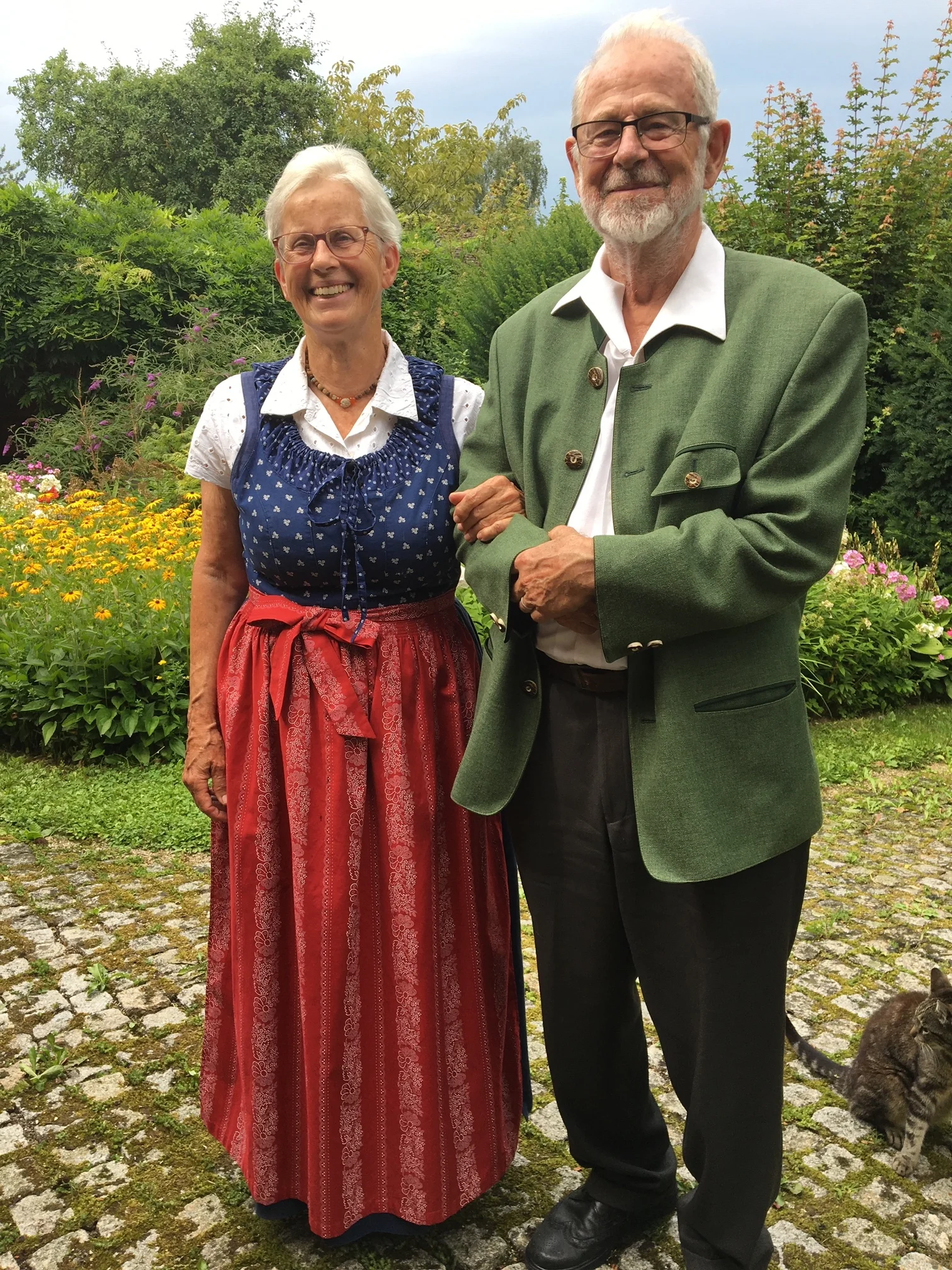
Hans-Peter and Verena Lang were the brains behind Wittenberg 2017. The brawn as well. And for decades before we met them, they carried a spiritual torch of reconciliation which lit the fires of our gatherings.
In 2010 Thomas and I traveled to Europe for an Antioch Network retreat. George Miley had arranged some appointments for us with Lutheran pastors in Germany, opportunities to share our vision for a prayer gathering on the 500th anniversary of the Protestant Reformation. He warned us ahead of time that Germans tend to be reserved, wanting time to weigh the possible pitfalls of a proposal against its potential benefits. (I must say we learned a lot of wisdom from our German colleagues in this regard!) The first two pastors we met were cordial and affirming. In the years that followed, they attended our meetings, but they felt no call to join us in leadership.
Then at George’s urging, we shared our vision with the Langs. Though we had met them some months earlier, we did not know them well. We were aware they had participated in ecumenical efforts in Austria as lay people, like us. Hans-Peter was a forester and Verena a historian. The Langs listened quietly, carefully. When we were finished, they said they needed time to think and pray. The following evening they asked to meet with us privately. Much to our surprise, they presented us with an impressive list of European leaders, people they knew personally, whom they were willing to contact in support of this vision. That list included a Catholic bishop, the archdeacon of Vienna, the international leader of the Catholic Charismatic Renewal, a leader of the German Lutheran charismatic movement, Fr. Peter Hocken, and the Austrian Round Table. My stomach grew queasy and my knees felt weak. I knew then and there that this Wittenberg thing was going to happen!
The Langs have always been people of vision. And hope. And action. In their early years they spearheaded a campaign to block construction of a nuclear power plant near their town. Verena told me, “this was a wonderful, active time, combined with courage, and a lot of hope that we can win the battle. Everybody at the right place - the men sticking anti-atomic posters in the night and we housewives in front of a table in the middle of our town distributing papers.” The Langs did indeed win that battle, and went on to win others.

The Langs’ daughter-in-law made this drawing of the anti-atomic campaign in celebration of their 50th wedding anniversary.
In 1997 Hans-Peter and Verena joined an ecumenical group of representatives from various Christian confessions in Austria. This group was called The Round Table, and in this setting, Hans-Peter learned that Austrian law discriminated against free churches. Catholic and Lutheran churches in Austria enjoyed rights and privileges not granted to evangelical, Pentecostal, or Anabaptist congregations. This injustice infuriated Hans-Peter and he worked alongside his free church brethren to see the law changed. It was not until 2003 that free churches had equal standing under Austrian law.
The Langs were seasoned warriors when we met them. Their zeal was tempered with a wisdom far beyond our own. We imagined Wittenberg2017 as a one-time gathering lasting several days – an occasion for lamenting division, praying as Jesus prayed for unity in the Church, and worshiping our Father together. We knew that such a meeting would take years of preparation. We would need time to share the vision, to work out logistics, to invite worship leaders and speakers. We did not understand the depth of spiritual preparation necessary.
Verena the historian informed us immediately that we could not simply show up in Wittenberg on Oct. 31, 2017. There were too many wounds leading to and proceeding from this tragic rupture. Without addressing those spiritual strongholds in prayer, we could not hope to see much fruit from a single meeting she warned. Thus Wittenberg2017 became a series of meetings, or pilgrimages of repentance, each addressing different aspects of our painful history.
We met in Ottmaring, in Volkenroda, in Trent, in Rome, and in Wittenberg in the years preceding 2017. As a community of Catholics, Protestants, and Mesianic Jews, we grew in our understanding of the issues which divided us. We grew in our understanding of one another. We mourned together and comforted one another. We prayed for healing of the wounds in the Body of Christ and for our Lord’s return. We learned to love one another.
Looking back on those years I see the great, unforeseen gift our Father invested in us through Verena’s wisdom. He gave us the gift of time together – time on the ground, time in prayer, time on the phone. In that time, though we were not consciously aware of the fact, He was forming us into a sacramental sign of the unity for which we longed.
How I wish every Christian might have the opportunity to work on a leadership team like the W2017 council! Serving with those mothers and fathers, sisters and brothers in the faith was a life-changing experience. In every meeting, every phone call, Thomas and I were learning from their examples. These saints were confident enough in their own gifts that they loved calling forth gifts in others. They felt secure enough in the Father’s love that they had no need of public recognition. They readily submitted to the wisdom of others. At the same time, they were willing to challenge one another in love, determined not to short-circuit the fullest blessing of God for quick or comfortable solutions.
Thomas and I continue to marvel that such an august group of leaders - Europeans with more experience, more connections, more education than our own - would look to us as leaders. This was especially true of the Langs who bore the logistical burden for our early meetings, who invited all the key players, who carried the game plan most of the time. Still they honored us, serving quietly behind the scenes without fanfare.
The Langs served this way because they are humble. They have become like their Lord, “who, although He existed in the form of God, did not regard equality with God a thing to be grasped, but emptied Himself, taking the form of a bond-servant.” Christ’s humility opened doors of grace and healing for the whole world. The Lang’s humility opened doors of grace for Wittenberg 2017.
Thomas and I wanted to offer Jesus a gift in W2017. We wanted to join Him in His prayer for unity, bringing many along with us. I believe Jesus saw our hearts and received our gift. Our Father also saw, and He gave His Son an even better gift. He answered Jesus’ prayer, in part, by making our group one.
Hans-Peter and Verena, I love you!
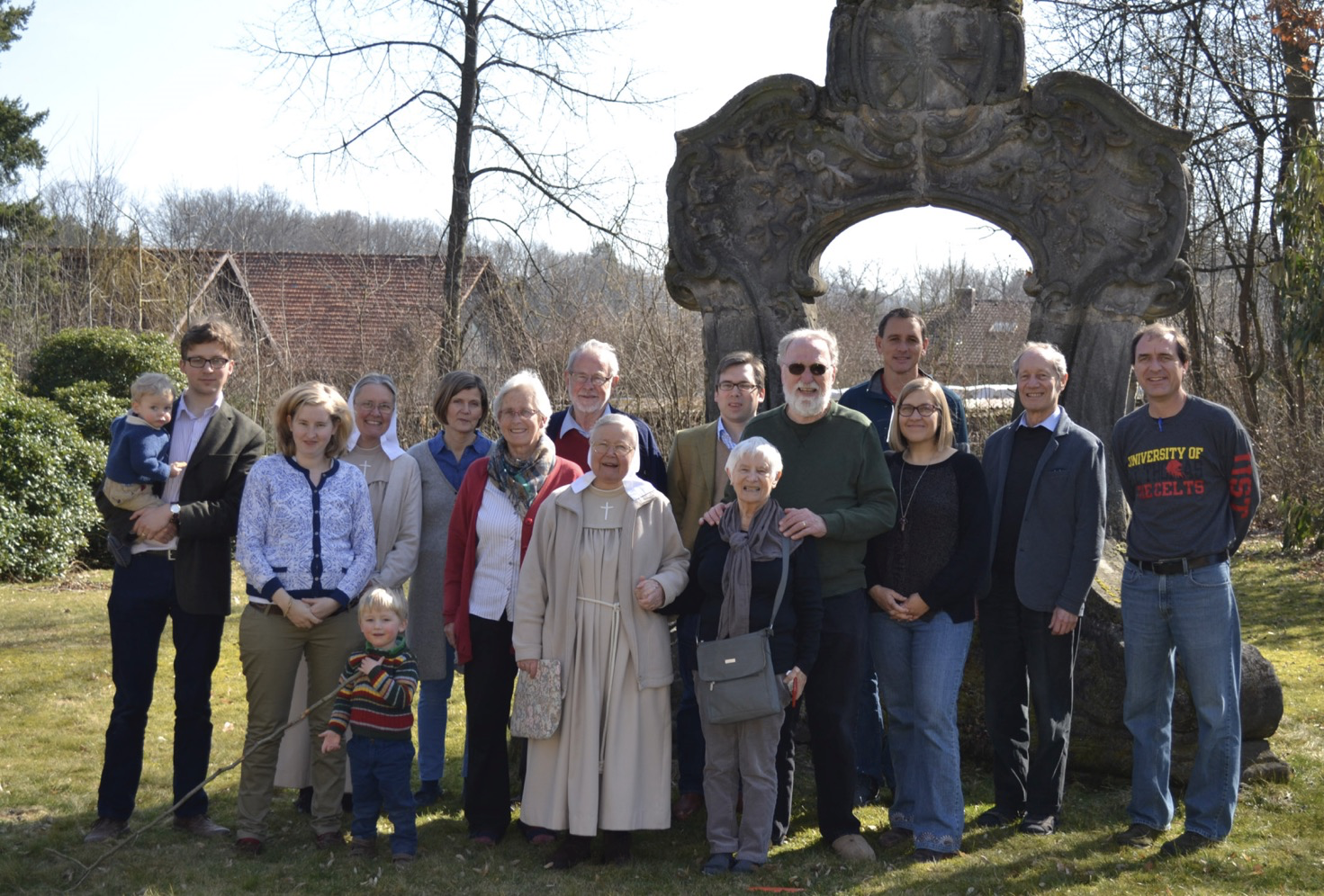
In Trieb, March 2017, the program planning team for our final Wittenberg meeting.
Stars

Orion’s Arm - Public Domain Photo from NASA
“He determines the number of stars and calls them each by name.” Psalm 147:4
I wonder what it is like to be an Artist without peer? A Creator so prolific that no audience can view the corpus of One’s work, much less appreciate its beauty? A Singer so masterful that One’s voice enkindles life? A Writer so brilliant that children can understand One’s story, though its telling yields new depth, new allusion, new revelation forever? A Sculptor who can weave matter and spirit, sight and sound truth and grace, word and deed into one glorious cosmic dance?
I have been thinking about the stars lately. When I was younger I pondered them often. Science was my favorite subject, and astronomy a special love. Studying the cosmos had a curious effect on my soul. The vastness of the universe made my head spin. My emotions would swing between ecstatic joy and dreadful doubt – wonder at the infinitude of our Creator, followed by disbelief that beings so tiny and fleeting as men could matter at all, squelched by certainty that the Story was all true. The Son of God chose to become a man and in so doing, swept us into a drama far more significant than we dare imagine.
The LORD begins our story with stars. I am not referring to the creation story, though that also begins with light and dark, but to the story of salvation. The story of men becoming friends of God. YHWH looked upon the earth and found a single man whose heart He trusted. A man He enjoyed. A man He talked with. A man He choose as a narrow gate through which His work of salvation will pass.
YHWH took Abram outside and begged him to look at the stars. “Now look toward the heavens, and count the stars, if you are able to count them. So shall your descendants be,” He promised. I cannot imagine how beautiful that night must have been. The sky was unpolluted with light or smog. The stars shone in their myriad colors, their unique clusters, their variable brightness – unfathomable in number, beyond beauty in description. The God of All stood with Abram, rejoicing in the works of His hands, rejoicing in the His secret plan of salvation, and in that moment, under the stars, He conferred on His friend the gift closest to His own heart – the gift of fatherhood.
Abram would become the father of an only son, a son whom he loved, just as God Himself was the Father of an Only Begotten Son. And in an astounding gift of humility, of love beyond all Abram could comprehend, God numbered His Own Son among the stars of Abraham’s line.
Only recently have I noticed how often Jesus is called a star in scripture. The first prophet to speak of Messiah in those terms was a foreigner, Balaam, who lived among the Midianites. Though hired by the kings of Midian and Moab to curse Israel, the LORD would not allow it. Instead, through the Holy Spirit, Balaam spoke these words.
The oracle of him who hears the words of God,
And knows the knowledge of the Most High,
Who sees the vision of the Almighty,
Falling down, yet having his eyes uncovered.
“I see him, but not now;
I behold him, but not near;
A star shall come forth from Jacob,
A scepter shall rise from Israel,
And shall crush through the forehead of Moab,
And tear down all the sons of Sheth.
“Edom shall be a possession,
Seir, its enemies, also will be a possession,
While Israel performs valiantly. – Num.25:15-18
Some scholars believe this is the prophecy which drew the magi to Jerusalem when Jesus was born. These men of the east observed an unusual star rising over Israel, and they came to worship. This astonishes me. Men of great wealth and learning bowed prostrate before an infant born in poverty to unschooled parents. And they did so with joy, with faith, with extravagant gifts because they had seen His star! The star of One who would rule over all nations. A star so glorious, so certain a sign in their hearts, that Israel’s status as a servile state to Rome presented no obstacle of doubt. The King of the Jews had been born, and He would be a light to the Gentiles just a Simeon prophesied. (Luke 2:32)
This image of Christ as a star was dear to first century believers. Peter used this language when he wrote of our Savior’s glory.
For we did not follow cleverly devised tales when we made known to you the power and coming of our Lord Jesus Christ, but we were eyewitnesses of His majesty. For when He received honor and glory from God the Father, such an utterance as this was made to Him by the Majestic Glory, “This is My beloved Son with whom I am well-pleased”— and we ourselves heard this utterance made from heaven when we were with Him on the holy mountain. So we have the prophetic word made more sure, to which you do well to pay attention as to a lamp shining in a dark place, until the day dawns and the morning star arises in your hearts.
Stars are also prominent in John’s Revelation. The apostle sees Jesus as one who holds the stars of seven churches in His hand. But the words in this book which move me most are the words from Jesus’ own mouth.
“I, Jesus, have sent My angel to testify to you these things for the churches. I am the root and the descendant of David, the bright morning star.” Rev. 22:16
Jesus, how beautifully humble you are! You, through Whom all things were created, become the son of one You created! You who were with the Father “when the morning stars sang together and all the sons of God shouted for joy” identify Yourself as the first of Abraham’s line, the Morning Star who leads all the sons of promise into the glory of the Your Father’s presence.
In these closing scriptures of Revelation, Jesus, You remind us of the the beginning, of the Father’s promise to Abraham that he would be the father of a multitude of nations. John’s vision is a witness to the fearsome jealousy, the surpassing greatness, and the joyous faithfulness of the Father to His Word. There is a multitude which stands before the throne of God from “every tribe and nation and tongue.” Though they are too numerous to count, each is a child of Abraham, born through faith. Each is dressed in white, like a star, having washed his or her robe in the blood of Jesus, Abraham’s son. Each is caught up in a story vast beyond comprehension. Each one is called by a name known only to the Father.
Truly, LORD, there is no friend, no artist, no one like You!
Hanna the Storyteller

Our Father is a teacher; but first He is a storyteller. A very patient artist indeed, willing to spend millennia, perhaps eons as we count them, unfolding His plots and themes, developing His cast of characters, adorning His tapestry with motif and symbol. His story is alive, eternally present. The drama is real and all creation is caught up in the march towards its glorious end.
Jesus was also a storyteller. When He encountered hearts hardened to instruction, He often spoke in parables. Doubters threw their hands up in frustration; but those in tune with the Story passed down through the prophets felt their hearts thrill. Foreshadowing was moving quickly toward climax. The Good Shepherd was among them, gathering His sheep. The Vineyard Owner had come to gather His harvest. The merciful Father was searching for his prodigal children. The King’s Son was issuing invitations to His own wedding feast, and they were invited! This Messenger was the Story’s center.
Teaching calls us to action; story demands contemplation. Stories are multi-faceted and complex. They surrender their secrets slowly over time. This is why great stories are given to those who, with the help of the Holy Spirit, will ponder them. Mary lived in continual wonder and meditation upon the Story in which she played such a vital role. Hanna follows in her path.
Like our Savior, Hanna was born a Jew. And like Jesus, her life is both a participation in the suffering of her people and a prophetic witness to their hope. Hanna was born in 1932, the only child of a well-to-do merchant in the small town of Gemünd, Germany. When Hitler came to power, her family was stripped of their possessions and forced to move from their home in Gemünd to a Jewish section in the city of Köln. Reading the signs of the time, Hanna’s father made the heart-breaking decision to send his daughter away to England on the Kindertransport which rescued 10,000 Jewish children from central Europe. It was a decision which saved her life. Hanna’s parents were killed some months later in Chelmno, Poland.
Hanna grew up angry, full of hatred towards Germans. She was never incorporated to a Jewish community in England, and as she did not form a close bond with her foster parents or their Christadelphian fellowship. As a young adult Hanna lacked a strong spiritual identity until Billy Graham preached a crusade in England. Everyone was abuzz with excitement, so Hanna decided to attend a local radio relay. It was a fateful day. She heard Jesus calling her into His Story, and she ran to Him.
Hanna ran with Jesus to Italy as a missionary with Operation Mobilization. Then she ran with Him to India where she met and married George. All the while she preached the Good News, proclaiming Christ’s story. And He, in turn, was perfecting her story – forming her, healing her, preparing her for the day He would ask her to write.
In the year 2000 Hanna returned to her home town of Gemünd. The Holy Spirit was calling her remember her parents and search out their stories. Speaking with historians and record keepers beckoned Hanna to explain her interest. Germans who heard Hanna’s story were deeply moved and asked for more. They wanted to know why she would return to a place which had caused her so much pain. This question allowed her speak of Jesus, the Jew who came to forgive us all.
Hanna’s exploratory trip to Germany turned into part time residence. For ten years the Mileys traveled back and forth between Gemünd and Phoenix. Hanna’s story served as the touchstone for a widening network of relationships in the Eifel region. As people listened, many discovered the grace to examine their own stories more deeply. Some found pain and shame which needed healing. Others recognized a grace and joy in Hanna which they desired. Her story was a door to the heart, a spiritual opening which often paved the way for George’s teaching gift.
In time, friends encouraged Hanna to write a book. With the Spirit’s prompting Hanna consented, but writing was not an easy process, or a quick one. It required work and vulnerability, revision and persistence. Most importantly, it required sitting with the Father and allowing Him to revisit painful memories. No one can tell her story accurately unless she hears it first from the Author of Life. He is the only one sees our being from conception to fulfillment. He is the only one who knows how we fit into the drama of the Son and His Bride. God is moved, truly blessed, when we ponder His action, His wisdom, His presence, and His desires for our lives. He loves our listening, our questions, our attention to divine detail, and our trust.
I believe that pondering her own story has taught Hanna to discern the beauty of other stories. Whenever I speak with Hanna, I am aware how of intently she listens. Her penetrating eyes fix on me as I talk. In moments of silence, they close in concentration. She asks insightful questions and waits before speaking. But when she is ready to respond, her reflections are full of surprising insights and connections. In her presence I feel seen and known. I feel strengthened to embrace my own call. I feel her cheering me on.
Our Father blessed Hanna with a profound story, both painful and beautiful. She received the gift, like Mary, and pondered it her heart. Then she gave it back to her Lord and to all of us. Storytelling, like teaching, is a gift of love.
You can find A Garland for Ashes, Hanna’s book in English, on Amazon.
https://www.amazon.com/Garland-Ashes-Holocaust-Survivors-Forgiveness/dp/1478712813/ref=sr_1_1?ie=UTF8&qid=1548773826&sr=8-1&keywords=Garland+for+ashes

Hanna’s Kindertrasport Papers

Hanna and George in India, fifteen days married.
Hanna and George at the final W2017 gathering.
George the Teacher

Crowds gathered around Him again, and once more, according to His custom, He sat down to teach them. - Mark 10:1
Our Father is a teacher. The Source of Wisdom delights to instruct those who will listen. His teaching is a gift of revelation and intimacy. When YHWH called Israel apart for Himself, He entrusted them with the Law. The Law was a window into His heart. It was a tutor, educating a nation to stand as a witness to the coming Kingdom.
How did the Lord teach Israel to worship? By loving Him alone. By honoring His Name. By resting on the Sabbath and ensuring their servants and animals would rest as well. By keeping faith with their spouses and speaking truthfully to one another. By guarding their inmost hearts and rejecting all covetous thoughts. God called Israel to walk with Him with by imitating His character. What a striking contrast to the demonic gods of other nations who reveled in drunkenness, prostitution and child-sacrifice!
Jesus is a teacher, like His Father. When Jesus came to earth, He revealed more about the Kingdom of Heaven. He opened our eyes to the love undergirding the Law. “You have heard it said, ‘You shall not kill,’ but I tell you whoever is angry with his brother shall be guilty.” And “You have heard that it said, ‘You shall not commit adultery;’ but I say to you that everyone who looks at a woman with lust for her has already committed adultery with her in his heart.”
George is a teacher, like his Savior. He is a man who has spent time with his Master, learning His ways. George has embraced the Word made flesh; now faithful instruction is in on his tongue.
When I was a little girl, my grandmother worked in a bank. Some evenings she brought home boxes of quarters and dimes to roll in paper wrappers. I was fascinated by the way her fingers moved deftly through the jumble of coins bringing order. One day she showed me something even more wonderful – the coin sorter! It was a machine which swallowed large jars of mixed coins and spit them out sorted by type, neatly rolled and stacked in columns.
They way George thinks reminds me of that magnificent machine. Many times I have come to him with a jumble of thoughts in my head. Intuitively I knew they were related, but I could not articulate the connection I sensed. George would listen patiently, pause, then return all of my thoughts stacked neatly in order, with the truth I was seeking resting on top.
Here is one of my favorite examples. In the early days of Wittenberg 2017, when the work was only a concept, not yet a reality, Thomas and I visited George and Hanna at their home in Germany. At the time I was wrestling with my role as married woman in leadership. The Lord was speaking to me, revealing things which I wanted to share, but I was uncertain how to find my voice. On the one hand, receiving a gift and failing to use it seemed poor stewardship. On the other hand, asking to teach felt forward of me as a woman. It was not the model of feminine humility I grew up with. The thought of trading humility for a platform terrified me. So one morning over breakfast I asked George a favor. “George,” I said, “teach me about humility. What is humility?”
“Amy,” he replied, “humility is very simple. Humility is agreeing with the truth.”
Immediately my head cleared and my soul settled. I knew what the Lord wanted for me and from me. Those simple words silenced the voice of the enemy in my head and called me into deeper fellowship with the Father.
George’s teaching has moved many in a similar ways. In the context of Wittenberg 2017 George carried the message which made reconciliation a matter of personal discipleship. To be like Jesus is to be reconciled with the Father. When we are at peace with the Father, we will love our brothers and sisters. There are wounded places in our heart which impede this unity with God and one another. Jesus can heal these wounds. Without this healing, we cannot know the Father rightly, as Jesus did. And apart from communion with the Trinity, we cannot become ministers of reconciliation. We must sit at the feet of Jesus and let Him speak to us directly in order to be healed.
I have heard George teach variations on this message many times in the past decade. Each time the Spirit comes, confirming the words of His minister. Tears flow and healing begins in the hearts of those who hear. Most often these teachings end with George offering a fatherly blessing, touching and praying for those who were moved. George’s teaching is both a gift from Jesus and a participation in His work. Teaching is a gift of love.
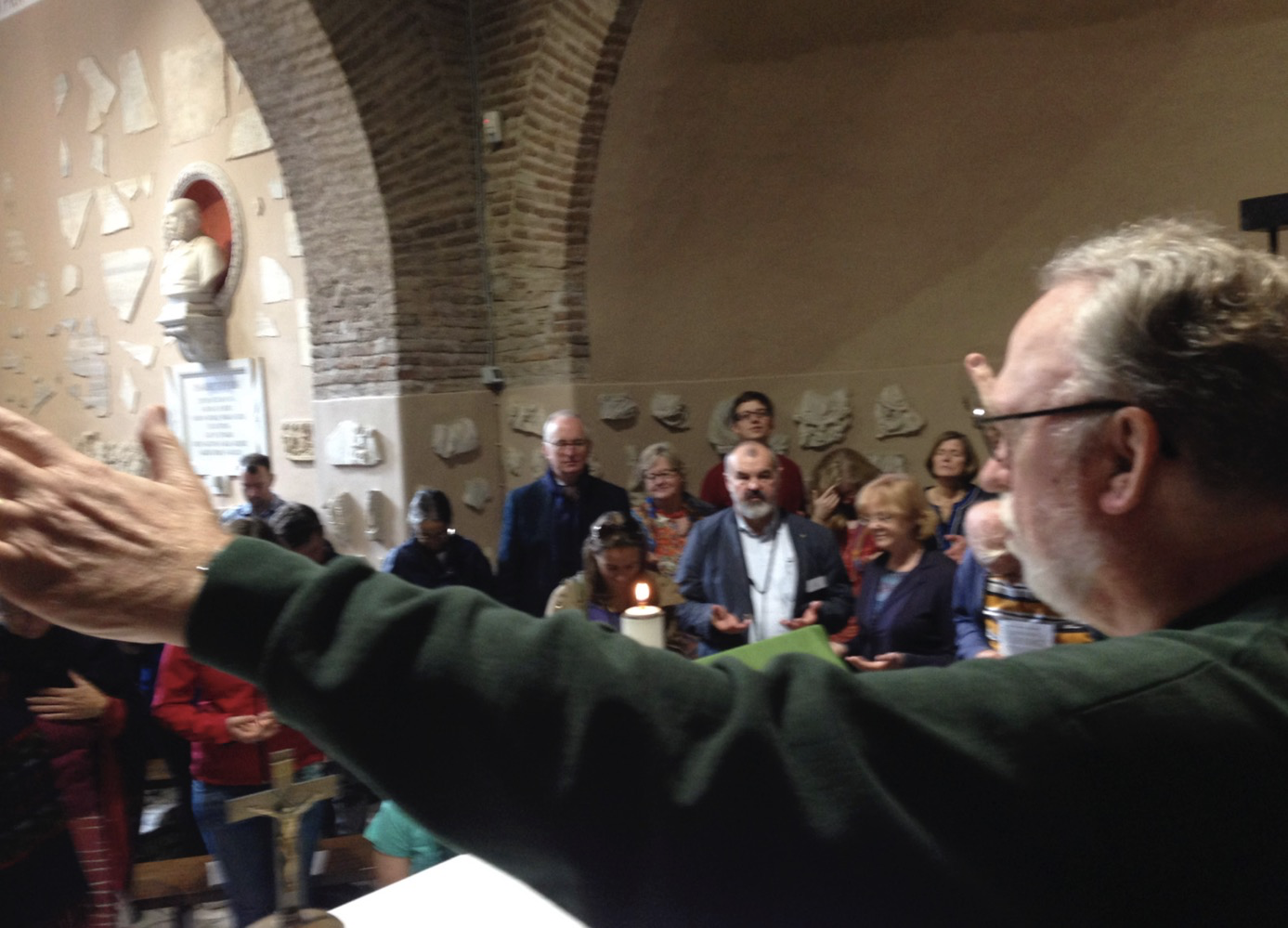
He declares His word to Jacob,
His statutes and rules to Israel.
He has not dealt thus with any other nation;
they do not know His rules.
Praise the Lord! - Ps 147:19-20
A Reflection on the Father by Karen
Today I am happy to post a piece written by my friend Karen Goldapp. I would love to feature more writers from our CTR community on this blog, so please let me know if you have a piece you would like to share. Listening and learning from one another is a gift of community. Thank you, Karen!
My most favorite teacher/preacher is Mike Bickle, who started and runs the International House of Prayer in Kansas City. He said something in a teaching that I will never forget, "Lovers always outwork workers". To me, this statement is so obvious-clearly in our own lives we give and receive the most from our closest, deepest, best relationships, far, far beyond what we are required to do at work. Yet this simple truth is harder for me to accept when I think about Our Father. It exposes my heart towards Our Father. One that doesn't really trust in His love.
I recently listened to a sermon about Our Father's love for us, and the speaker thought God loved him, but didn't really trust that God actually loved him. Basically a worker mentality, rather than a lover relationship. It's a simple thing, but pretty much the basis of our whole faith (John 3:16 comes to mind). Here is a link to the sermon, if you think it might help you, it probably will: www.ihopkc.org
When I think of what our culture says about Our Father, and what some of us experience in earthly parents and other leaders, it's not a pretty picture what actually comes to mind (ok, stop now and listen to that sermon; it's really good, I promise!) Here is what Jesus, the 2nd person of the Trinity, our beloved Lamb and Bridegroom, said in his explanation to the religious leaders about why He was hanging out with "sinners". Jesus in a short story illustrates what we are like, and most importantly, what Our Father is like, in the famous Prodigal Son story. The Prodigal Son, like me, hasn't really got his Father's heart yet. He even wants to return to his Father like a “hired worker”. See how pervasive the worker mentality is? We pick up in the story when the son decides going home is better than starvation, and his daddy is watching and waiting for him:
Luke 15:20 (WYC): And when he [son] was yet afar, his father saw him, and was stirred by mercy. And he [father] ran, and fell on his neck, and kissed him.
And a Jewish translation...
OJB: And while he [son] was still a long way off, his Abba saw him, and was filled with heavenly mercy and compassion and tears, and fell upon his neck and kissed him.
We sing a song about us running to God, and yes, we choose to follow Our Father, but really He is running to us. He is humble though. So, so, so, very, very, very humble- as evidenced by the freedom Abba gives the Prodigal Son (ahem, us) to make messes in the world- even destructive messes that cause others pain and loss. Anyways, this running God, the One who is so much more engaged with me, my soul, than I am, the One who is far more committed, kind, gracious, and invested in my well being than I am...that's...my papa, my daddy?
Whew, that last sentence was intense for me. Unbelievable, actually. So here's what Jesus had to say in His final recorded prayer, with the disciples, right before He would be tortured, murdered, and sacrificed:
John 17:23 and 26 "and that you [Father God] have loved them just as you have loved me" and Jesus' prayer that God [Father God] loves us like God loves Jesus, "so that the love with which you have loved me may be in them, and I myself may be united with them"!!!
What??!! Jesus of course flowed in a perfect love relationship with the Father, but us?? Father, Mother, Eternal Creator God loves me like He loves His perfect son? Jesus' life, death, and resurrection is/was/will be so that we have His relationship with the Father. I understand with my mind that Father God loves me. I know, however, that my heart needs more healing to believe in the kind of radical love that God has for me. When I have this love in me more than I have air to breath or blood in my veins, living a life of love to others, the broken, lost, hateful, and needy won't be a chore, won't be work. It will be from the overflow of confidence in the Being who loves me just as much as He loves Himself and His perfect Son.
Our Father is the best, most perfect Father. Words can't convey the Perfect Love who kisses all our boo boos with the most tender of care; He makes glittery, extravagant signs and jumps with joy at our graduation; He sees and affirms all our giftings and unique design like no one else; He tells us when not to listen to the haters and go out with boldness to operate in our calling. Our community at CAE will be transformed by knowing the love of Our Father, as when we see the byproducts of all our insecurities and worries melt away. How will we know when we have faith in Love? When we can take divine correction and believe its for our best. When we can be vulnerable with each other and ourselves. When we want to be in His presence, talk with Him, share our time, money, and friendship with the Trinity because, well, we'd just love to.
- Advent reflection from Karen Goldapp
Mystical Body of Christ - Part II
Usually I keep my eyes closed before communion. I love the peace, the stillness, the intimacy of that space. But one morning not long ago, I lifted my eyes and watched as my brothers and sisters came forward, one after another, and received Jesus. To each one Fr. George proclaimed, “the Body of Christ”, “the Body of Christ”, “the Body of Christ,” and the double meaning of that confession filled my heart – the Real Presence of Jesus in the bread, and the Real Presence of Jesus in His people.
When I served as a Eucharistic minister, I was reminded of this truth every week. Unworthy as we are, we become Christ’s Body because He desires us and poured out His life for us. In recent years this corporate dimension of communion had receded a bit in my personal meditations, but it came rushing back the morning I lifted my eyes. Suddenly I felt stricken, sick with grief, as it dawned on me what violence we do our Savior, what violence I have done Him, by entertaining envy or contempt for fellow members of His Body. The Son of God humbles Himself to become food for all who will come. The least I can do is pray that His joy be made full in each one to whom He gives Himself.
Jesus, that is what I desire for You – that You be glorified in each of Your members. I pray that every brother and sister who receives the Bread of Your Body will drink deeply of the Holy Spirit and bear Your glory. I know that when Your Body is made whole, I also will be healed.
Sister Joela
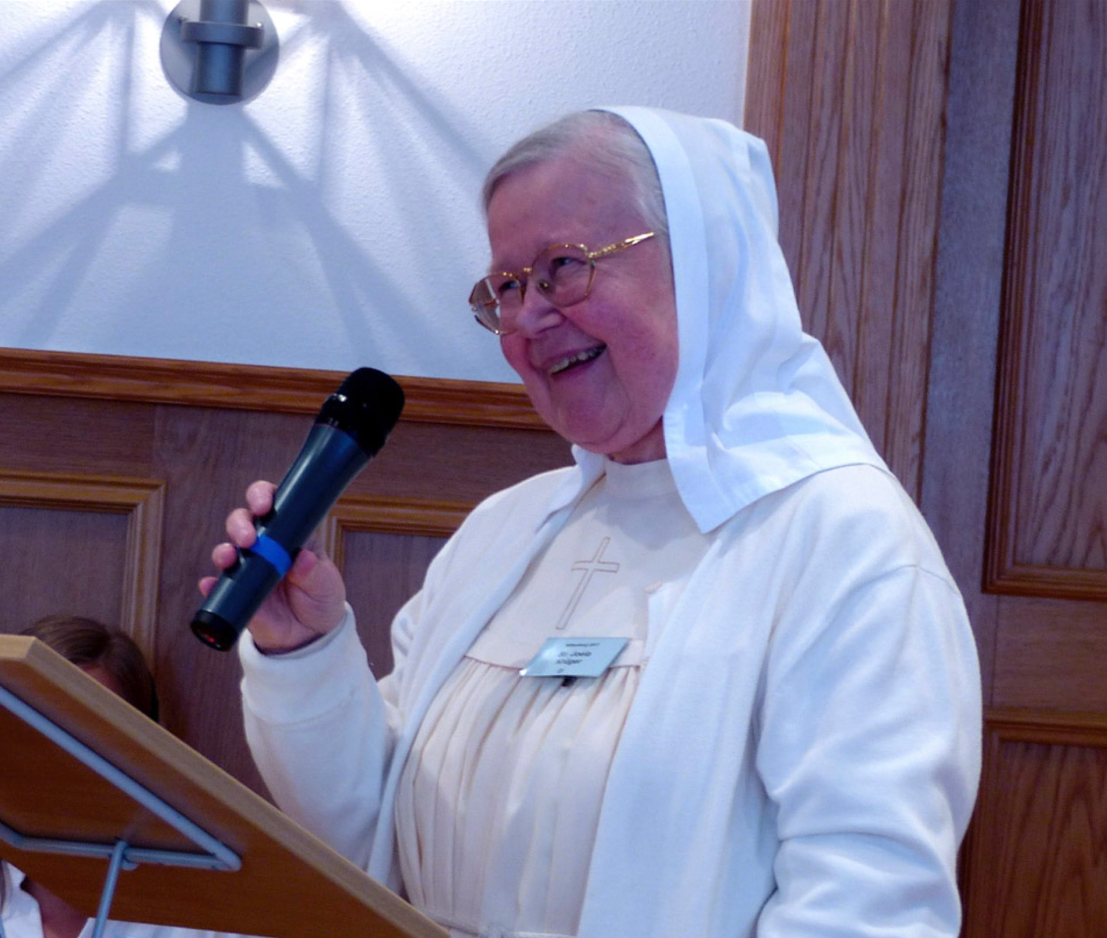
Prophets are intense. No doubt about it. Sr. Joela is a prophet
We met Sr. Joela in Ottmaring, Germany, at the first gathering of Wittenberg 2017. At that time it was more of an idea than an initiative. The purpose of our gathering was to present the proposal of a prayer gathering on the 500th anniversary of the Reformation to German spiritual leaders, both Lutheran and Catholic. I am not sure how Sr. Joela heard about the gathering. I do not recall her being on the list of expected guests. Somehow she caught wind of the meeting and decided to come. When news of her imminent arrival spread through the room, we could feel the buzz. Clearly she was a woman of influence.
Thomas was assigned the honor of meeting Sr. Joela at the train station. In her simple tan habit, she was not hard to spot. Cutting through all introductory pleasantries, she looked up into Thomas’ eyes and asked, “Are there any Messianic Jews here?”
Thomas was thankful he could answer truthfully, “Yes, there are a couple of Jews here.”
“Good,” she responded. “Otherwise I would have to get back on the train and go home.”
She was looking for a significant spiritual response to the anniversary of the Reformation, she explained. She was not interested in ceremonies. Our inclusion of the Jewish voice was a sign to her that this was the group where she belonged.
Sr. Joela is a member of the Marienschwestern, a Lutheran religious order founded by Basilea Schlink on the heels of WWII. Even before the war, Schlink dared to speak out against Hitler. In Nazi eyes, perhaps, the young woman was not enough of a threat to bother. In reality, I believe, God shielded her, hiding her away in His great love for a time and purpose close to His heart. After the war Sr. Basilea would lead Germany in repentance. She would preach and write books which the Spirit used to open many eyes to the Father’s love for His people Israel. Over the course of her life, hundreds of thousands would travel to the little convent In Darmstadt to receive teaching and blessing. Mother Basilea carried a deep love for the cross. She understood the necessity for the Bride to stay close to Jesus in His suffering, through repentance and intercession. Mother Basilea was a prophet. Sr. Joela is her true daughter.
Our Wittenberg gatherings were shaped by Sr. Joela’s prophetic voice. As a faithful Lutheran she brought forward the travesty Luther’s anti-Semitic rhetoric. She spoke fearlessly of Lutheran cooperation with the Nazis, with the hope of cleansing and renewal, never division. She challenged all of us Gentile Christians to honor Jesus as King of the Jews, a title which He loves and will return to fulfill in all its glory. And in our last gathering she insisted on the centrality of the cross. Jesus crucified is our hope for healing, purification and unity.
Of all the characters in the scripture, the one Sr. Joela most envies is the donkey which carried Jesus through the streets of Jerusalem on Palm Sunday. “I want to be Yeshua’s donkey,” she says. She wants to hear His people say, “Blessed is He who comes in the Name of the LORD.” I believe the Father has heard her. Today Sr. Joela is in her latter 70’s. She suffers constantly with back pain. She has carried the burdens of our Lord for many years, weeping over His sorrows, grieving over her own sins and those of the world. But she carries more than our Messiah’s burdens; she carries His glory as well.
Prophets are intense. Their Father loves them for it.
|
Related links:
austinhouseofprayer.org | wittenberg2017.org | georgeandhannamiley.com |