
Your Custom Text Here
< Paused >
Amy has paused her “Passing Through Baca” blog, to take up a new project called “One Year In Torah”
Find her One Year In Torah blog here:
https://cogdellcreative.space/amy-one-year-in-torah
Passing through Baca may return after her year in Torah is up!
Who has an Ear?

I love theology. The word literally means “the study of God” which is a lofty aspiration indeed. It would be the highest form of presumption if God Himself did not initiate the pursuit. The fact that God desires to be known and loved never ceases to stun me. He is humble beyond human comprehension - a fact which must remain at the forefront of our theology.
There are many truths about God which defy human comprehension. He exists without beginning or end. He possesses unlimited power. He speaks and worlds come into existence. He is more compassionate, more just, more powerful, more loving than any person; yet we are made in His image. He has made us in His image so that we might known Him; but His reality transcends our own. We cannot grasp His nature purely through reason. We must rely on revelation. And when our logic conflicts with God’s self-revelation, that revelation must take precedent. If we forget this truth, doctrine can dull our ears. Our own assumptions about what God would do in a certain situation can become barriers to seeing God in action. I think this is why Jesus often calls to His audience, “He who has an ear, let him hear!”
I confess that I usually assume that I among those who hear. After all, I am a believer. I have heard decades of sermons. I know how different schools of thought fit Jesus’ words neatly into their theologies. But recently I have begun to realize I have not always heard what Jesus is saying to the churches. At times my own theology has presented a good answer to the wrong question.
Take for example the story where James and John ask to sit at Jesus’ right hand in the coming kingdom. (Mark 10:37, Matt 20:21). Most preachers say that James and John were asking the wrong question. I have heard countless sermons on how James and John did not understand that Jesus’ kingdom was a different kind of kingdom, a purely spiritual kingdom. The implications of that statement can vary, but essentially they all miss the point that Jesus never says James and John asked a bad question. Rather, Jesus affirms the disciples’ theology by saying that there will be a day when flesh and blood friends sit on His right and left - but His Father will decide who those people are. In fact, Jesus’ own teaching likely prompted this question, for just a few verses earlier in Matthew Jesus tells His disciples.
“Assuredly I say to you, that in the regeneration, when the Son of Man sits on the throne of His glory, you who have followed Me will also sit on twelve thrones, judging the twelve tribes of Israel.” - Matt 19:28
Jesus ddid not rebuke James and John for their ambition. Rather, He asked if they were prepared to receive the kind of baptism He must undergo. They responded with a resounding “Yes!” and I believe Jesus smiled with great love and sorrow at that moment, for the Spirit showed Him that James and John would, indeed, be baptized with fire. The other ten disciples were indignant with James and John for their questions, but rather than rebuking the two daring ones, Jesus instructed all twelve on how to become great rulers in the resurrection. He told them they must become servants of all. Only the truly humble can be vested with power in God’s Kingdom.
My theology warmly embraces a certain find of self-effacing humility. I know Jesus wants us to be servants, to not think more highly of ourselves than we should, etc. But does He really want us to reign with Him? Is ruling with Jesus a position to which an ordinary housewife should aspire? The very thought makes me tremble. It seems proud and stressful. However, Jesus bids me to listen carefully. Listening and believing is true humility.
“To him who overcomes I will grant to sit with Me on My throne, as I also overcame and sat down with My Father on His throne. He who has an ear, let him hear what the Spirit says to the churches.” - Rev 3:21-22
The truth which I am coming to grasp is that Jesus wants to share His throne! If this is what He desires, then I need to hear what He has to say on the subject. I should eagerly make myself ready by serving others and welcoming the baptism of fire.
One morning last month I had a wonderful encounter with Jesus during my prayer time. In my mind’s eye, I could see Jesus looking out over the Kingdom which He is preparing for His Bride - the New Jerusalem where He will reign. Unlike John, I could see no details. I simply felt the expanse. It is a broad and beautiful land He is making ready. I heard Him whisper in my ear, “You know, I will need help.”
In that moment, my heart finally embraced the governmental duties of the Bride. Ruling with Him in eternity may not be so very different from the way I serve my husband in this life. Here in the present, Thomas and I share a calling and vision. We pull together to perform the work God has given our family. In pursuit of that calling, I have authority to spend money, invite guests, make rules, initiate projects and teach. Thomas needs me to rule this house with him. It gives him joy for me to serve others in this place. For my part, it gives me joy to serve him and walk together in the administration of this tiny slice of the Kingdom. Can you imagine how happy Jesus will be when we rule with Him in the world to come?
“And he who overcomes, and keeps My works until the end, to him I will give power over the nations— He who has an ear, let him hear what the Spirit says to the churches.” - Rev. 2:26, 29
Fire on the Earth
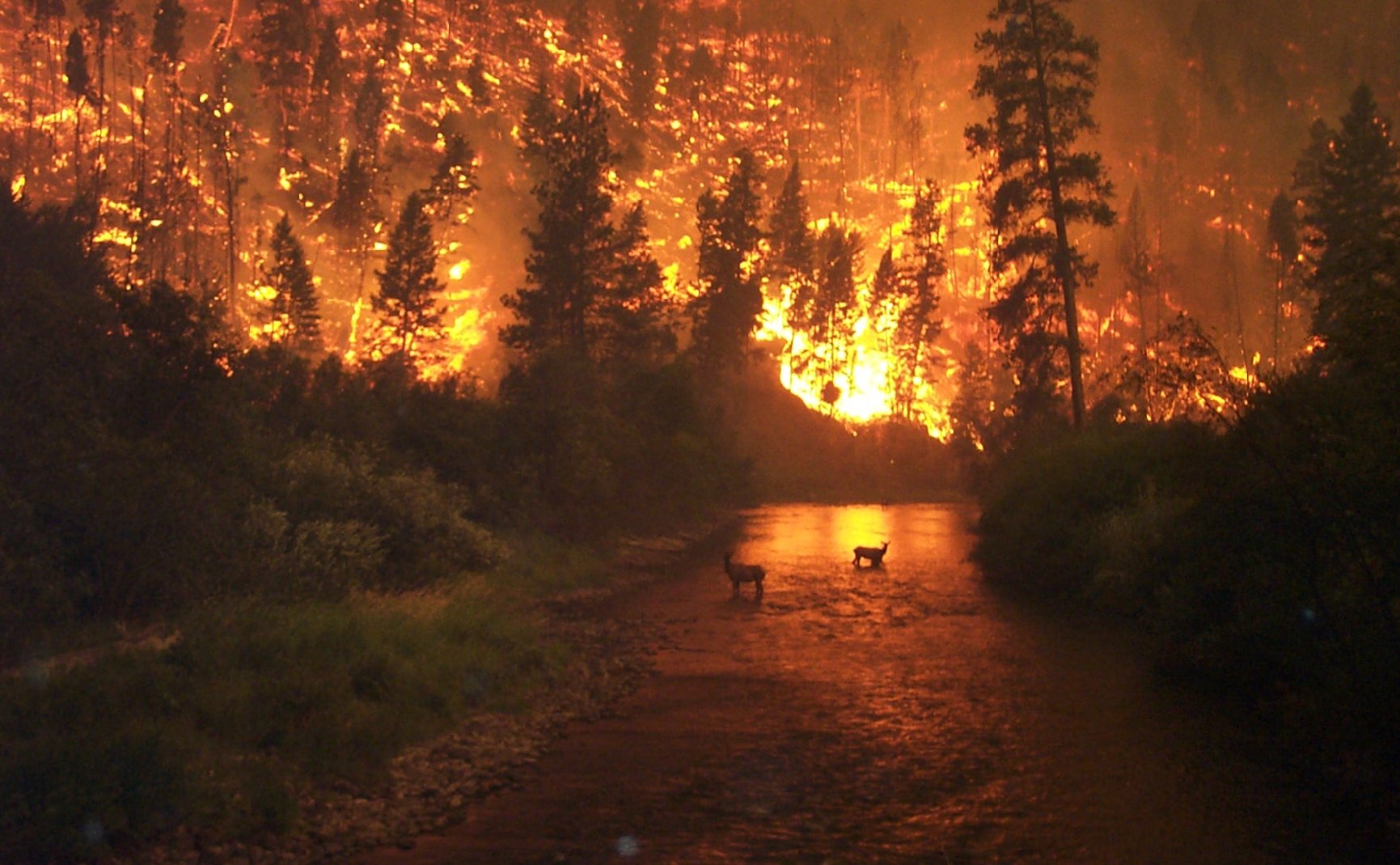
As I walked through my field this morning, my heart quickened remembering that the coming evening would mark the beginning of Holy Week. I love the eight days which begin tonight . They are set apart in the liturgical year as a spiritual journey with Jesus through the last week of His life - from His entry into Jerusalem, through the last supper, the passion, crucifixion, the tomb, all the way to His resurrection. Each year the Spirit emphasizes a different part of the story, unveiling new dimensions of its beauty and power. So as I walked, I wondered what the theme of this Holy Week would be?
I am always surprised when the Spirit reads my thoughts, answering a question I have not yet put to prayer. Before I had had taken ten steps down my path, this verse came to mind.
I came to send fire on the earth, and how I wish it were already kindled! But I have a baptism to be baptized with, and how distressed I am till it is accomplished! - Luke 12:49-50
It is a rare thing in scripture for Jesus to speak about His feelings. He rejoices when the 70 return from their mission. He weeps for Lazarus. He shows compassion to the sick and forgives the sinners. But for the most part, Jesus speaks about His Father. He does what He sees the Father doing. This is the first time in the gospel of Luke where Jesus speaks openly about the cost of His obedience.
“Do you suppose that I came to give peace on earth? I tell you, not at all, but rather division. For from now on five in one house will be divided: three against two, and two against three. Father will be divided against son and son against father, mother against daughter and daughter against mother, mother-in-law against her daughter-in-law and daughter-in-law against her mother-in-law. Then He also said to the multitudes, “Whenever you see a cloud rising out of the west, immediately you say, ‘A shower is coming’; and so it is. And when you see the south wind blow, you say, ‘There will be hot weather’; and there is. Hypocrites! You can discern the face of the sky and of the earth, but how is it you do not discern this time?”
Jesus sounds frustrated, close to angry at His audience. Why? Luke begins the chapter by informing us the crowds were so dense that people were trampling upon one another. Israel was abuzz. The people were beginning to believe that Jesus might truly be the Messiah. On this point, they were correct. However, they gravely misunderstood the implications of His appearance.
Most Israelites believed that the Messiah would take his throne in Jerusalem, defeat the Romans and bring quick prosperity to the Jews. But Jesus knew that His victory would actually unleash chaos. His death and resurrection would demand a response. Believers would be divided against unbelievers. His closest friends would be put to death. His people would be scattered and the Temple would be razed. His own baptism of fire would throw the world into paroxysms of upheaval.
Hypocrites! You can discern the face of the sky and of the earth, but how is it you do not discern this time?
Why did Jesus rebuke the crowds this way? Perhaps because they were so out of touch with the burden He carried. Perhaps He felt terribly alone even as the crowds pressed against Him. Perhaps He knew that if they understood the course laid out before Him and what it would cost them personally, they would no longer be interested in His teaching.
Here is the more pertinent question. What is Jesus saying to me?
I believe this Holy Week Jesus wants me to abide with Him in this distress. He wants me to discern the times rightly. Once again the earth is suffering with the brith pangs of Jesus’ victory. We are in the midst of a societal paroxysm. Families are divided in their response to the lordship of the Messiah. Hatred and accusation are rampant. But there is no going back.
All I can do this Holy Week is rejoice with Jesus that His baptism is complete. He has set the world on fire and it is burning! This is a good thing - painful as it may be. Fire destroys whatever will burn, but it purifies what remains. And Jesus knew this fire must burn before His reign would begin on earth.
Painful and frightening as these times are, it would be far worse if Jesus had not done the will of His Father. A cold, dark world without hope is far more frightening than one burning in defiance. These flames will eventually come to an end. Jesus will return to judge the living and the dead. He will reign and shatter the head of His foe.
I do not presume that my loved ones or I will escape these days unscathed. Those closest to Jesus at the time of His passion suffered greatly in the backlash which followed His resurrection. But they are safe now, and full of joy, having passed through the fire.
I take comfort in the tender words Jesus spoke to His followers early in this chapter.
“Do not fear, little flock, for it is your Father’s good pleasure to give you the kingdom. Sell what you have and give alms; provide yourselves money bags which do not grow old, a treasure in the heavens that does not fail, where no thief approaches nor moth destroys. For where your treasure is, there your heart will be also.”
I want my treasure to be with Jesus in His Kingdom. It is no good keeping it here, for Jesus has already set a fire on the earth.
Changing Seasons

Happy Birthday to all the wonderful people born in March!
Spring is in full force here in Central Texas. Bluebonnets and paintbrushes blanket our fields. The air feels crisp and clear, radiant with golden sunlight. This is the time of year when three of my children were born. It is when which I first fell in love with Thomas. March is hands down my favorite month in Texas.
Spring burst upon us suddenly this year. On the morning of March 3, I walked into the courtyard of the Oblate Seminary in San Antonio and knew it had arrived. The air was chilly from a fierce thunderstorm which swept through the previous night, but the sun shone brightly that morning. The birds sang triumphantly and the wisteria flowers opened, perfuming the courtyard. And suddenly, I felt sad.
Why such a gorgeous day, filled with with the promise of stimulating conversation and time alone with my husband, should evoke feelings of melancholy puzzled me. As I walked the Oblate grounds, the answer slowly dawned on me. The changing of the seasons reminds me that time is passing. The years before me are shorter than the years behind me. The world seems to be spinning faster than ever, and in a certain sense, it is true. Each passing year occupies a smaller percentage of my lifespan than the year before. Each new equinox drags me closer to the winter of my life.
As I thought about these things, I began to wonder if the earth is also feeling old? Is it aware, in some way, that its time is drawing to an end? Is it growing increasingly tired with each trip around the sun? Does it feel itself wobbling on its own axis, even as I ache now when I stand?
The birds, of course, know only this spring. They have no reason for melancholy. Each flower blooms only once, and so it bursts with unbridled joy. But the angels observe that colorful fields are scanter than ever. They remember bird songs which have gone extinct. They have watched the snows grow thinner, and raging waterfalls turn to trickles. They know a day of fire is coming when the mountains will melt as wax; the stars will fall from the sky; the sky will be rolled back like a scroll and the Lord will come to judge both the living and the dead.
But that day has not yet come. The earth is called to flower once again, for thus the Lord has ordained it. He is not finished with spring yet. He will keep this Passover feast with us. Jesus will enter into our Lenten fasts and our Easter celebrations, even as He is busy preparing a place for us in the Father’s house.
Knowing this, I push aside my melancholy. I fill my lungs with the sweetness of plum blossoms and give thanks. It is good to grow older because I am drawing closer to my eternal home. For now there is work yet to do – young ones to raise, books to write, feasts to prepare. There is life in these bones yet, creaky though they be.
Two of my favorite people celebrate birthdays today. My granddaughter Marian turns seven and my dear friend Cheryl marks 61 trips around the sun.
Marian is a little bird with her whole life before her. She is a flower offering her fragrance to a weary world. She is a bright-eyed, eager, joyful witness to hope. This world is the only one she has ever known, and in her eyes, it is full of wonder.
Cheryl, by contrast, has walked through several springs. She has born the heat of many summers, and the bite of bitter winters. She knows the world is growing weary, and she shares its pain. But she also is a witness to hope for she has seen the beauty of God. She has walked with the Father and trusts in His faithfulness. She can serve as a guide to younger generations because she knows how to find honey in the rock, and streams in the desert.
I am thankful for friends like Cheryl who continue to take up their yokes and plow with Jesus year after year. I am equally thankful for children like Marian who remind me why God so loves this world. I am grateful for the seasons of our lives which mirror the seasons of creation. Spring made me anxious for just a moment this year because it reminded me that I am no longer in the spring of life. I have entered the autumn of my years– a time of harvest - and that is also beautiful. I realize that my winter is coming, and my flesh recoils a bit at the cross which awaits. But after winter, I will enter a new kind of spring – with a new body, seeing a new earth for the very first time. I will be younger than ever and full of wonder at all God is waiting to reveal.

Even the sparrows have found a home in the missions at the Oblate Seminary.
Article in Living City Magazine
This is Thomas hijacking Amy’s blog … again 😬 but I just have to brag on my wife who had an article published last month in Living City magazine! You can read it online here but the layout is much nicer in the printed magazine:


Way to go, Amy!
👏🎉💐
Beauty

Looking in the mirror this Wednesday was a jarring experience. It was not (primarily) that the image I saw disappointed; it simply did not conform to the image I carry in my own head. It was not me. The woman in the mirror looked old! How did that happen?
The pandemic years certainly took their toll on my body. My shoulders have started stooping. My spine has grown resentful of its task. The long walks I have loved since childhood have been severely curtailed. Running is out of the question. Typical middle-age “softening” has been exacerbated by lack of exercise. And the wrinkles on my face are not the smile lines I had hoped for, but furrows carved into a brow often knit together with pain. Alas!
On Wednesday my daughter’s homeschool co-op came to study at our house. While their clear, youthful voices were lifted in praise to God, my mind was wandering - searching for a plan to reverse my aging. I cannot remember what schemes I was conjuring when the Eternal One, the Ancient of Days, gently interrupted my thoughts with His humor. He reminded me of a gift He had given me 15 years, and 15 pounds ago.
Right around my 40th birthday I was invited to coffee by two lovely women in their 20’s. The young ladies had questions. They wanted to soak up the wisdom and counsel of older, godly women, and I was honored to be on their list. Even so, as I looked into their bright young eyes and saw the smiles on their fresh young faces, I began to feel old. I figured that my wardrobe needed updating for starters. Maybe I could get one of those cool looking sundresses K was wearing. Or maybe I should enroll in an exercise class…
I was running full speed down this path of vanity when my Father interrupted my thoughts.
”Amy,” He asked loudly, “Who is the most beautiful woman in the world?”
Somehow I knew this was not a trick question. An answer popped immediately to mind. “Mother Teresa! She is the most beautiful woman in the world!”
As soon as I answered, I felt chastened. I knew it was true. Mother Teresa was far more beautiful than any movie star and it was not clothing or exercise or face creams which made her so.
A few days later I happened to be in the post office. To my great delight I discovered the US government was selling Mother Teresa stamps! (This was about a year after her death.) I bought a page of stamps to keep as a reminder of my Father’s lesson and put them in a wooden desk sorter in our kitchen counter where they would stay in sight. Then things got strange.
My brother-in-law came to visit. When he walked into our house, the stamps caught his eye. “Amy,” he exclaimed, “how did you get stamps made of yourself???”
“What???” I asked.
“Those stamps have your picture on them,” he replied.
“No,” I laughed, “That is Mother Teresa.” I brought the stamps over so he could see. I think he felt embarrassed for mistaking me for an ancient, wrinkled woman, but in light of my conversation with the Father, I found it intriguing.
Then later on the very same evening, my mom joined us for dinner. When she walked into the kitchen she exclaimed, “Amy, you had stamps made of yourself. That is so cute!”
“OK, Lord,!” I thought. “I get the joke!”
Why the God of glory should find anything beautiful about me, or any human for that matter, is a mystery. I cannot comprehend it, but I know from scripture that it is true. Furthermore, the Son has taken a human face. Forever He will remain both God and Man. Jesus lives in a resurrected human body.
I have never lived apart from my body, and still I do not understand the mystery of this temple of flesh which holds the treasure of a spirit. Our bodies are not separate from ourselves. They are not mere containers for a soul. And yet, being flesh, our bodies grow weaker with age whereas our spirits grow stronger the longer and more fervently we love God. Every mortal temple will someday die. Every body will fail. Yet it is wrong to neglect the body or hate it, for our life depends upon it. So does our interaction with others. It is with our mouths that we speak, an with our arms we embrace. The image which our body carries in the material world is our key to recognizing one another. Thus the stamp-sized image of Mother Teresa evoked a sense of recognition for my mother and brother-in-law.
I find it interesting that scripture uses the image of a temple for our mortal frames. I have a strong preference for old churches! I love churches which smell like wax and churches with sagging wooden pews. I love steps worn by decades of foot traffic. I don’t mind if there are a few paint chips here and there, but I hate to see a neglected church. Neglect implies a lack of reverence for the worship which happens within a building, just as self-neglect indicates a lack of recognition of one’s dignity as a son or daughter of the Most High.
Sterile churches also make me sad. I mistrust a church which looks like an office building. Nor do I like glitzy churches which are used only on Sundays. I am not a fan of fog machines or fancy lighting. On the Catholic side, I dislike gilded baroque altars. They feel like too much make-up for me. I prefer the solidity of old stone, or the faded wood of a chapel in the country - a place where worship has been conducted in “spirit and in truth” for many years.
I hope that is what my Father sees when He looks down at my little temple. I hope that is what my friends and family see as well. And someday I hope to see Mother Teresa in all her resurrected glory and have a good laugh.
When God Asks a Question

When God asks a question, He is not seeking information. Rather, He is calling us to listen. He has something to say, something to teach us. Him. He is knocking on the doors of our hearts, seeing if we will let Him enter. And so it was with me when the Lord interrupted my morning routine with a question some weeks ago. Quietly but clearly I heard Him ask , “Amy, what do I hate most?”
Immediately, I knew the answer was not sin - at least not sin as I usually imagine it. Our Father was not referring to acts of passion, or theft, or lying. His question evoked a response in my own heart - an intuitive “knowing” that what grieves Him most is disbelief.
By disbelief I do not mean the garden variety questioning of God’s existence which most people experience at some point in their lives. No, the disbelief which God hates takes root in people like me- those who have seen His wonders and known His saving power, yet still doubt His love.
The majority of the adults who passed through the Red Sea grieved God with their disbelief. The saw the fire of God’s presence which warmed them by night and the the cloud which shaded them from the burning desert sun. They ate bread from heaven and drank water from a Rock, and still they accused they Almighty of leading them into the wilderness to die. His anger burned against the nation He had chosen for they refused to believe He would deliver the Canaanites into their hand. They doubted His goodness even after laying eyes upon the land flowing with milk and honey. And so the Lord sent them back into the wilderness for forty years. He never abandoned Israel, but He could not delight in that doubting generation. It was their sons and daughters who inherited the land.
I do not think we Christians are so different from the Israelites. We believe that God interrupted history once long ago to bring us salvation, but we doubt His nearness now. We fail to remember His unfailing provision in our lives. We hardly dare to expect answers to our prayers, much less the fulfillment of ancient prophecies. We do not understand the eagerness of God to show us His ways, to prove Himself as a warrior, and to escort His Bride as she passes through the wilderness.
It is true that the wilderness is harsh. The journey will not always be pleasant. God did not spare His own Son the heat, the thirst and hunger of the desert. We should expect no less. We will be tempted and threatened by enemies. But we must live as Jesus did, that “by every word that proceeds from the mouth of God.” God has given “great and precious promises” to His people and He will surely fulfill them all.
There are words the Father has spoken to me, personal promises concerning the next generation, which have not yet come to pass. At the moment I do not see their fulfillment. I am passing through the wilderness along with the next generation. Here we wait, learning the ways of God, receiving our daily bread. There is a pillar of fire over our heads - the very presence of the Holy Spirit. This fire is not visible to mortal eyes, but I believe our enemies see it and fear. Sometimes I can feel this fire in my bones; most often I do not. But my awareness not change the reality of the Father’s nearness. It does not change His commitment to His word. There will be a fulfillment of all He has spoken, and our Father is blessed when we believe the words He has spoken, just as Mary did. It know it is good for me to cling to His word! Doubt leads to fear, and I hate living in fear.
So I thank you, Lord, for interrupting my thoughts with a question. You knew I was drifting into disbelief, overcome by the rigors of the wilderness, and You came knocking on my tent door. When I hear Your voice, it is much easier to believe. Holy Spirit, give us ears to hear the Father’s voice!
Born of God
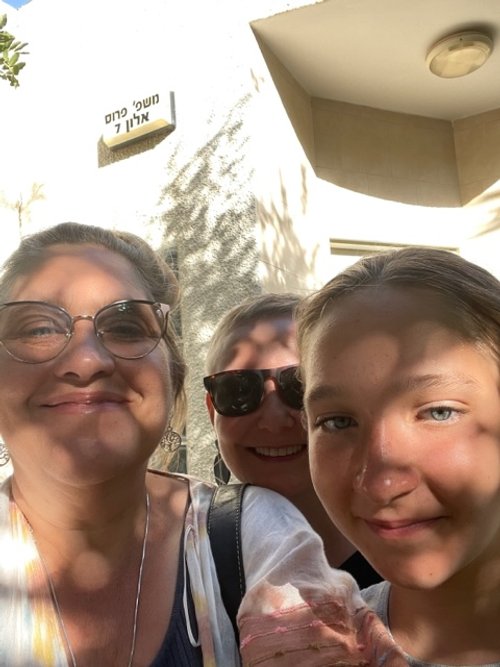
a photo with Marianna, our host and guide in Israel
From a personal journal entry shortly after returning from Israel
June, 28, 2022
Years ago, Jesus, I heard you say that You would be my guide in Jerusalem. Ever since that time, I have imagined myself wandering the streets of the ancient city with only You as my companion. It was a beautiful thought, and perhaps it will come to pass in time, but it did not happen on this trip. Having now visited the holy city, I realize how impractical my fantasies were. I cannot imagine trying to enter old Jerusalem, much less navigating its crowded throngs, without a flesh and blood guide. I am glad I was not alone. Even so, I did long to get away with You.
I told you this one night in the Galilee. After being with people constantly for more than three weeks, I asked when You would come speak to me. When will You be my guide, I asked?
”I am in Marianna,” You replied. “I live in her. I am showing You the land through her.”
That was the theme of the entire trip - we who have been born of the Spirit are living temples. We have the mind of Christ. In the New Jerusalem, there will be no Temple, for God will dwell with men in fullness. The whole city will be holy for the Godhead resides there.
Last night I woke up pondering what it means for the Father to have a Son, “begotten and not created.” What does it mean for the Son to share fully in the eternal nature and power of the Father? Why does the Son suffer to manifest the perfection of His union with the Father?
Satan, of course, was given a share in the Father’s glory. He was not begotten of the Father, but he was endowed with majesty and wisdom beyond mortal reckoning. Yet he turned on his Creator. He who had seen the Father’s glory refused to bow.
But Jesus, the Begotten Son, remained true. He resisted the devil’s temptations to doubt His Father. He refused to give into the devil’s taunts to prove His identity or use His power in anyway contrary to the Father’s will. Jesus resisted the temptation to act contrary to the Father’s desire even in the throes of His suffering, when He could not see the Father. He remained true when He could not feel the consolation of the Father’s nearness. The fact that Jesus, unlike Satan, remained true in His agony gives me hope that we who have been born of God’s Spirit can be like Him, the One who “did not regard equality with God something to be grasped. Rather, He emptied Himself taking the form of a servant and being born in the likeness of men. And being found in appearance as a man, He humbled Himself, becoming obedient to the point of death, even death on the cross.” History proves this hope is well founded. Thousands of saints through the ages have shown themselves to be true brothers and sisters of Christ in their virtue and their suffering.
Now that I am home from Israel, pondering what You said about Marianna, I am thinking of this verse from John. “To everyone who received Him (Jesus), who believed in His name, He gave the right to become children of God, who were born, not of blood nor of the will of the flesh nor of the will of man, but of God.” Is it true that being born again is more that just adoption? Do I really believe that the Spirit of the Only Begotten abides within me? For if I do, then I can trust Christ’s spirit will sustain me even in darkness, even when I cannot feel God’s presence.
Of course Jesus says there is another option. We can prove ourselves children of the devil if we desire what he desires (John 8:44) But that is not what I want, Father! I want to be a true temple of the Holy Spirit.
Beauty and Holiness

Photograph by Abigail Cogdell
Many years ago, when our first daughter was still quite young, we took the kids to a big aquarium. The final exhibit was located in a large, dark room lit only by cylindrical, floor to ceiling tanks filled with jellyfish of various species. There was an unusual hush in that room. People moved quietly, almost reverently, as if the silence of the jellyfish called for silence in response.
When we exited the building, my little girl came skipping up behind me, buoyant with joy, and clasped my hand. It was an unusual move for Peggy - not that she was a somber child by any means, but she preferred to keep her emotions to herself. We walked together for a few minutes before she looked up to me and asked, “Have you ever seen anything so beautiful that it makes you forget all about sin?”
To this day, I consider that question one of the most profound I have ever heard. It was an expression of wonder, of worship even, which enlightened my own understanding. In a moment of revelation, I responded, “Yes, I have! I know what you mean!”
Beauty springs forth from holiness, moving outward from the Creator. At the same time, beauty beckons us into God’s presence. It draws our senses upward toward “whatever is true, whatever is honorable, whatever is just, whatever is pure, whatever is lovely.” Once we arrive, we are so full of wonder that we cease to think about ourselves. The restlessness which drives our sin disappears. We are content to “be still and know God.”
The first time I was overcome by beauty, I must have been six or seven years old - about Peggy’s age at the aquarium. Against my will, my mother took me to Pentecostal revival meeting in the mid-1970’s. What first-grade girl would want to spend her evening at church? But once the music started, I was captivated. After a few opening hymns, hundreds of people began singing in the spirit - hundreds of voices lifting up different words with different melodies all at once. On one level - the song was unintelligible, but the beautiful, other-worldly music spoke directly to my heart. I knew this had to be a sound straight from heaven, and I was perfectly content to listen as long as it might last.
I wonder if Satan’s rebellion was terrible and final because he lived in the presence of God’s beauty? At some point, he must have turned his eyes away from God, towards himself, unleashing horror and destruction on the whole world. The full story is a mystery, of course, hidden from our eyes for now. But I hope that in eternity as we behold the Father’s beauty, we will not forget the ugliness of sin. I hope that somehow our experience on earth will be an inoculation against Satan’s temptation.
For now we wait, with eyes veiled, for the fullness of God’s plan to be revealed. There is a purpose to our waiting, I am sure, and to the limits of our human flesh. But the more we experience God’s beauty now, the more we will long for Him. The more beautiful we find Him to be, the more distasteful sin will become. And the more we reflect His beauty, the more life will flow from our inner beings.
For this reason, I pray for Christian artists - Holy Spirit, direct our eyes to the beauty which flows from the Throne. Give us skill to touch hearts through the senses, manifesting the Creator’s own beauty.
I pray for the teachers among us - Holy Spirit, inspire teachers to remind of us of truth even when our eyes are veiled. May they instill a love in our hearts for what is true and noble and good.
Most of all, Holy Spirit, I pray for You to breathe on us anew. Enlighten our eyes to see beauty so that we forget all about sin! Touch our hearts yourself, for when we wholly love our holy God, we shall become holy as well.
City of Thrones - Part II

O Jerusalem, Jerusalem, the city that kills the prophets and stones those who are sent to it! How often would I have gathered your children together as a hen gathers her brood under her wings, and you were not willing! -Matt 23:37
I wonder what it was like for Jesus to walk through the streets of Jerusalem incognito? He was, after all, her promised King - the one who would rule both Israel and the nations. Jesus understood this truth from the time he was twelve years old, but the influential citizens of Jerusalem failed to recognize the Son of Man in His humility.
The priests and Pharisees could not fail to acknowledge Jesus’ popularity. Nor could they refute the miracles, but they resented Him and His teaching. In an effort to discredit Jesus, they posed Him with a quandary. They asked for His judgment in a case they thought sure to split His followers. It was a test the Father allowed for the King of Kings would someday judge the whole world, setting right all that has been broken. This test, meant as a trap, would serve as a sign of the glory of His coming reign.
Scripture says the adulteress was “caught in the very act,” exposed in her sin and paraded through the streets of Jerusalem to a council of scribes and Pharisees. The council did not care much about the woman’s fate. They were after Jesus and her seemed to serve their purpose. Should the adulteress be stoned according to the law of Moses or not? That was the judgment they demanded from the popular young rabbi.
I imagine some rough garment had been thrown over the woman’s body by the time she reached Jesus, but her soul must have trembled “naked and ashamed” just like Eve’s on the day of the Fall. She was, in fact, standing before God Incarnate. The Judge, in silence, bent low to the ground in the presence of all and began writing in the dust. The Pharisees were annoyed and pressed Jesus for an answer.
Jesus stood and spoke, “Let the one who is without sin cast the first stone.” Then He stooped again and continued His writing.
Scripture does not tell us what Jesus wrote, but the image is evocative. I am reminded of God bending down to earth, forming Adam from clay. Or then there was the time that the finger of God traced the words of Torah on tablets of stone. “You shall not kill. You shall not commit adultery. You shall not steal. You shall not bear false witness.. You shall not covet.” It seems that whatever Jesus wrote in the dirt, the Spirit disturbed the hearts of the woman’s accusers for they dispersed, deflated and rattled.
When the two were alone, Jesus stood and faced the accused. “Woman,” He asked, “where are they? Has no one condemned you?”
Without no fig leaf to hide her shame, the woman answered simply, “No one, sir.”
Then the only man qualified to cast a stone pronounced His judgment. “Neither do I condemn you,” He said. “Go and sin no more.”
Something wonderful and mysterious took place that day. The adulteress stood before the Son of God, guilty like Eve. She had failed to follow God’s word, and in her adultery, she stood as a symbol for all Israel, and in fact for all humanity. But Jesus did not condemn the woman. Instead, He broke the curse upon her. Jesus, the seed of Eve and the Son of God, fulfilled the promise God made to Eve on the day of her sentencing. He crushed the head of the Accuser in the City of Peace! He offered the woman mercy by the authority of His blood. And in that mercy was eternal life, though she did not yet know this.
Jesus knew, however, that He would be put to death in the City of the Great King. The cross would become the tree of life on which His body would be broken. The woman he met in the street that day would take and eat from the fruit of that tree, and she would live forever - free, and clothed in His own righteousness.
I wish I could fully grasp what my sister experienced that day, for its truth does not fully reign in my heart. The Son of Man is not ashamed to be seen with sinners like me, for when we stand naked before Him, acknowledging His judgment, He will clothe us with mercy. His justice will break the curses upon us. His blood will cleanse of all stains. There is no shame for anyone who takes refuge in His Court - though we must enter with fear and trembling.
What would have happened, I wonder, if the scribes and Pharisees had cast aside their fig leaves? If they had stood with the adulteress, confessing their sins as Jesus wrote in the dust? I suspect they would have left that encounter as changed as the woman, eager to “go and sin no more.” But no one who runs from Christ’s judgment can receive the gift of His mercy. The freedom every heart craves is found only in nakedness before God.
Someday there will be no place to run, no way to hide from the Son. The Righteous Judge will open the scrolls of history in the City of Thrones, and King will render His judgment. Every word, every secret intention of the heart will be revealed, and justice will be served. Those who overcome, Jesus tells us, will sit with Him on His throne, along with our sister, the former adulteress, now dressed in dazzling white.
City of Thrones - Part I

Clara sitting in one of the gates of the ancient Tel Be’er Sheva
Clara and I returned from our Mid-East tour last Sunday. We are past the jet lag, but still processing all we have seen and learned. Most people who visit the Holy Land discover that scripture takes on new dimensions when standing on the biblical sites, and I am no exception. Though I’ve always known that our faith is based on history rather than myth, my mental images of stories set thousands of years ago in a far away land were fuzzy at best. The stories played out in my head like a great epic novel where good defeats evil, and while there IS a wonderful arching narrative at the core of our faith, these stories are not merely symbolic. I am realizing that many phrases I have interpreted spiritually or metaphorically in fact have a literal, material meaning. This does not mean that my spiritual interpretations have been wrong - just incomplete, lacking the awesome multi-dimensional fullness intended. Our God has always been a God of incarnation - displaying His glory in creation, making spiritual truths visible, inviting us to “taste and see” His goodness. He is the God who dwelt in a Tabernacle of skin before taking on flesh Himself. And He is a God who instructs us ways before calling us to live in the “city prepared for us.” Since the time of Abraham, He has been making us ready for the day when the veil is lifted and we are drawn - spirit, soul and body - into the fullness of His reality.
Unlike most pilgrims, Clara and I began our Israel tour in Be’er Sheba. This is the desert where Abraham pitched camp in the Promised Land. I am a big fan of Abraham to say the least, but I did not know he had built a city! By modern standards the collection of buildings discovered at Tel Be’er Sheva would hardly qualify as a city. There were no permanent residents living there. Rather, it was refueling station for Abraham’s numerous shepherds, and also a seat of justice. Shepherds came the cistern to water their flocks. They visited the storehouse to stock up on supplies. And if they had a complaint against a fellow shepherd, they climbed up to the city gates where judges were seated to hear disputes. These judges were the only residents who remained in the city day after day. No soldiers or craftsmen or merchants. I had always thought of early cities as fortresses built for protecting, but apparently our first father in the faith saw more need for judges than for warriors.
I am sure Moses would have agreed. Forty years he led a mobile city through wilderness - more than a million souls under his care. I cannot imagine what a management headache that must have been! Granted, Moses had help. God handled the food and water. The Lord even provided shade from the sun and warmth at night. But the job of settling disputes fell to Moses, and that was the task which almost wore him out. Day in and day out, Moses sat listening to angry people who grew angrier the longer they had to wait. Jethro, Moses’ father-in-law, came to congratulate Moses for his victory over Pharaoh, and he is the one who recognized this tinderbox in the making. Jethro proposed to Moses the establishment of a hierarchy of judges to serve thousands, hundreds, fifties and tens. He urged Moses to instruct these judges in the ways of God and delegate the simpler matters to them. Moses heard the wisdom in the counsel and implemented the plan. I find it interesting that scripture records this story in such detail.
Once the Israelites entered the Promised land, judges ruled the people for four hundred of years. They had no king until Saul was anointed. They had no capital city until David moved the tabernacle to Jerusalem. Mount Zion became the center of worship for the Jewish people, and also their seat of justice. I did not realize how inextricably worship and judgment are related in scripture, and thus in the mind of God, until I visited Jerusalem in person. The morning of our planned ascent to the holy city, I began singing Psalm 122.
”I rejoiced when I heard them say, “Let us go to the house of the LORD.
And now my feet are standing within your gates Jerusalem.
Jerusalem, the city build compact and firmly bound,
There the tribes go up to give thanks to the LORD.”
Then my memory gave out. What comes next, I wondered? What else does the psalmist say about Jerusalem? I opened my bible and discovered:
“There the thrones for judgement were set,
the thrones of the house of David.”
The people give thanks to the LORD because He has set thrones of judgment at the gates of the city of David.
Tel Be’er Sheva, Moses, Joshua, and David’s Jerusalem all point forward to the eternal city - the place Jesus has prepared for us. John saw the New Jerusalem in a vision given to buoy our hearts until its fulfillment. John tells us that the New Jerusalem boasts twelve gates made of a singe pearl, each inscribed with the name of an apostle. I do not believe these gates are memorials, nor are they built for ornamentation. I believe the apostles, the pearls Jesus bought with price of His blood, will sit in these gates, just as the judges sat in the gates of Te Be’er Sheva. From there they will do the work Jesus for which Jesus called them.
Jesus said to them, “Truly, I say to you, in the new world, when the Son of Man will sit on his glorious throne, you who have followed me will also sit on twelve thrones, judging the twelve tribes of Israel.” - Matt 19:28
The apostles will share in Christ’s authority, but they are not the only ones. Jesus has promised to share His Throne with all who overcome. (Rev 3:21) He will put His anointing on those who know His ways, just as the Lord took from the anointing on Moses and shared it with the elders of Israel. We will work with Jesus, the Righteous Judge to implement the justice of His Kingdom. The glory and the weight of this thought makes my head spin, but Paul regarded this truth as an obvious fact.
”Do you not know that we are to judge angels? How much more, then, matters pertaining to this life!” - I Cor. 6:3
The New Jerusalem will have no temple for God Himself will dwell there, and we with Him. But there is a Throne which stands in the center of the city. The Holy One is a Judge and His justice will endure forever!
Memory and Eternity

“For just as he remained with us even after his ascension, so we too are already in heaven with him, even though what is promised us has not yet been fulfilled in our bodies.” - St. Augustine
Time is a fixed parameter of human existence. We experience life within its boundaries just as we move within the axes of space in a body made of matter. While we Christians affirm the goodness of this world and cannot rightly imagine any other, we also believe that God exists beyond these limits. Someday we will live with Him in His reality. Our bodies will be transformed by the Resurrection, and our minds as well. No longer will we perceive time as a single moment moving relentlessly forward. Rather, we will see from the perspective of eternity. C.S. Lewis likens the coming change to stepping out of a flat painting into three-dimensional space.
It is the linear movement of time, I think, which makes memories feel ethereal. We can never re-experience any moment of our past in the same way that we can return to a place. We may recall many events. We may even have unbidden flashbacks, but our brains are simply incapable of recording all that happens to us, within us and around us. We lose context. We forget details. And our memories are colored, perhaps indexed, by emotions which change or fade over time. Even vivid memories are limited by incomplete perception. In this life, we cannot view events from another person’s perspective. We cannot see all the ways in which one action impacts or precipitates another. Such knowledge is hidden from our eyes for now, and I am thankful. But someday, in the safety of our Father’s presence, we will discover that the simple lines we traced here on earth have taken on depth and width in heaven. Ephemeral memories will be revealed as substantive history. Those who hope in God will discover that they have been living eternal life all along.
We know this is true in the history of salvation. Jesus reminds us that His Father is “the God of Abraham, Isaac and Jacob,” and He is “not the God of the dead, but of the living.” The patriarchs, apparently, are quite alive though the world awaits the general resurrection. They are present to God; thus, their stories are living and active. The impact of their lives continues to unfold as their memory is passed from one generation to the next. The Spirit breathes on their witness, enlightening minds and transforming hearts.
Scripture informs us that God keeps records in heaven. Every act of kindness done to God or His people is remembered. But it is not only the works of men which are inscribed in the annals of heaven. God treasures the memories of His own work! His own Word is ever before Him. It is witnessed by thousands upon thousands of angels. And if the witness of men can be imbued with such grace that they are remembered forever, how much more certain and irresistible is God’s memory of His own promises!
In the most holy place of heaven God has placed a memory box – the ark of His covenant with Israel. The ark contains material evidence of God’s wonders in the Exodus - miracles which accompanied Israel’s deliverance. John the Beloved saw the ark revealed the twenty-four elders exclaimed, “The kingdoms of this world have become the kingdoms of our Lord and of His Christ!” I cannot imagine the joy John must have felt as a Jew in that moment for Israel had lost the ark given to her as a sign of God’s Election. At some point in her past, the nation had grown inattentive and unbelieving. The memory of God’s wonders toward their fathers cooled. The majority of the Israelites did not love the tablets of the law, the jar of manna and Aaron’s budding rod the way God did. Instead, Israel bowed to other gods time and again. Eventually, God allowed the Temple to be sacked, but He never let go of His promise. When the ark was no longer treated with reverence on earth, He ensured its safety in heaven.
Scripture does not tell us exactly what happened to the ark, or how it came to be in heaven. We simply know that John saw it in “God’s temple in heaven” when the twenty-four elders sang Christ’s coronation hymn. The timing was, of course, no coincidence. God’s covenant with Israel was always meant to bring light to the nations. Jesus’ rule over all the earth was always he intended end of the covenant. Jesus is the fulfillment of the Law, and the Bread come down from heaven, and the Resurrection of the dead. Without the witness of the ark, Christ’s reign could not be recognized in its rightful glory. Memory is important to God!
Recently, the Holy Spirit has been messing with some of my memories, lifting the veil of eternity just a peak. I find ordinary scenes from my own life coming to mind with a wholeness I find hard to describe. I recall a time when I was tempted to lie but chose to tell the truth; or a moment when a friend wrapped my fearful frame in a warm embrace. I see myself watching a rainbow with my husband or exploring a creek with my children, and these moments which once seemed faint and inconsequential now feel solid and immovable. It is as if I can step out of the flow of time and explore the events in three dimensions. Speaking metaphorically, I can move around them and touch them, viewing them from different angles. The Spirit shows me these memories are held in the Father’s heart, and therefore they are eternal.
Before the Throne, in the presence of the ark, the twenty-four elders rejoice in an eternal hymn. They sing “the time has come for the One Who was and Who is and Who is to come to judge the earth!” Judgment is based upon memory, and only God remembers accurately. Only He can weigh the actions of our lives. But when we are judged, we will see as He sees. We will know the truth of our lives. We will see the eternal ramifications of our actions. Perhaps this is why Jesus would dare to share His throne with His people. Once we have passed through the judgment of our King, no memory will be ethereal. Each deed of history will be solid – yielding itself to examination. And each memory washed in the Blood of Christ and in the Father’s love, even those that were painful on earth, will continue to unfold in glory, like the complicated stories of the patriarchs. The God of covenant is a Father who holds fast the memories of His children.
Figs

My three year old fig tree. It died back to the roots during Snovid, but came roaring back to life last spring.
Spring came to Texas a little late this year, or so it seemed to me. I spent most of March lamenting the lack of color in our field. Our mountain laurel did not bloom until the first week of April. And the dewberries are just now flowering. In previous years, I have harvested ripe berries the last week of April.
The one exception to the season’s delay was my fig tree. The last week of March I noticed that it was putting out fruit before it had leafed our completely. That was folly, of course, on the part of the tree. The fruit fell before it ripened. But I did admire the tree’s enthusiasm.
My eager fig tree reminded me one of the stranger stories in the gospels. The event took place the day after Palm Sunday, which happens to be today on our western calendar. Here is what the gospel of Mark says.
Now the next day, when they had come out from Bethany, He (Jesus) was hungry. And seeing from afar a fig tree having leaves, He went to see if perhaps He would find something on it. When He came to it, He found nothing but leaves, for it was not the season for figs. In response Jesus said to it, “Let no one eat fruit from you ever again.” And His disciples heard it….
Now in the morning, as they passed by, they saw the fig tree dried up from the roots. And Peter, remembering, said to Him, “Rabbi, look! The fig tree which You cursed has withered away.”
I am sure most people would agree that is seems uncharacteristically harsh of Jesus to curse a poor fig tree for doing only what was expected. Passover week was too early for figs. Figs normally do not ripen until Pentecost. But none of Jesus’ actions were pointless. He was not in a bad mood because of his hunger. He was not flaunting His power or lashing out in frustration. We know that Jesus did only what He saw His Father doing. So what was the Father doing that day?
I confess I had no clue how to interpret that story until three weeks ago, sitting in Mass at McAllen, the connection between Jesus’ actions and His parable of the gardener suddenly clicked in my head. Here is the parable Jesus tells in Luke.
“A certain man had a fig tree planted in his vineyard, and he came seeking fruit on it and found none. Then he said to the keeper of his vineyard, ‘Look, for three years I have come seeking fruit on this fig tree and find none. Cut it down; why does it use up the ground?’ But he answered and said to him, ‘Sir, let it alone this year also, until I dig around it and fertilize it. And if it bears fruit, well. But if not, after that you can cut it down.’ ”
Because parables are, by nature , short - told to convey one central message - any details offered in their telling may be significant. Two specificities in this story make me think of the odd incident on Holy Week.
The first detail is the naming of the fig. It is not a generic fruit tree Jesus speaks about, but a fig tree. Then there is a time frame. The tree is given three years but does not produce fruit in the that time. The owner of the land is ready to cut it down, but the vinedresser begs for one more year and then agrees to cut it down if it does not produce.
These details are important for two reasons.
1) The fig tree is often used by the prophets as a symbol for the blessing and prosperity God desires to give Israel, especially Jerusalem.
2) Three is the number of years most scholars believe Jesus visited Jerusalem during the time of His public ministry.
Given these facts, it seems to me that Jesus is performing a prophetic act, offering a terrible sign of the destruction that will come upon the city which refused to “bear fruit in keeping with repentance.” Jesus, the vinedresser, pleads with God for one more year, offering His own life for the city, weeping over her, longing to “gather her as a mother hen gathers chicks under her wings.” But Jerusalem is unwilling.
Therefore, Jerusalem falls. Her Temple is destroyed. The city is left desolate, like the withered fig tree. Neither the city nor the fig tree recognized the time of their visitation, and the result was devastating.
But Holy Week is good news for all that has died. Christ has risen, holding the keys of death and Hades. Withered fig trees can live again! And Jerusalem will be restored! The King will come again, hungering for His people. The people will shout Hosanna and the fig trees in the city will offer their fruit, no matter the season of His return.
Of course, nothing takes our Father by surprise. He holds our times in His hand. He is always working for the good of those who love Him. There were many true believers in Jerusalem on the day of its fall and their exodus turned into a blessing for the nations of the earth. His faithful ones brought their testimony of the Messiah to others, and we are blessed as a result. But there is a greater blessing yet to come. In the words of Paul, “For if their (the Jews) casting Yeshua aside means reconciliation for the world, what will their accepting him mean? It will be life from the dead!”
I am longing to see this great resurrection! Not just the hope of heaven, but the real bodily resurrection of all the saints- a resurrection which will mark a new season for creation. A resurrection which will bring judgment and justice to earth. A resurrection in which every knee in heaven and on earth will bow to Jesus as King!
The flowers in my field are finally in full bloom – brighter and fuller than I have ever seen them before. They are, to me, both a sign of the coming resurrection and a picture of the glory with which will adorn Christ’s Bride. My fig tree continues to leaf out. Its early fruit draws me to pray for my Jewish brothers and sisters, hoping that they will receive another visitation from their Messiah soon. I know the next time He comes, Jerusalem will recognize her Messiah. On that day, graves will burst forth with life (as a few did on the day of Christ’s death) and a new era will begin.
Even so, Lord, come quickly!
A Dream

Photo by Linnaea Mallette
I had a dream last night which I am recording here in my blog. This is unusual for me. Dreams are rather private by nature. Their symbols are usually personal and contextual. While this dream is no exception (it was given to me as an individual call to faith), the imagery is so biblical and the message feels so pertinent to our day, that I felt others might find something in it worth contemplating. In any case, writing the vision down gives me an opportunity to preach to myself. It is a message the Spirit knows I need to hear.
The dream was set in the midst of a great wilderness covered by sand dunes. Perhaps it was near the ocean, or maybe it was further inland, I do not know. I found myself standing on a dune near a mother and her child. The woman and her young one were sheltered underneath the withered roots of some very large and ancient trees. It looked as if the trees themselves had died long ago, but these roots were left exposed, arching over the sand, making the skeleton of what could be a canopy if some cloth were thrown over their tops.
As I looked out toward the horizon, an enormous tsunami, or avalanche or landslide of sand began rolling toward us. I could not comprehend the height of the wave or imagine the destruction it would leave in its wake. I tried to run, but failed to get much traction in the sand. I called to the mother, imploring her to pick up her child up and run with me. She replied quietly, “Stay here, in this shelter with us. The ancient ones told us this place will be safe from all destruction.” Looking across the landscape, I could not see how this place could possibly be spared. It appeared no higher than other ground. It was not set apart by any natural boundary. The open roots overhead could not possibly offer protection- but running was futile. The only hope I could find was faith in the ancient wisdom.
The dream ended before I could see the wave roar past, but in my heart I knew we would be safe because I heard the words “Exodus 8” ring in my ears several times before the dream ended. This morning I jumped up to read the text, eager to see if it made any sense of the dream. The eighth chapter of Exodus recounts three plagues which God brought upon Egypt through Moses - frogs, flies and gnats. The magicians of Egypt were able to duplicate the first plague, but not the flies or the gnats. The magicians were reduced to telling Pharaoh the plagues came “from the finger of God” and they begged their king to ask Moses to pray for them. The Israelites, however, were untouched by the plagues. There were no frogs or flies or gnats in the land of Goshen, though no natural boundary separated the Hebrews land from the rest of Egypt. It was only the “finger of God”, the jealous love of the Almighty, which kept their land safe.
I have a friend, a Jewish rabbi, who believes in Jesus as Messiah. He once explained to me that the plagues in the book of Revelation mirror the plagues brought upon Egypt. And like the plagues of Exodus, they are meant to demarcate the people of God from those who bow down to the beast. The bowls of wrath are not meant for the faithful! What a relief that is!
Of course this does not mean the end times will be easy for God’s people. On the contrary, the wrath of Satan will be fierce. Swords will pierce our hearts, as they did Mary’s. But they Lord will provide for us, as He provided for the woman in Revelation 12. In fact, I believe the woman in my dream is the woman from Revelation - a symbol of Mary, and Israel and the Church. The child, of course, is Jesus. And our “safe place” is the instruction of the prophets. If we remain standing on the promises of scripture, we will not be shaken, though the dragon rages in his fury. Here is the passage from Revelation.
The woman was given the two wings of a great eagle, so that she might fly to the place prepared for her in the wilderness, where she would be taken care of for a time, times and half a time, out of the serpent’s reach. Then from his mouth the serpent spewed water like a river, to overtake the woman and sweep her away with the torrent. But the earth helped the woman by opening its mouth and swallowing the river that the dragon had spewed out of his mouth. Then the dragon was enraged at the woman and went off to wage war against the rest of her offspring—those who keep God’s commands and hold fast their testimony about Jesus.
The dragon stood on the shore of the sea. And I saw a beast coming out of the sea.
Even now, there are tsunamis on the horizon. Perhaps we will live to see the beast. We cannot escape these events. They are foretold. We may shake in our sandals as the Israelites did watching the plagues unfold, but we have the advantage of their wisdom. We know the end of their story, and so we can rest assured in our own. The skies will be rolled back, like the sea before the Israelites. Our Savior will come riding on His white horse, and call us up to the clouds with Him. He will be our God and we will live in His light forever. Amen.
Savior of the World

“Eye has not seen, nor ear has heard, nor has it entered into the heart of man what God has prepared for those who love Him.” - I Cor. 2:9
I spent this morning walking the beach of South Padre Island. Thomas and I set out early from McAllen to watch the sun rise over the ocean. A solid bank of clouds obscured the sun as it first peeked over the horizon, but soon it was shining between gaps in the cotton ball clouds above, casting glorious god-beams in all directions.
The wind was crisp so I had to keep moving in order to keep warm. I enjoyed the exercise. For me there is no quicker path to contemplation than watching light dance on the ocean, or hearing the waves roll in and out over the sand. The rhythm of the surf felt like a prayer, so I added my voice to the waves - bringing friends and family one by one before the Throne of Grace. Then, without thinking, the words of the memorial acclamation came to my lips.
Lord, by your cross and resurrection, You have set us free. You are the Savior of the world.
Jesus is the Savior of the world! Why had I never considered the implications of this truth?
If Jesus is the Savior of the world, then He is the one who will decide what needs saving and how it should be saved. He is the One who will benefit most from saving the world, for He will be its ruler. He will determine the length and breadth and depth of salvation for He is the Savior, and all authority has been given to Him. We will surely not be disappointed!
Living in the age when creation groans in the pains of childbirth, I confess my imagination is limited. I love the beauty of the shore and the grandeur of the mountains, but everything in this world is tainted with sadness and sin. My own life is no different. One the one hand, it is full of wonder and grace. Yet I often feel grief and sorrow, even though I have been saved. My life is held safe in the Savior’s hands. I am, in some essential way, the same person I will become. But I am wrong to think that salvation has worked its full power in my life.
I take comfort in the fact that Jesus was also a “man of sorrows and acquainted with grief.” I believe this was true of His life well before the Passion. Jesus felt the weight and weariness of this world like the rest of us. Yet He was willing to endure it all, including the shame of the cross, “for the joy set before Him.”
Several months ago I had a vision of Jesus in which He led me through His Father’s house. I could not see the house,. I could not look at its furnishings or its architecture. I could only see Jesus’ hands as He held mine, and I could hear His voice explaining to me that this was the place from which He ruled. His voice was confident, joyful and tender without a hint of sadness or regret. His presence radiated a peace which is foreign to this world. I knew Jesus was completely satisfied in His work, and eager for us to see it unveiled.
For now we can look only with eyes of faith. For now we must groan with the world as we wait for salvation to be made complete. But we have an assurance , a joy set before us, which gives us hope to endure. We can even hope that our sorrows will be united to Jesus’ suffering, for He lives within His people. And while our sufferings, in their own merits, may effect no temporal change, Jesus’ wounds will surely heal the world. Every tear will be wiped away in heaven, I believe, not only because we are happy, but because the Savior has made our tears His own and employed them in glorious feat of redemption.
Truly our Savior will make all things new!

In Training

Today I am sharing a short piece my son wrote this morning. It is nice to have a guest blogger in the house!
My dog in serious training! He’s got three collars now: a flat collar, a pronged collar, and an electric collar. Each has a unique purpose, each is edifying, and all are forming him into a fully mature companion. Each collar, and, in turn, each discipline he learns, is a step towards obedience, and obedience leads to liberty. With more discipline, more trust is built, and in turn, more fun gopher hunting! This is a beautiful example of how we are in constant need of discipline and obedience. While the teachings of Jesus and his apostles can be painful and hard to follow, when we follow them in obedience and submission to God’s will, we are entrusted with more gifts and authority in our churches. But far more than this, we learn how to live in the liberty of Jesus’ life and redemption. Although we may not understand what the new collar that our Master puts around our neck does or it’s implications, when we trust Him, and allow these yokes to guide our lives in submission and obedience, we find we have a better and freer existence. We are all in need of spiritual formation just as my dog is in need for obedience training.
Epiphany
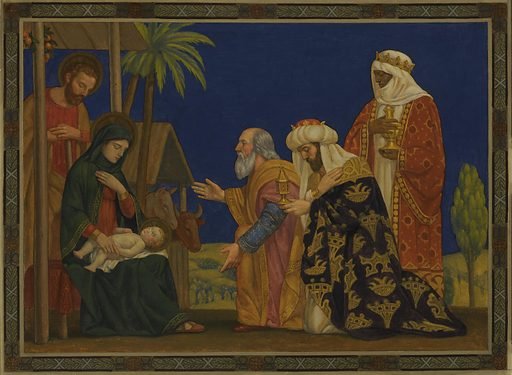
The Magi by H Siddons Mowbray, circa 1915
I am thinking about the magi today on their feast. I love these wise men from the East! There is so much mystery wrapped up in their worship that they are worthy of an entire book. If I were to write such a book, one chapter should be entitled, “The Census” for it plays an important part in their story. This short sentence from the gospel of Luke has been rolling around my head - “Now in those days a decree went out from Caesar Augustus, that a census be taken of all the inhabited earth.”
All of the Roman world was in motion when the magi set forth on their journey. They did not know about the commotion when they set out, for they were not under Caesar’s rule. Would they have been worried, I wonder, to know that the King they sought would not be “home” when they arrived? I suppose not, for they assumed that all Israel would be rejoicing at the wonder so clearly marked in the sky. Surely they would be celebrating.
What fills me with awe about the census are the powers at work behind the scene. Caesar thought the census was his idea. He was flexing his muscle, puffing up his ego. With one word from his mouth, all the citizens of his realm were up-ended. Both the mighty and the humble were forced drop their work and enroll with the officials in their ancestral home. For most, this was a mere hassle - a few hours of wasted time. For others, like Mary and Joseph, the decree was a true hardship. For a few, the trip was most certainly disastrous. Robbers took advantage of vulnerable travelers. Some probably fell ill on the road.
When Mary and Joseph arrived in Bethlehem, the city was buzzing. There was no room for them at the inn.. The crazy part of the story, I believe, is this - they were the true cause of the hubbub! God used Caesar’s ego to move the holy family. The Messiah needed to be born in Bethlehem as a sign that He was David’s heir. He had to be born in Bethlehem, so that the magi would find him there. The whole world was set in motion so that Mary and Joseph would be in Bethlehem at the proper time, yet they themselves did not know it. Mary had no idea that the child she carried was rocking the world before His arrival. I am sure she found the census as inconvenient as everyone else, until the magi arrived with their caravan!
It strikes me that the whole world has been rattled again. This time we are not in motion; rather, the we have been arrested by COVID. Certainly the Enemy has his hand in this disruption, just as Satan worked through Herod long ago. We have lost many of our elders to disease, and a tragic number youth to suicide these past two years. Others are struggling with depression or economic hardship. And yet, I believe, the LORD is in control, bringing all things to their appointed end. Everyday the return of Jesus draws closer. I cannot help but wonder if something essential has been set in place during the pandemic - something like the census of Caesar Augustus?
In times like these, when we suffer with upheaval, we must write the promise of Jeremiah 31 on our hearts. These words were written prophetically to the mothers of Bethlehem who would lose their baby boys in Herod’s rage. They acknowledge the weeping those mothers must suffer, but promise a hope beyond the grave.
This is what the Lord says:
“A voice is heard in Ramah,
Lamenting and bitter weeping.
Rachel is weeping for her children;
She refuses to be comforted for her children,
Because they are no more.”
This is what the Lord says:
“Restrain your voice from weeping
And your eyes from tears;
For your work will be rewarded,” declares the Lord,
“And they will return from the land of the enemy.
There is hope for your future,” declares the Lord,
“And your children will return to their land.
The magi did not know their visit would precipitate such suffering. They did know, however, that the King of the whole world had been born- a King who would rule in justice. He will indeed bring our children back from the land of the enemy. Let us worship Him with the magi!
Truth

I’ve been thinking lately of an Advent revelation which came upon me suddenly, like fever and chills, several years ago. I was not expecting an encounter with God as I sat in my car, stalled in holiday traffic with three kids in back. However, the Spirit blows where it will. Noah had recently turned eight years old, Peggy was five and Justus was a baby in the car seat. We were listening to an old cassette tape of Pat Boone narrating Bible stories when the Christmas story came on for the tenth time that season. Suddenly, a sob rose up in my throat.
I whirled around in my seat, face streaked with tears and locked eyes with my young children. “This is how I know it is all true! The Bible must be true. Most stories, when you have heard them a dozen times, get old and boring. But I’ve heard hundreds of times and I always learn something new. Now that I’m grown up, I cannot hear the Christmas story without crying. Do you understand?” I asked with an urgent passion in my voice.
I am not sure if, in their youth, my kids could grasp what I had just realized myself. But something gripped us all in that moment on North Lamar. Noah and Peggy looked up at me with big, solemn eyes, and replied, “Yes, we understand.”
The truth of the gospel is not merely a matter of historical fact; it is a revelation of the Godhead. Fantasy may excite the imagination, but it cannot transform the soul. Lies will damage us, shrinking our hearts and minds. But Truth is found in the Person of Christ, and we will never plumb its depth.
My Golden Pink Dog

Each morning in the early light, when the grass is wet with dew
My pup and I go walking.
It is a solemn ritual we share
Securing the land together.
Oslo clears the way with fearsome growls
I follow quietly in prayer.
My protector is mighty beast, rippled with sinewy strength.
Valiant in his canine dreams, though skittish and untested.
This morning he sniffed danger.
His snowy white hair stood straight.
He froze in silent tension, waiting for his foe.
The sun laughed at his posturing
Painting his white coat pink, rimming his ears in gold
Like a unicorn from ancient tales,
Or perhaps as a harbinger of a coming age
When all God’s colors shall clothe the creatures of a new and peaceable world.
Abraham's Call

James Tissot, God’s Promises to Abraham
I have not posted in awhile. Ironically, that means I have been writing. When I am working on my books, time for other writing is scarce. Recently, however, I gave a sermon at Hope Chapel from my book about Abraham. I opened with an excerpt from the first chapter which seems suitable for a blog, so here it is. Perhaps I will post other excerpts from the books in coming weeks.
A voice. That was all.
Except the stars, of course, and the trees.
Creation was Your witness, but there were no books. Or rules. Or religion.
Legends, yes, of a distant past in which God walked with men. Sacrifice, perhaps, made to powers unseen. But no examples, no teachers for the man You chose.
It had to be that way in the beginning. A walk led purely by the Spirit. The beginning of salvation history as a foretaste of its end when we will have no need of teachers, for we will all know You directly.
I wonder what You saw in Abram that moved You so? That You would speak to him in human words, entrusting him with a promise dear to Your own heart? That You would seal him with Your friendship? It was something similar, I imagine, to what you saw in Mary.
Was it awe? Or humility? Longing? How do You choose those to whom You open Your thoughts? I wonder what it was like for Abram when he heard You the first time? When he realized that the One who called the universe into being was calling him? When Your voice cried out from eternity and landed in Haran upon him?
It must have been electrifying, exhilarating, terrifying, consoling all at once. Your voice is power and glory. It transcends human imagination. When we hear it, our souls are shaken. Or rather, they are plowed, laid bare and tested.
Those who hear You must respond. The choice is simple, though weighty. We will believe or we will doubt. Those who dare to believe receive an eternal seed which takes root in their souls, a seed of the same stock You gave to Abram.
You spoke to Abram many times before You released the Seed - the great Seed which You promised Eve in the garden. The Seed which would grow into Your own family tree. Before he could bear the weight of that promise, Abraham had to trust Your voice.
You are kind to Your prophets that way, introducing Yourself slowly, mindful that we humans are dust. You spoke to Moses in a burning bush before coming in a pillar of fire. You fed Elijah with ravens before lifting him to heaven in a whirlwind. You showed Jeremiah a simple tree before revealing the boiling pot of destruction.
You sent an angel to prepare Mary before You overshadowed her Yourself.
With Abram I suspect You began even more slowly, for You were doing an entirely new thing. You were choosing a people as Your witnesses on earth.
Abram knew You as Creator, as God and Judge of all. But Isaac would know you as the God of his father. And Jacob would know you as the God of Abraham and Isaac. All men afterwards would know You as the God of Abraham, Isaac and Jacob.
I am astounded at such humility, that You would choose to be known by the name of men! You love this name, I think, for You are a Father Yourself. Fatherhood is the joy from which Your action springs. It is the end for which the world was made. It is the mystery into which You called Abram and his descendants.
|
Related links:
austinhouseofprayer.org | wittenberg2017.org | georgeandhannamiley.com |