
Your Custom Text Here
The Trial - Part II
I wonder what Caiaphas was thinking when he tore his robe. What was fueling his fury?
Was it pure religious zeal? Did he see himself as the protector of God’s people, saving them from error and blasphemy which would call down the judgment of YWH?
Or had he, perhaps, ceased to believe a Messiah would really come? Was he like many of our modern seminary professors, practicing religion without a living hope?
Had he become enamored with his own power and position? Did he see a Messiah as a personal threat?
Scripture does not answer this question. All we know is that Caiaphas felt so agitated that he did not wait for a reasonable hour to question Jesus. He did not deliberate with the council about the merits of the accusations. He did not ask Jesus why He claimed to be the Messiah. He never considered the possibility that Jesus was speaking the truth. Instead he tore his priestly garments and looked on with satisfaction as the crowd jeered and humiliated the quiet man who had claimed with unnerving certainty that they would see “the Son of Man sitting at the right hand of the mighty one and coming on the clouds of heaven.”
How beautiful it is that, for all the wrong reasons, Caiaphas did the right thing! The high priest of an old covenant tore His garments before the High Priest of a new and better covenant. This was entirely right and fitting, though Caiaphas did not understand the import of his actions.
What a mysterious dance this trial is – Jesus is submissive, but He holds all authority. He is condemned, but remains the Judge. Free will and sovereignty are both in play. “The Son of Man will go just as it is written of Him. But woe to that man who betrays the Son of Man!”
I believe this dance continues until the end of the age. Evil men make real decisions which cause great suffering, but God directs history toward its climax. We are free to choose; our Messiah is determined to rescue. Our Great High Priest is with us – suffering for us, with us, even through us. He is merciful, kind and powerful. He may not intervene as quickly as we would like; but He will raise us to new life., and all the kings of this earth will bow before Him.
The Trial - Part I
This week a friend of mine wrote me a letter. Like most of my friends who do not believe in God, this man is intelligent, fun, and gracious to our family. Unlike most of my other atheist friends, he is not hesitant to engage in philosophical debate. I admire this quality of his, and I appreciated his frank explanation of why he could not believe in God. His objections are familiar to me – familiar to all of us, I suppose. “If there were really an omniscient, omnipotent God who loves people, then He would act on my behalf. He would not allow such suffering. He would not hide Himself. He would act in a way that makes sense to me.”
Though these accusations resonate with us, they are really madness. We humans cannot imagine what it is like to be eternal, omniscient, or omnipotent, much less how One with those qualities should act. Mired in our various addictions, resentments and fears, we are entirely unfit to make such judgments; but we hurt, and so we beat our fists against the God we hold responsible for our pain. Even we Christians do this at times. We may not doubt the existence of God, but we don’t trust Him fully; we are not always convinced in the deepest part of our being that He is altogether good.
But He is good, and humble and patient. I am awed thinking of Jesus, the one in Whom all creation holds together, standing trial before miserable, proud men. He stands in silence, speaking nothing of His miracles. He calls no character witnesses. He issues no threats. He simply confesses to the charge brought against Him. He is the Christ, the Son of God, and that is the reason we hate Him.
We blame Him for our misery. We hate Him because we do not understand Him. We judge Him because our vision is so small. We are like little children screaming at our father, pouring out the violence of our anger and pain.
Thankfully, God is a Father who loves us more than we dare believe. In sending His Son to walk through the Passion, He takes responsibility for all that was lost in our fall – all the pain and death, all the hostility between brothers, all the futility of the earth, even the accusations we hold against Him. Jesus bears it all. He understands our pain and He cares enough to enter it. He will open all things to His Beloved, and we will “be like Him when we see Him as He is.”
I am no better than Pilate or Caiaphas or my atheist friend. I have accused God more than once. I have threatened to leave Jesus if He did not explain certain things to me – things far beyond my ability to understand. Jesus has treated me the same way He treated His accusers in Jerusalem, with silent patience, allowing me to pour out all my doubt and pain until I could say with Peter, “Where would I go, Lord? You have the words of eternal life.” Blessed be His name!
The Humility of Fear
As I have mentioned before, meditating on the Christ's Passion has been hard for me in the past. Not that I did not love my Lord, or was not thankful for His sacrifice. I simply could not imagine how to relate to Him in such pain. Like the disciples at Gethsamane, I did not know how to remain with Jesus in His suffering, much less how to offer any comfort. Yet is is clear that Christ wanted His disciples near Him at Gethsamene. He longed for their prayers.
A few days ago I was visiting my friends among the Marienschwestern at their cloister in Darmstadt, Germany. I mentioned to the sisters how odd it has always seemed to me that Paul prays first that He will know Christ in the power of His resurrection and then in fellowship of his suffering. That is, of course, not the order in which Jesus experienced them. But Sr. Damiana explained to me that we disciples must learn in this order. Without the assurance of the resurrection, we would have no strength for the suffering. Peter, James and John could not participate in their Lord's suffering on the night of His betrayal. But later, knowing Him in His resurrected power and glory, they would follow Him through persecution, exile and martyrdom.
I told the sisters of my desire to spend this Lent meditating on the Passion, so they gave me a book written by their foundress, Basilea Schlink. Let me Stand at Your Side is a series of meditations and prayers, many based on revelations given to a Catholic mystic, Anna Katharina Emmerich. The first meditation touched me deeply. It is too long to quote fully, but below are some passages which I am contemplating in prayer.
In those last days it must have been immeasurably hard for our Lord Jesus to be in such close company with His disciples who had always been at His side. Jesus' heart was filled with suffering. He lived wholly in that which awaited Him and which constantly confronted His soul - His path of bitter suffering that would lead to death. He yearned to speak with His disciples about the coming suffering in His tender care for them, but also in His love, for love longs to share everything - especially sorrow - with the beloved. However, Jesus found no loving response, no understanding. He found no one to suffer with Him.
The disciples, though no doubt full of fear, were sure of themselves. This is what made Peter vow shortly before they went to Gethsamane, "I will go with You even if I have to die.".... Ultimately they repressed the thought that Jesus' work could soon lie in ruins...
In contrast to this self-assurance of the disciples, Jesus was filled with trepidation, as He expressed to them, "My soul is exceedingly sorrowful, even unto death." Jesus, the Creator of all worlds, did not live in self-assurance; He was filled with fear at the thought of suffering. Earlier when He had spoken of the baptism of suffering that awaited Him, He said, "How great is my distress till it is over!" Thus Jesus prepared to meet suffering by surrendering His will to the Father, by praying for strength, whereas we, who are mere created beings and sinners, suppress the possibility that suffering could enter our lives...
The distance that separated the disciples from Jesus was immeasurable, although outwardly they were at His side. Jesus wanted to do the will of the Father and He gave His consent. He prayed for help and received the ministry of angels.. The disciples refused the cross: their answer was NO.
Jesus the Door

This glowing cloud in the sky was the climax of a spectacular light show one evening here at CTR. It reminded us of the "door standing open in heaven" which John saw in Revelation. Sadly, we could not pass through this door. Someday we shall see what John saw.
As a young girl I was fascinated by storybook pictures of castles. Long corridors with rows of doors, secret passageways and locked rooms excited my imagination. They felt mysterious and foreign. Houses in my small West Texas town were simple – front door, back door, a couple of rooms in each home. Even so, I loved going new places and wondering what secrets might lie behind a closed door. Though I was too polite to try them, I badly wanted to open them all.
Only recently has it occurred to me that my fascination with doors is rooted in divine mystery. My Savior is a Door, and a Door to endless revelation. Jesus Himself said so. “I am the Door; if anyone enters through Me, he will be saved, and will go in and out and find pasture.” (John 10:9) In the same passage Jesus calls Himself the Doorkeeper and the Good Shepherd as well. I am sure this made John’s head spin, even as mine does when I contemplate Jesus as King and Servant, God and Man, Bridegroom and Judge. But surely He is all of these and more.
Jesus is the Door of reconciliation to the Father. In parables He teaches us the nature of the Father. In prayer He shows us how to draw near to the Father. In His death and Resurrection He proves the depth of the Father’s love. On the evening of His betrayal, Jesus tells the disciples, “He who has seen Me has seen the Father.”
Now if Jesus is the Door to the Father, He is an unending door, always opening new rooms, new mysteries, new revelations of the Father who is glory without end. John experiences this truth on the Island of Patmos when once again His Savior appears to him. John hears a voice like a trumpet, a voice we are told belongs to Jesus, and the voice tells him to look into heaven where a door stands open. (Rev. 1:10. Rev. 4:1) This door reveals the Father in a glory John has never seen – shining like sardius and jasper with peals of thunder and lightning flashes around His throne, encircled by the rainbow, a sea of crystal at His feet. This door is no humble sheep gate!
Yet the Alpha and Omega, the Firstborn of the Dead, is always the Good Shepherd. As John looks through the open door in heaven he sees, “a great multitude from every tribe and nation and tongue, clothed in white robes, standing before the Lamb.” I am sure this vision recalled to John's mind words that Jesus had spoken early in his his life. “I have other sheep which are not of this fold; I must bring them also; they will hear My voice and become one flock with one shepherd.” I cannot imagine how Jesus’ Jewish audience understood these words, but I am sure it was puzzling. Even today we Christians stumble over these words. We find sheep from different folds a bit off-putting with their strange language, odd worship, doctrines which feel unbalanced or misguided in places.
But as Jesus is the Door to the Father, He is also the Door to our unity. He is the Shepherd of a vast and varied flock. Jesus knows His sheep even as the Father knows Him. And true sheep know the Shepherd’s voice. They recognize His voice in other sheep, even sheep of a different flock. True sheep always follow their Master, and they share in the love which binds the Father to the Son, the Shepherd to His sheep.
Jesus, we ask You to continue opening doors of revelation of the Father. And we pray for You to make us one flock under one Shepherd.
Suscipe
When I pray these days I often see the Son before His incarnation. I see Him standing before the Father in glory, "Light from Light, true God from true God." He stands and offers Himself as a living sacrifice for men. The Father receives the gift and strips His Only Begotten of all that is rightly His - His glory, His power, even His memory, His intellect, His will. The Father reduces the Son to a single biological cell and entrusts that cell to a defenseless girl and her betrothed husband.
I see the baby with Mary and Joseph in the Temple. The Father looks down in watchful protection, joyfully proud, loving all who bless His Son. The Spirit hovers around the infant, stirring friends of God to see and rejoice. The Holy Trinity is present, though in a different form than it has ever known. The Father will take responsibility; the Spirit will lead. But the Son, for now, is oblivious, helpless, completely dependent on earthly men whom He does not know, and the Father whom He has forgotten. Surely the Incarnation was a kind of death within the Trinity.
Jesus did become like us, more than I have dared to consider. Being born in the flesh, I imagine that Jesus came to know the Father in ways not so different from the ways in which we come to know the Father - more purely, more perfectly, but in keeping with His nature as a man. "Growing in wisdom and stature" Jesus' intellect and will developed over time. Perhaps the Spirit even graced Jesus with memories of the "glory He shared with the Father before the world began." (John 17:5) Scripture is quiet on this point. However, we know that by the age of twelve Jesus had discovered something of His identity. He had learned to trust the Father to the extent that He was unafraid of losing Mary and Joseph. The Son's love had been awakened and this restoration must have been something like a resurrection for the Trinity - the joy of the fellowship of the Godhead returning, not yet in its fullness, but with solid hope for the future. God’s "wisdom in a mystery, the hidden wisdom which God predestined before the ages to our glory" was coming to fruition.
As Jesus came to know the Father more fully, He grew in confidence in His unique identity. The Son's identity held the key to His power and authority; thus it become the target of Satan's attack. "If you are the Son of God...." the devil prodded, "then you can....." I believe this was a real test for Jesus, just as our identity in Christ is a continual battleground for us.
But there was one more test to come; yet another stripping of the Son. This stripping was also voluntary, though it did not appear so to our eyes. This stripping came at the hands of cruel, violent men rather than the hands of a loving Father. But it was endured for the Father Jesus had come to know and trust, and for the men whom He had come to love. Having once surrendered Himself to the helplessness and forgetfulness of the womb, the Son again surrendered His will, His power, His intellect, His life and embraced the tomb.
There is a daring prayer written by Ignatius Loyola which I have always wanted to pray wholeheartedly, but it just seemed beyond my ability, and in some ways puzzling. The prayer is known as the Suscipe after its first word in Latin.
Take Lord, and receive all my liberty, my memory, my understanding, and my entire will, all that I have and possess. Thou hast given all to me. To Thee, O lord, I return it. All is Thine, dispose of it wholly according to Thy will. Give me Thy love and thy grace, for this is sufficient for me.
As I consider these words now, I realize that this is the prayer which Jesus lived at the Incarnation and once again at the Passion. He gave the Father, whom He knew could be trusted, all His liberty, His memory, His understanding and His entire will. That fills me with wonder and hope, for the Father loves me too, and the more I come to know this, the more closely I can follow Jesus. Even if I should lose my memory of my Lord, He will never forget me Jesus knows His sheep as the Father knows the Son. (John 10:15) I can trust Him as He trusted the Father. He is the Good Shepherd who never leads where He has not walked before.
And so, Father, I ask you...
Suscipe, Domine, universam mean libertatem
Accipe memoriam, intellectum atque voluntatem omnem.
The Wisdom of John Bosco

Cristo Rey youth with Sr. Guadalupe on a mission trip to Laredo. Jack and Yolanda are on the far right. There are some Cogdells in the picture as well.
Seventeen years ago I met the Salesian sisters - nuns who became heroes of the faith to me. Their order is named after St. Francis de Sales (one of my favorite writers), but it was founded by St. John Bosco who lived in Italy during the mid-nineteenth century when the industrial revolution was in full swing. During that time, the economy was changing rapidly and farmers were finding it hard to make a living. Rumor had it that there were factory jobs in the cities, so many starving rural families packed up their boys, some as young as nine or ten years old, and put them on trains in hopes that they could make their own way in the new urban world.
Or course, unparented children do not fare well in cities. Many of them landed in jail. Fr. Bosco was moved by the plight of these street children and began ministering to them through magic shows followed by snacks and homilies. Later he founded oratories which would house and feed the boys who continued to work in town. Eventually he founded an order devoted to youth ministry.
Modern Salesians continue to use the pattern set by their founder - play, food, preaching and prayer. When I first began attending youth meetings at Cristo Rey, I was surprised and puzzled by how much time was devoted to games - simple games like musical chairs and Simon Says. I would have never dreamed of asking burly 18 year old young men, some of them with criminal records, to play musical chairs, but to my amazement Sr. Guadalupe pulled it off week after week. At first I attributed our youth's compliance to the power of the habit. Who could refuse Sr. Guadalupe anything? She was so kind, so lovely, glowing with holy happiness - and she was a nun. Catholics respected nuns, I thought, so that must be the answer.
But I was wrong. There was a deeper wisdom at work, one born of the Holy Spirit. I began to realize this on a confirmation retreat, a weekend in which we had much more time together than at our weekly youth meeting. So what did we do? We played games for two full hours. Played until these teens were rolling on the floor laughing. Played until I was tired and confused. Didn't we have an agenda to cover?
Then Jack, one of our leaders, quieted the group and led us in a reflective exercise of healing prayer. These same teens who were running and laughing minutes ago were now weeping holy tears. It was beautiful
That evening I understood the wisdom of the Salesians. We first experience the Father heart of God through joy. Fun and laughter, chasing and rough-housing - these are ways fathers show affection for their children. This kind of safe, playful love was sorely missing in the lives of this group of teens, many of whom had no fathers at home. Play opened the doors of their hearts to receive their heavenly Father's love.
Reflecting back on my experience with the Cristo Rey youth, I am certain most of them have forgotten the homilies and prayers. I am equally certain that most of them remember the wonderful feeling of laughing and being safe in a group. And I pray that those memories serve as a rock, a stepping stone, to a greater experience of the Father's love.
Today is the feast of St. John Bosco. On this day I always thank my Father in heaven for Sr. Gaudalupe, Sr. Emma, for Jack and Yolanda, for the wonderful youth I met at Cristo Rey. I learned so much from them! So much from John Bosco.
Mostly, I thank you, Father, for your joyful, playful love!
Broken Heart of God
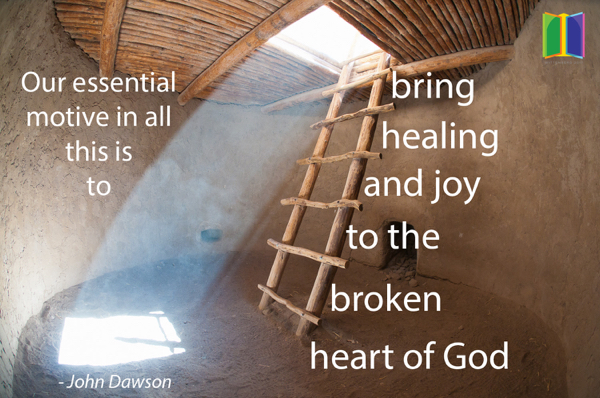
Photo credit: Michael Clark, Copyright 2011 Michael Clark Photography, used with permission, http://www.michaelclarkphoto.com
Quotation source: John Dawson, What Christians Should Know About Reconciliation
Recently we received a response to this Door of the Day on our Wittenberg 2017 website. The sister who wrote objected to the phrase "the broken heart of God." She rightly pointed out that nothing in God is broken. He is all wise, all powerful and works everything according to His will. Suggesting that His heart was broken seemed to imply to her some deficit in Him and His authority. This is a valid concern worthy of a response. Below is a copy of the reply I sent to her.
Dear __________,
Thank you for your thoughtful response. I will try to give an explanation of the thought behind this quote while acknowledging that we "all see through a mirror dimly" the glory of God. This response will have its weaknesses, but I offer it for your consideration.
We absolutely agree that God is holy and sovereign and wise. In this sense there is nothing broken in Him. Yet there is something very broken in us, and inasmuch as He longs for us to be in union with Him, this brokenness which prevents that union with Him and with one another causes longing and even grief in His heart.
We can see this longing in many scriptures. In Matthew 23:37 Jesus laments over Jerusalem. "Jerusalem, Jerusalem, who kills the prophets and stones those who are sent to her! How often I wanted to gather your children together, the way a hen gathers her chicks under her wings, and you were unwilling."
There are many passages in the Old Testament where God speaks as a forsaken lover. The whole book of Hosea is a metaphor for God's grieving heart for an adulterous bride. The second chapter of Jeremiah takes up this yearning, sorrowful love. "I remember concerning you the devotion of your youth, the love of your betrothals, your following after Me in the wilderness,......What injustice did your fathers find in Me, That they went far from Me and walked after emptiness and became empty?"
Many other scripture speak of God's desires (that none should perish), His anger, His wrath, His mercy, and even His gratitude and joy when people believe and respond with faith.
We believe that God is an emotional being - not controlled by His passions, certainly - but full of longing and joy, just anger, sorrow and love. We believe that we experience emotions because we are created in His image. Yes, we are weak and tossed about in our emotions in ways that God is not. But there is also something very good and right about our yearning, our sorrow, our joy and hope which resides in the image of God stamped within us.
So in the Wittenberg 2017 initiative, we do believe that our division causes God grief. We also believe that He is sovereign and will bring about the unity which He desires for His people. We wait in this tension in the place of prayer.
Thank you again for your response. May God our Father bless you!
If anyone reading is interested in receiving Door of the Day quotes, you can sign up at http://www.wittenberg2017.us/door-of-the-day.html
We are almost half way through our 500 day countdown to Nov. 1!
Thorns
Then to Adam He said, “Because you have listened to the voice of your wife, and have eaten from the tree about which I commanded you, saying, ‘You shall not eat from it; Cursed is the ground because of you; in toil you will eat of it all the days of your life. Both thorns and thistles it shall grow for you."
Though I have often heard how fruitful it is to meditate on the wounds of Christ, until very recently found that practice difficult. The horror of the Passion overwhelmed me, saddened me, frightened me. But something has changed of late which allows me to look on my crucified Lord with new eyes. In my last post I talked about the nails in Jesus' hands. Now I am seeing the crown of thorns. Another type of piercing painful to the body, yes; but this torment was aimed at the soul. The men who fashioned the crown were mockers taunting Jesus' for His claim to be king, or rather, for His refusal to deny that title.
Perhaps there was an even deeper mockery going on, one inspired from hell. There was one present at the crucifixion who was present in the garden, a witness to the curse of Adam and the ground. I am sure Satan reveled to see the Son of God crowned with thorns - a reminder of the Father's judgment and his own first victory with men.
But I believe Jesus saw the crown of thorns differently. He came with the intention of bearing and breaking the curse, and so the thorns were a fitting symbol. The crown was a visible sign of humility, of love, and in a way obscured to our jeering, disbelieving eyes, it was a sign of authority. The crown on Christ’s head testifies to His redemption of the earth, just as His wounds witness His power over death.
Adrienne von Speyr was an early twentieth century mystic and Catholic theologian who claimed that the most defining attribute of the Father is that He is the one who takes responsibility. He created all things. He sustains them. And because He fathers men, He refuses to abandon them to their own fate but plans a means of redemption at His own cost. He inflicts the curse in His righteous judgment, and in so doing, puts limits on our folly. But He sends His Son to bear the curse with us and for us – limiting our pain and opening the tree of life again, only more gloriously as we now known the depth of God’s love.
The funny thing about mockers is that they cannot stand to be mocked. Satan delights in our fear, in our anger, in our hate, but he cannot stand to be laughed at. Silence unsettles him as well. I suspect hell would have enjoyed the crucifixion far more had Jesus spat and cursed and called down fire from heaven. But He did not. Jesus suffered in silence, in patience, in confidence.
I fear that for all our talk about becoming Christ-like, most Christians resemble the devil more than their Savior when faced with mocking. We hate it. We fear it, and with some justification. It is true that mockery usually precedes persecution. This was the pattern for Jesus. Mocking at the trial, death at the cross.
This was the pattern in Nazi Germany. Years of defamatory propaganda fueled the fires of Kristalnacht. Our friend Hanna Miley remembers being taunted at school. She and other Jewish children were put in the middle of a circle while their Gentile classmates danced round singing songs about killing ugly, stupid Jews. Shortly after, her family was rounded up and forced into a ghetto in Cologne. Thankfully, Hanna escaped on a Kindertransport rescue train. Her parents did not.
For the most part, American Christians have not suffered the sting of mockery or persecution. There have been some shining exceptions – the early abolitionists, the pioneers of the civil rights movement. But in general, American has been a safe-haven of religious freedom and that is a blessed thing – a gift to us citizens and a blessing to the world. Yet many of us feel the tide turning. Academia has long been a skeptic of faith, if not an outright mocker. Our entertainment industry daily serves up fare pushing traditional standards of decency farther and farther to the fringes of society, and they do so because we eat it up, Christians included. Now we begin to hear outright attacks on traditional Christian teaching regarding sexuality, beliefs held by most civilizations for millennia, not only Judeo-Christian societies.
I feel the fear rising. We try to fight back with legislation. Others rant on social media. We do not like to be mocked. We are not comfortable with silence. And not all of us should be silent. There is always need for the prophet. But I believe there is also need for patient enduring, even suffering in confidence that our Father will make all things right.
As a child I loved the beatitudes. I spent a lot of time imagining what it must be like to be pure in heart, to be a peacemaker, to be meek or poor in spirit. But there was one beatitude which scared me. “Blessed are you when people insult you, persecute you and falsely say all kinds of evil against you because of me. Rejoice and be glad, because great is your reward in heaven!” On the one hand, I was relieved that it seemed unlikely that I would ever be put to such a test. I simply did not know if I had that kind of strength. On the other hand, I wanted all the blessings and rewards in heaven I could carry. That is a childlikeness which I hope pleases the Father. I still want that desire to mark me though I am now wiser and more aware of my own weakness.
Jesus, you are beautiful in Your crown of thorns, and I want to be like You.
Iron
"Oh mad lover! It was not enough for You to take on our humanity; You had to die as well!" - St. Catherine of Siena
Lately when I pray I often see the nails in Jesus' hands. It is not a gory, bloody scene. What strikes me most in this internal vision is His patience and humility. His willingness, His love.
And I know that the One who allowed his body hands to be pierced with iron is entirely trustworthy to wield the rod of iron that will shatter the nations.
Come, Lord Jesus! We need Your mercy and Your justice!
Advent Howling
My favorite family traditions are the ones that spring up spontaneously – moments so perfect that they must be relived, remembered, revisited each year. We have a few such traditions unique to the Cogdell family. One of my favorites is associated with Advent evening prayer. It is better experienced than described. You are all invited to join us for prayer to see for yourselves. Here I will simply say there is some howling involved.
A couple of months ago I received this wonderful short story from my Austrian friend Maria Lang who spent a month in Israel this summer praying. Now every evening during prayer, I find myself recalling this story and joining in the howl.
A very funny detail about my trips to Israel is that each time I live close to animals usually associated with Africa. On the first trip, I lived close to a zoo and could even hear the lions roar nearby. Now on the second trip, I live on top of Mount Carmel, surrounded by forests and bushland. There I experience a very strange ritual every evening.
In the beginning I did not quite know what it was.
When the sun is down, all of a sudden strange cries can be heard. They sound like cheering voices that become gradually louder, until they turn into a howling sound. It sends shivers down my spine. First I thought: “Is there a celebration going on?” When the same thing happened on the second and third night, I thought: “Well, they can’t celebrate like this every night.” So I asked somebody what it was all about. “Oh, these are not people! These are the koyotes – and maybe some hyena!”, they explained and laughed.
How strange! I have never heard a sound like that! During the first week it made me feel kind of uneasy to be surrounded by so many of these strange wild creatures. I did not want to go out of the house when it got dark. But I got used to it and people assured me that the koyotes were not dangerous. From time to time I even spotted one during the day. They looked like small, fox-like dogs and seemed to be very shy.
On one of my walks I found a really nice path which I decided to use for jogging. It was so good to get away from people sometimes and be out in nature. One evening, I went jogging, being aware that the sun was about to go down. But I longed to get some exercise. I had taken my torch with me, just in case it got really dark. The full moon shone its pale light down. It was kind of spooky and I thought: “The only thing that is missing now would be the koyote’s howling…” Thought it, and there it was. All around me the koyotes started to lift their voices. Although I could not see them, I knew that they were quite near. But I also knew that God was with me. This gave me the courage I needed.
One moment I thought of running back as fast as I could. But then I decided to stop for a minute and join the chorus. I howled as loud as I could, receiving answers from all around me. The thought crossed my mind that it was like a worship song of some sort…May all creatures praise their maker! Then I lit my torch and marched back to my house.
In my bible I even found a passage saying: "The wild animals honor me,
the jackals and the owls,..." (Isiah 43:20)
When I hear it now every evening again, I love the idea that the koyotes are having their worship time… I am grateful that God has taken away my fear and given me a totally new perspective.
Job and Peter
Recently my son Noah commented that I hadn’t posted anything on my blog for awhile. Frankly, I was flattered. I didn’t know my kids read my blog.
I told him that I had, in fact, been writing, but my thoughts were still in process.
He responded, “Then you mean you are journaling.”
“Not exactly,” I replied.
“Well, then what are you doing?”
The answer is that I have been readinga lot of scripture and pondering – mystery, redemption, mercy, suffering and the “manifold wisdom of God.” And in this pondering, two saints have become dear to me - Peter and Job.
I am fascinated by the opening scene of Job.
Now there was a day when the sons of God came to present themselves before the Lord, and Satan also came among them…. The Lord said to Satan, “Have you considered My servant Job? For there is no one like him on the earth, a blameless and upright man, fearing God and turning away from evil.” Then Satan answered the Lord, “Does Job fear God for nothing? Have You not made a hedge about him and his house and all that he has, on every side? You have blessed the work of his hands, and his possessions have increased in the land. But put forth Your hand now and touch all that he has; he will surely curse You to Your face.”
As Christians, we know there are more things on heaven and earth than we can see with our mortal eyes. We know there is a spiritual realm filled with creatures different from us.
For by Him all things were created, both in the heavens and on earth, visible and invisible, whether thrones or dominions or rulers or authorities—all things have been created through Him and for Him. He is before all things, and in Him all things hold together. (Col 1)
But we don’t know much about these spiritual beings. In the Father’s great wisdom, much is still veiled to our eyes. We do know these beings are strong and glorious, numerous and diverse. And they are not all friendly to men.
And there was war in heaven, Michael and his angels waging war with the dragon. The dragon and his angels waged war, and they were not strong enough, and there was no longer a place found for them in heaven. And the great dragon was thrown down, the serpent of old who is called the devil and Satan, who deceives the whole world; he was thrown down to the earth, and his angels were thrown down with him. (Rev. 12)
It is unsettling to think that powerful spiritual beings hate us simply because the Father loves us. Because they, perhaps more than we, have an inkling of the gloryset before us, they are at war against the God’s design, wanting us to fall just as they did. But the Father has a plan, a mystery to reveal, something the angels have never seen or imagined, and so He replies to Satan concerning Job….
“Behold, he is in your power, only spare his life.”
Job suffered, and he questioned, and he complained, but did not curse God. Instead, through, the Holy Spirit, he prophesied of the mystery to come – a Savior, who was both God and man.
“For God is not merely human like me;
there is no answer that I could give him
if we were to come together in court.
There is no arbitrator between us
who could lay his hand on us both…
“Oh that my words were written!
Oh that they were inscribed in a book!
“That with an iron stylus and lead
They were engraved in the rock forever!
“As for me, I know that my Redeemer lives,
And at the last He will take His stand on the earth.
“Even after my skin is destroyed,
Yet from my flesh I shall see God;
Whom I myself shall behold,
And whom my eyes will see and not another.
And when Job spoke these words, the Father rejoiced for this was the hidden mystery -the great risk that God took with men. Unlike the fallen angels, men could be won back. They could be redeemed! The love of a Savior, in flesh like theirs, could fill them with the love of God. And they could come to love like God - even in weakness, even in suffering, even in failure. Though the glory of God was hidden from their eyes, they would love Him. Though they knew only a fraction of what the angels knew – they would bear His image. This love which sees only in part, this love which suffers and endures, this love which brings sinners to repentance, this love which embraces the mercy Lucifer rejected – this love brings God joy and glory in the heavenlies. It reveals His manifold wisdom.
Yet we do speak wisdom among those who are mature; a wisdom, however, not of this age nor of the rulers of this age, who are passing away; but we speak God’s wisdom in a mystery, the hidden wisdom which God predestined before the ages to our glory; the wisdom which none of the rulers of this age has understood; for if they had understood it they would not have crucified the Lord of glory. (I Cor 2)
Jesus was also tempted by Satan – with physical suffering and mental trials.
Satan demanded to “sift Peter like wheat,” and the Father permitted it. I believe the devil gloated in victory because the battle with Peter seemed easy. Peter denied Jesus. He betrayed God in flesh, as Lucifer had betrayed God in glory. But the story was not over.
God’s manifold wisdom was still hidden in the cross, waiting to be revealed in the resurrection
For men, mercy could triumph over judgment. So the resurrected Jesus went looking for Peter.
“Peter, do you love me?” Jesus asked.
“Lord, you know that I love you,” Peter replied.
“Peter, do you love me?” Jesus asked again.
“Lord, you know that I love you,” Peter replied.
One last time Jesus asked. The question grieved Peter, but he responded. “Lord, you know all things. You know that I love you!”
And the Father, Son and Spirit rejoiced ! Peter testified three times in the court of heaven, in the ears of the Accuser – love stronger than sin, stronger than despair. Mercy embraced and man saved from the dominion of Satan. The redemption of a Bride! A Bride who could return the love of her Bridegroom. A bride who, for the joy set before her, could suffer like her Savior.
Heaven’s economy is truly not like our own. The Father and Son receive as much glory through faithful suffering as through great exploits. It is never man who works a miracle, always God through the faith of a man. But is always the choice of man to love or to despair.
In this you greatly rejoice, even though now for a little while, if necessary, you have been distressed by various trials, so that the proof of your faith, being more precious than gold which is perishable, even though tested by fire, may be found to result in praise and glory and honor at the revelation of Jesus Christ; and though you have not seen Him, you love Him, and though you do not see Him now, but believe in Him, you greatly rejoice with joy inexpressible and full of glory, (I Peter 1)
When a man leaves his home to wander in the desert because of faith – this glorifies God in the heavenlies. When people believe the promises of God, despite all worldly wisdom – this proves God wise. When sinners repent and embrace mercy – Satan and his minions are put to shame. When Christians love their Savior in spite of loss, illness, depression or grief, this love is treasured in heaven.
And God will by no means let these sufferings go unrewarded.
“Things which eye has not seen and ear has not heard,
And which have not entered the heart of man,
All that God has prepared for those who love Him.” (I Cor 2)
A Lesson from my Daughter

Clara introduces Martin Luther to a water fairy.
Last week my thirteen-year-old son John, my four-year-old daughter Clara and I were praying together in our prayer room. We were using the Divine Mercy Chaplet, a set of prayers said with rosary beads. The heart of the Divine Mercy chaplet is this petition addressed to the Father - "For the sake of His sorrowful passion, have mercy on us and on the whole world." We modify the prayer a bit in our family, addressing Jesus and asking His mercy upon specific individuals. It is an excellent way to pray for 50 people, and at the end of each chaplet, we realize how many friends, family members, and others are still left on our hearts.
We went around the circle a few times - John, then Clara, then I - lifting names up to the Lord. When we came to Clara the third time, she paused. "This one is a little strange, " she warned us. And she prayed, "For the sake of Your sorrowful passion, have mercy on God."
I was surprised and needed a moment to think. My silence made Clara self-conscious. She ran to me, wrapped her arms around my neck and cried, "Mama, I couldn't help it! I just love Him so much!"
In that moment I knew, as circular as the prayer might be, it was highly pleasing to the Trinity!
Jesus prayed for the Father's desires. " Our Father who art in heaven, hallowed be Thy name. Thy Kingdom come, Thy will be done on earth as it is in heaven."
I am not sure exactly what it would mean for Jesus to have mercy on the Father. While all contemplation of the Trinity makes my head spin, it is easier for me to conceive of the Father having mercy on the Son. But I do know that Jesus praised His Father, thanked His Father, glorified, obeyed and loved His Father. And I believe that at least part of the reason Jesus has mercy upon us is that such mercy blesses the Father.
Though I cannot wrap my little brain around my daughter's prayer, I want more of her heart. I want to consider God's desires before my own, "because I love Him so much!"
More Preschool Theology
A few months ago I was filling up the car with gas when Clara giggled in the back seat and announced, "I am thinking about those cookies!" She was referring to some cookies Thomas had brought home from a meeting the night before. I didn't think much of the comment until Clara continued, "I know I should be thinking about God, but I am thinking about the cookies."
Hmmmm.... what to say? I could not really blame a four year old for thinking about cookies. I think about them far too often myself. But then again, we should never give ourselves over to things we sense are wrong... so, since preschool self-control is limited, I suggested this course of action.
"Clara, do you think you could think about God AND the cookie."
She lit up immediately and replied, "That is a great idea! I will think about God the Father, and God the Son, and the Cookie!"
I laughed, feeling certain the Holy Spirit was not offended.
The Transfiguration
God is not a man. I know this. Yet sometimes I grow comfortable imagining God simply as the man Jesus who walked among us weak and hungry men many years ago. Yes, He is still with us. And I love Him! But Jesus is one of three persons in a Holy Trinity. And there is much more to Jesus than the meek and mild teacher.
I love the passages in scripture where Christ’s glory, His divine, uncreated nature burst through. My heart quakes when I hear Him thunder to the Pharisees, “Before Abraham was, I AM!” Since my retreat in April, I have been especially fascinated by the transfiguration and its connection to the exodus.
My Passover vision took me to the book of Exodus, which I now read in a very different light. I am riveted, captivated by the stories which once seemed distant. God the Father, Creator of all, the One who has no beginning and no end, set His affections upon the people of Israel. He fought for them. He ate with their elders. He made a covenant with them, writing the words of that covenant with His own finger. He fed them. He dwelt among them. The Israelites could see his presence in the cloud by day, in the fire by night! They heard His speak and they trembled. They saw Moses’ face shine, transfigured. And when they dedicated the tabernacle, none could stand in His presence, not even Moses.
My heart is burning to see the God that Israel knew in the desert. The God of glory, the consuming fire! The Creator of all that exists, both visible and invisible. Entirely other, unfathomable, but One who loves His people with a jealous love.
This is the glory that Jesus had from the beginning. This is the glory which He prays to the Father just before His passion that His disciples might see. “Father, I desire that they also, whom you have given me, may be with me where I am, to see my glory that you have given me because you loved me before the foundation of the world.” (John 17:24) And this is the glory which Peter, James and John glimpsed at the Transfiguration.
Until recently, this story in the gospels puzzled me, perhaps in the way it puzzled the disciples. Surely the scene is awesome, a scary and a sober reminder that our Savior is not like any other man. But why Moses and Elijah? And why would they come to talk to Jesus at this point in His ministry?
One problem for English readers, in my opinion, is inadequate translation. Most English versions of Luke 9:30-31 read like this. “And behold, two men were talking with him, Moses and Elijah, who appeared in glory and spoke of his departure, which he was about to accomplish at Jerusalem.” The word departure seems odd to me. I have always understood that the word refers to the coming passion and death of Jesus. Even so, it is an unusual usage of words. Departures are everyday affairs. One does not often speak of “accomplishing” a departure, one simply makes a departure.
But as I walked the beach on the morning of the Passover, I recalled that the word in Greek is “exodus.” And then what joy filled my heart! Of course, Jesus would accomplish a great exodus with his death. He would be the Passover lamb, and He would open the expanse between death and life, earth and heaven!
We know from scripture that Jesus desired to be with His close friends on the night of His passion. But He began thinking about His exodus well before that day. And as the day grew closer and began to consume His thoughts, would it not be a comfort to share this burden with friends who understood? Friends who could rejoice with Him, who could speak courage. Friends who knew Him as He really was, in His glory. Moses and Elijah had both seen Jesus in glory, before the Incarnation (or inasmuch as one can speak of “before” when one is outside the confines of time.) They were the type of friends Jesus prayed for in John 17, those who saw the glory the Father had given the Son before the foundation of the world. Peter, James and John would become those friends, and they were invited to the mountain top for a foretaste. But Moses and Elijah already knew. And as a witness to the first exodus, I believe Moses had a special interest in the exodus to come. Speaking mystically, Moses and Elijah were the reward of Jesus’ sacrifice – men who became friends of God by grace, clothed in glory, living with God.
Once again, this is just my imagination, but I believe Jesus longed to wear His glory, or a small bit of it, before entering His passion. I know the Father spoke over His Son on that mountain, and I know that the Son rejoiced in the manifest presence of His Father. Jesus loves the glory He shares with the Father and the Holy Spirit, and the promise of returning to that glory, and sharing it with the people He loves, that was the “joy set before Him.”
On the night of His passion, Jesus prayed this prayer. “ The glory that you have given me I have given to them, that they may be one even as we are one.” I find it fascinating that as often I hear John 17 taught, I rarely hear anyone address this verse. It seems to me that we Christians are understandably often focused on our brokenness. But Jesus prayed for us to have a share in His glory, that we may be one. Somehow carrying the glory of Jesus is essential to our hope of unity. It is certainly essential to our promised life in the presence of God.
How can we carry that glory unless we gaze upon it? Unless we long for a vision of Christ’s glory? Today, on the Feast of the Transfiguration, I set my internal vision toward that mountain in Israel. Toward the consuming fire on Mt. Sinai. Toward the one whose “eyes were like a flame of fire. His feet were like burnished bronze, when it has been made to glow in a furnace, and His voice was like the sound of many waters. In His right hand He held seven stars, and out of His mouth came a sharp two-edged sword; and His face was like the sun [k]shining in its strength..” (Rev. 1:14-16) And I take great hope in these other words of the Apostle John, a witness to the Transfiguration, “ Beloved, now we are children of God, and it has not appeared as yet what we will be. We know that when He appears, we will be like Him, because we will see Him just as He is.” (I John 3:2)
The Exodus - Part II
And while He was praying, the appearance of His face became different, and His clothing became white and gleaming. And behold, two men were talking with Him; and they were Moses and Elijah, who, appearing in glory, were speaking of His exodus which He was about to accomplish at Jerusalem.
I wrote recently about my vision of the Exodus on a retreat this April. The next morning, Sunday the 24th, the vision continued. This time I saw the hands of God with His fingers in the dirt. He seemed to be working on something impossibly small, and He began speaking to me like a teacher.
"Amy, Israel could not respond to my glory. My fire terrified them and they would not look Me in the face, so they never learned my emotions, they never felt My love. Instead they made idols which would not burn, gods they could touch. But still my heart longed for Israel. I still yearned for a bride. And so I did another magic trick – one which confounded the heavens.
I hid My glory in the dirt. My Son became very, very small. He took on a face so men could look at Me and learn My heart, learn My emotions, learn My ways.
How could one man accomplish an Exodus? In Egypt, a million people beheld my glory at one time. This time my Son called each person by name – each man, woman, child."
And then Jesus began speaking to me.
"I was the Passover Lamb. And I descended into hell. And I opened a path from death into life. None can shut it until My return, and whoever will may come. The Father and I are one.
I have a glorious Bride from every tribe and nation and tongue and none can deny her because I have parted the expanse between heaven and earth.
When I rose from the dead, I was full of joy because I walked in both my natures – in glory and in humanity. I ascended to the Father and received the glory which was mine. But I am a man like you, and when you see me in glory you will be like Me for you will see Me as I am.
After the Resurrection, I breathed on you, I touched you, I ate with you so you would know that I am with you always, even to the end of the age.
Grief and Intimacy - Part III
Thomas and I enjoy teaching together as we did in Wittenberg. Blogging together is another matter. I tend to speak much as I write. Thomas speaks from notes and slides which don't read easily. But his part of this teaching is by far the most practical, so I have made an effort to adapt them below.
My sense is that we in the Western Church – certainly in America – have lost the ability to grieve. This may be another consequence of separating ourselves from our Jewish roots. Our approach to pain is not grief. Instead, I think it can be summarized with two words:
Clinical – we diagnose and cut out the source of the pain, or prescribe drugs to mask the fact that the pain is there.
Cynical – we decide to become accustomed to the pain, so much so that we inflict it on others, and ridicule anyone who expresses hope of healing
In scripture, we do not see God responding to the pain of His heart, in either of these manners. He does not simply cut out the source of the pain and discard it. He never is described as masking or dulling His own pain. But God also never accepts the pain as normal.
Instead, God grieves
Jesus grieved in the gospels. Here are seven principles for grieving taken from the gospels.
1) Refuse All Comfort Except God’s
Entering into grieving opens you up for God’s comfort.
The Discipline of Lament
From Reconciling All Things by Katongole & Rice
The voice from Ramah refuses to be consoled.
These are profound words in a world full of easy
ways of consoling ourselves. Rachel’s cry refuses
to spiritualize, explain away, ignore or deny the
depth and truth of suffering in the world. She
rejects soothing words and “can’t we all just get
along” sentiments. Her refusal takes seriously the
rupture and wounds of the world as well as the
deep cost of seeking healing … Rachel allows the
truth to shake her to the very core.
Matt. 5:4
Blessed are those who mourn, because they
will be given comfort.
2) Express Your Frustration with the Power-less Church
Matthew 17:14-17
When Jesus and his disciples came down
from the mountain, they met a crowd of
people, and a man came and fell on his
knees before Jesus and said, “Lord, have
mercy on my son .He has seizures and experiences
tremendous suffering. He often falls into the
fire or into the water. I brought him to your
disciples, but they could not heal him.”
Jesus said, “You unbelieving and perverse
generation of Israel, how long will I put up
with you? Bring your son to me.”
3) Change Your Location to Draw Near to Pain
John 11:17, 33-35
When Jesus arrived at the town of Bethany, on
the Mount of Olives, Lazarus had been in the
tomb for four days ... When Jesus saw Mary and
the Jews crying, he was deeply moved in his spirit
and greatly troubled.
Jesus said to the Jews, “Where did you put
Lazarus’ body?” They said, “Lord, come. We will come. We will show you."
Jesus wept.
Jesus first drew near to grieving people, then drew near to the dead man’s tomb.
4) Imagine What Is Lost
Imagine what God intended, then meditate on what has been lost, what is currently being lost, and what will be lost because of human choices.
Luke 19:41-46
The days will come upon you when your enemies
(the Romans) will build a great battle bank against
you and surround you on every side.
They will destroy Jerusalem, down to the ground,
with you and your children within its walls.
They will not leave one stone upon another,
because you did not recognize the time of your
God’s coming to you (this prophecy came true
when the Romans attacked and destroyed
Jerusalem and the Temple in AD 70).”
5) Fast from Food
Mark 2:19-20
Jesus said to them, “The guests of the bridegroom
do not fast when he is with them. But the time
will come when the bridegroom will leave them,
and then they will begin to fast.”
Appropriate fasting can unlock grief in our hearts, because it removes one way that we comfort ourselves so that we don’t have to grieve.
6) Weep
John 16:20-22
I tell you the truth: You will cry and mourn when I
leave, but this world will rejoice. You will mourn,
but your sorrow will become joy. A woman giving birth has great pain at the time
she is giving birth, but after she gives birth she
forgets her pain because of her great joy in her
new baby.In the same way, your hearts will be filled with
sadness when I leave, but when I return your
hearts will be filled with joy, and no one will be
able to take this joy away from you.
7) Seek Companionship … & also Solitude
Mark 14:33-35
Jesus took Peter, James, and John along with him,
and he became deeply grieved and troubled.
Jesus said to them, “My soul is overcome with
sorrow to the point of death. Stay here and keep watch.”
Going a little farther away, he fell to the ground and prayed
that if possible he might not experience this time
of great suffering.
Jesus takes all of his disciples to the garden. He takes his most trusted friends further, and tells them of his condition. Then goes by himself, asking them to stay and pray.
We Westerners may need permission to enter into some of these seven activities. Jesus is giving us this permission. One reason we have abandoned the practice of grieving, is that there can also be inappropriate grieving. Jesus was aware of this Himself. He removed noise-makers from Jairus' house.
But we have lost something precious and essential when we turn away from the response of grieving, out of fear of grieving inappropriately. Jesus actually seems more concerned about inappropriate non-grieving, than inappropriate grieving.
Luke 7:31-35
Jesus said, “To what do I compare this
generation of Israel? What are they like?
They are like children sitting in the public
market and calling out to each other,
‘We played the flute for you, but you did not
dance; we sang a song of the dead for you,
but you did not mourn.’"
So, there is an appropriate time for lamenting and for weeping. But as Jesus makes clear, there is also an appropriate time for rejoicing and dancing. In fact, grieving opens our heart to joy. Without deep repentance and grief, we cannot fully enter into the joy of Christ. In our work in Wittenberg, we have a particular focus on grief over the sins of the Church which have brought division, pain and dishonor to the name of Jesus.
Paul writes, "Godly sorrow brings repentance that leads
to salvation and leaves no regret, but
worldly sorrow brings death. "2 Corinthians 7:10
I will end with a reflection on this passage written by a friend, Rabbi Jonathan Kaplan.
This experience of grief and comfort is not, for
Paul, an unnatural state … Rather, these
experiences of suffering and grief are essential
facets of reconciliation and paradigms.
Paul sees the Corinthians’ participation in this
cycle of suffering and comfort as identification
with “the sufferings of Messiah” and the
“abundant … consolation” made available through
the Messiah (2 Cor 1:5). The death and
resurrection of Jesus not only answer the grief
Paul and the Corinthians face but also enable Paul
to embrace this pain (and invite the Corinthians to
join him) in the texture of salvation that moves
from death to life.
For Paul, comfort comes as God’s work to assuage
this pain and grief. Comfort is part of the process
of reconciliation and salvation leading to the
renewed participation of the Corinthians in the
common work of Paul and the communities he
founded.
Grief and Intimacy - Part II
"It was a night of watching by the Lord, to bring them out of the land of Egypt; so this same night is a night of watching kept to the Lord by all the people of Israel throughout their generations." Ex. 12:42
Toward the end of April I went on a quiet, unstructured retreat with a dear friend of mine. I had never spent much time at the beach before. Thomas and I have always considered ourselves mountain folk. But it was surely the Lord who led me to the coast that weekend. He had something specific on His heart.
Shortly after midnight on Saturday, April 23, I woke up. “Come out on the porch,” I felt the Lord whisper.
I went outside and saw a near full moon reflected on the waves of the ocean and on the wet sand of the beach. It was beautiful and I was mesmerized. The midnight blue of the waves graced with white ribbons of moonlight took me back to a vision of colors I had experienced earlier. I had seen this same dark blue dancing with flashes of white light, and I knew it was an image of the God who made the galaxies spin – the Creator God– the God of magic! And then I heard Him whisper, “For my beloved, I part the sea.”
As I stood watching the light play on the waves, my internal vision was taken back to Egypt. I saw the terrifying pillar of fire – orange, yellow, red flames – and God was in those flames. His glance threw the Egyptian army into confusion, but His eyes burned over Israel with a jealous love.
The flames lit up the night sky. Orange light reflected on the waves. The moon was full, and it also played on the ocean as the winds began to blow. Black sky, fire, moon, wind and waves, walls of water, light reflected a million ways! And the tension. Two peoples facing off, God in visible glory standing between them.
Over a million people were gathered for the spectacle. All night long they sat in vigil, both Egyptians and Israelites. Who could have slept? It was the most glorious sight the world had ever seen – the most glorious sight it has ever seen to this very day.
It was magic show to win the heart of a bride! The Israelites were decked out in gold jewelry and purple linen. God plundered the Egyptians, because this was their wedding night and He wanted His bride dressed in glory.
I watched the beauty, the majesty of that vision for some time before returning to bed.
Around 3:30 am I felt the Holy Spirit wake me again and draw me into the living room. My friend was sitting there. The Lord has waken her as well. We sat together for awhile, and then I told her I had seen the Exodus.
"Sister," I said. "God loved Israel like a bride and she broke His heart." And then I wept hard. I wept for the heartbreak of God, the heartbreak of a rejected lover. The magic did not win Israel’s heart and she went after other gods.
I was up most of the night - talking with my friend, just sitting with her in the presence of God, waiting. Finally I went back to bed at 5:00 am, though I knew it would be a short sleep at best. The Father asked me to walk with Him on the beach at sunrise.
At 6:00 am the sky was already a gorgeous deep pink. I walked out to the surf and watched the sky as I made my way along the beach, picking up shells. The sky brightened, moving through shades of pink, peach, orange and yellow. All light seemed more alive, more beautiful than ever.
When the sun rose hot pink I stood still and let the light wash over my face. A man passed and then turned back and spoke to me.
“It is beautiful, isn’t it” he asked.
“Yes,” I replied.
“The most beautiful day of the year,” he answered.
And then it hit me. I knew what day it was, though I had not realized or thought about it before. It was the Passover! I had kept a vigil with the Father on the night of the Passover, then walked with Him on the beach at the first light of dawn, like the Israelites passed through the sea at daybreak.
When I returned to the beach house, I ran inside to read the story of the Exodus, to see if it really happened the way I saw it in the night. Scripture read exactly as I saw the vision. The winds blew all night. The light flashed all night. And the Lord called Israel to walk through the sea at the first watch of the morning.
What a precious night of grief. What a glorious hope! To feel the love, the pain, the vulnerability of the God of Israel. And still, He will have His bride!
He has set a tent for the sun, which comes out like a bridegroom leaving his chamber, and, like a strong man, runs its course with joy. Ps 19:5
Grief and Intimacy - Part I
It has been a long time since I posted anything. Much of my attention this spring was focused on the Wittenberg gathering. We are back from Germany and I hope to write more about the meeting soon. Until then I will do something unprecedented on this blog - I will post the teaching Thomas and I gave in three parts.
Part I
Sisters and brothers, I will tell you a mystery. The God who created the Universe, the Holy and Righteous One, the Eternal One who dwells in inaccessible light – this God is a Lover with strong emotions. He lives in an eternal, joyful communion of love – Father, Son and Holy Spirit. And the love of this Holy Trinity is creative, expansive - burning both to give and receive more love. So God created men. He formed us in His image – with emotions, intellect, and will. He kindled our life with His own breath. And He did this because He longs to share our love, as a Bridegroom longs for a Bride.
This mystery is too deep to fathom. It feels daring, even dangerous to believe. Yet I know this love is the deepest desire of my own heart. I know there is nothing short of this union with God which will ever satisfy. And more objectively, I must believe it to be true because scripture is full of this theme of a longing Lover.
Moses tell us - It was not because you were more in number than any other people that the Lord set his love on you and chose you, for you were the fewest of all peoples, but it is because the Lord loves you and is keeping the oath that he swore to your fathers, that the Lord has brought you out with a mighty hand and redeemed you from the house of slavery. (Deut. 7:7)
Isaiah writes – For your Maker is your husband,
the Lord of hosts is his name;
and the Holy One of Israel is your Redeemer,
the God of the whole earth he is called. (Is. 54:5)
John the Apostle says…For God so loved the world that He gave His only Son…
John the Baptist tells his disciples- He who has the bride is the bridegroom; but the friend of the bridegroom, who stands and hears him, rejoices greatly because of the bridegroom’s voice. (John 3:29)
And Jesus Himself says - Father, I desire that they also, whom You have given Me, be with Me where I am, that they may see My glory. (John 17:24)
Now here is another mystery. Love makes one vulnerable. Love makes even the Father of all vulnerable to rejection, to misunderstanding, to pain. Israel’s idolatry hurt the Father's heart. God grieved over Israel. Over and over again, the Old Testament prophets lament Israel as a harlot who has abandoned the Husband who loves her. And over and over again, through the prophets, God expresses his grief over Israel.
How the faithful city has become a harlot,
She who was full of justice!
Righteousness once lodged in her,
But now murderers. (Is. 1:21)
Can a virgin forget her ornaments,
or a bride her attire?
Yet my people have forgotten me
days without number. (Jer. 2:32)
I remember the devotion of your youth,
your love as a bride,
how you followed me in the wilderness,
in a land not sown.
Israel was holy to the Lord,…. “What wrong did your fathers find in me
that they went far from me,
and went after worthlessness, and became worthless? (Jer. 2:2,3,5)
These are painful words - the words of a God whose love has made Him vulnerable.
Certainly God understands our weakness. He knew from the beginning what His love would cost Him. Behold the Lamb of God, slain from the foundation of the world! For the joy set before Jesus endured the cross. But in order to enter into full intimacy with God, we must understand His emotions. We must grieve when He grieves and rejoices when He rejoices. This is the glorious intimacy into which we are invited – the intimacy of friendship.
Imagine the relationship between a husband and a wife. What if the wife is unfaithful? If the husband still loves her, as God still loves us, then he will take her back. But how must she respond if she loves her husband and wants to repair the marriage? Should she not feel grieved over her sin? If she is not grieved, how can the two be lovers again? How can they share their hearts, if the wife refuses to feel the husband’s pain?
Sorrow for our sins is the first step to repentance and repentance is the first step toward reconciliation. Our sorrow moves God’s heart. He is full of mercy, longing to show us grace. But we cannot experience grace and mercy if we are not grieved over our sin.
Repentance is the key to finding intimacy with God. And if we have sinned against our brothers, repentance is necessary to restore intimacy with them. Repentance is more than grief, of course. It is a change of action, of mind and heart. True repentance is a gift of grace - a gift of divine intervention. But sorrow is a catalyst to pray for that grace, and a motivator to keep our feet from straying again. Godly sorrow also opens the heart of the one who is offended, allowing them to forgive and experience grace.
But what if the source of grief is not a personal matter? What if we are not the ones directly responsible for the sin which grieves God’s heart? In these Wittenberg gatherings we spend a lot of time looking at the sins of the Church, at the tragedies of our shared history. While we all have said, done, and thought things which contribute to division among the people of God, none of us is personally responsible for the major divisions, schisms and hostility we have inherited. So why do we spend so much time in these meetings looking backwards?
The answer is that we are part of a bigger story. And if we love God, we must care about His story, about His pain, about His hopes and desires. That is how we enter into the intimacy He so desires– to share His emotions.
Through Jesus the Church has been called into the bridal relationship which God wanted from the beginning. The Church is born out of the love story which began with God and Israel. It has been grafted in. And if you look at Christian history, you see that followers of Jesus have also been unfaithful to God – through greed, through immorality, through oppression of their neighbors, through disbelief and hatred, through division. That sin continues to play out between brothers, to resurface in our story, until it is acknowledged and grieved.
If we want deep intimacy with God, and this intimacy with the Trinity is our only hope for unity among ourselves, then we need to learn to move with God’s emotions. We need to look at history the way He looks at history. We become friends of God when we grieve with Him over the things which grieve His heart and rejoice over the things which make Him rejoice. And when we enjoy this unity with God, we are in the position Jesus prays for in John 17, to love one another the way the Father loves the Son.
This is how unity among the brothers will be achieved – not by our own striving. Unity happens when we are swept up into the heart of God, when we experience His love in its fullness – the love which makes us vulnerable, the love which sometimes brings us to grief.
David's Dying Words
During Lent, in the virtual company of some friends, I read through the history books of the Old Testament. It was an enlightening experience on many counts. I had not read the Bible straight through like that since I was a teenager, and I was surprised to discover how much time and age, walking with the Lord for a few decades can change one's perspective. I hope to write more about that in future posts. This evening I will simply record the prayer which has been on my heart in recent weeks.
In reading 2 Samuel I discovered a psalm of David which is not included in the Book of Psalms.
Now these are the last words of David.
David the son of Jesse declares,
The man who was raised on high declares,
The anointed of the God of Jacob,
And the sweet psalmist of Israel,
“The Spirit of the Lord spoke by me,
And His word was on my tongue.
“The God of Israel said,
The Rock of Israel spoke to me,
‘He who rules over men righteously,
Who rules in the fear of God,
Is as the light of the morning when the sun rises,
A morning without clouds,
When the tender grass springs out of the earth,
Through sunshine after rain.’
“Truly is not my house so with God?
For He has made an everlasting covenant with me,
Ordered in all things, and secured;
For all my salvation and all my desire,
Will He not indeed make it grow?
“But the worthless, every one of them will be thrust away like thorns,
Because they cannot be taken in hand;
But the man who touches them
Must be armed with iron and the shaft of a spear,
And they will be completely burned with fire in their place.” (2 Samuel 23)
Though I am no king, I also have an everlasting covenant with the Almighty God. My place in God's heart has been secured through Christ. My salvation and all that I desire will grow, as long as I can "be taken in hand." This is my prayer - that I will be a daughter who can be taken in hand. I want to be quick to repent, pliable and teachable, with ears open to the Holy Spirit.
Lord, may I never grow thorny to Your touch!
Rome

It has been a long time since I posted anything on this blog which is a sign of activity rather than idleness. But too much activity leaves little time for reflection, or prayer. That is a problem which the Lord has recently brought forward. Today it is rainy outside, and the internet is down. The house is relatively quiet and it seems like a good time to write.
I have been neglectful in writing about Rome, remiss in a debt I owe many friends who prayed, brought meals, helped the children or gave toward the Wittenberg gatherings. I have found it difficult to speak about the gathering last October because in those meetings I experienced a quality of life in the Body of Christ which was new to me. I have nothing to compare it to, few words to describe it. I am even hesitant to share photos because some of our pictures portray a time and space which feels too holy to objectify. Though the analogy is overblown, it seems a bit like trying to describe the Transfiguration, or the walk to Emmaus. And as I say that I smile, thinking of the stark economy of the scripture writers. Really, what could they say?
I will take my cue from the gospel writers and try a simply narrative approach.
We met in Rome to lament the inability of the Catholic hierarchy to bring effective reform to the Western Church. The state of the papacy in the 1517 was deplorable on many levels, and the corruption spread outside of Rome to the many bishoprics which were bought and sold for political reasons.
But of course, corruption is never the whole story. There have always been men and women of goodwill, friends of God faithful to the end. The Catholic Church has always held treasures of grace and truth, even when those gifts have were dragged through the mud of abuse and distortion. And of course, the same is true in Protestant and Orthodox traditions.
This tension of sorrow and repentance, along with hope and beauty propelled the whole meeting. Everyone found reason to repent – for the sin of our fathers which opened doors of division and war, for misunderstanding or misjudging others, for failing to honor our fathers and mothers, for failing to honor Jesus, the King of the Jews. I wept in St. Peter’s cathedral for the gold bought with indulgences – the pride of men exalted above the good news to the poor. And my Protestant brothers wept with me, understanding that this fault exists in their traditions as well, though masked in different cultural norms.
But there was also a different kind of weeping in our meetings – one that sprang from beauty and hope too deep for words. On the Sunday of our meeting, we visited the catacombs. Sundays are always difficult in ecumenical meetings because of the problem of communion. Do Catholics and Protestants hold difference services with different communion tables? Does one group find itself excluded? Both options are painful. As a movement, we are committed to living under authority, so bending the rules is not a possiblity. In this case, the pastors among us led us back to the foundations of our faith – our baptism, the hope of the resurrection, our common confession of faith, and the call to serve one another.
When we emerged from the graves of our fathers and mothers in the faith – both martyrs and common citizens- we gathered in a chapel above ground. We worshiped in song. We renewed our baptismal promises. One of our Lutheran pastors, Henning, sprinkled us with holy water and then returned to the altar where our Catholic brother, Bishop Franziskus sprinkled him. And then eight of the pastors among us – Catholic, Lutheran, Anglican and Pentecostal – paired up and washed our feet. I cannot describe the beauty of that place in time and space. Most of these pastors were over 70 years old. Kneeling was a true sacrifice for them, and yet none of us would have denied them that sacrifice out of a false sense of humility. It was a sacred act of love for Jesus which inflamed a strong and sincere love for one another.
Many of us were in tears, but my friend Jill was completely undone. She could not speak for a long while. I doubt she will ever be able to speak of that service without tears. When she was finally able to compose herself for a few moment, she could only say something along the lines of “that was the most solid experience of beauty I have ever had.”
I find myself praying with Paul in a new substance of hope, “Now to Him who is able to do far more abundantly beyond all that we ask or think, according to the power that works within us, to Him be the glory in the church and in Christ Jesus to all generations forever and ever. Amen.”

|
Related links:
austinhouseofprayer.org | wittenberg2017.org | georgeandhannamiley.com |