
Your Custom Text Here
Our Pied Beauty
GLORY be to God for dappled things—
For skies of couple-colour as a brinded cow;
For rose-moles all in stipple upon trout that swim;
Fresh-firecoal chestnut-falls; finches’ wings;
Landscape plotted and pieced—fold, fallow, and plough;
And áll trádes, their gear and tackle and trim.
All things counter, original, spare, strange;
Whatever is fickle, freckled (who knows how?)
With swift, slow; sweet, sour; adazzle, dim;
He fathers-forth whose beauty is past change:
Praise him.
(Gerard Manley Hopkins, "Pied Beauty")
I have always had a weakness for spots, and soft fur, for animals of all kinds. I remember walking down a country road one day as a young mother. I was serving at a youth retreat, taking a few moments for myself. I was lost in thought, as I often am, aware only of the road in front of my feet. Suddenly, a large horse came up right beside me and whinnied softly in my ear. It startled me, delighted me! And I realized all at once how lonely I would feel if humans were the only inhabitants of this planet. Thanks be to God for Brother Horse and Sister Bird!
When we bought this land in Elgin we had a small dog named Greg. A Catholic dog, in fact, who had many adventures with Japanese soldiers, Roman gladiators, angels and demons - but that is another story. In real life Greg was a self-assured, dashing 9 pound rat terrier-chihuaua mix. He was a pint-sized pied beauty and we loved him. But we didn't know if he was suited to country life. We had heard rumors of coyotes and birds of prey that could carry off dogs his size. And, moreover, we were now caretakers of a retreat house. As much we as we loved Greg, we realized that he was a high energy, yappy dog - not always conducive to quiet contemplation.
Thankfully, my sister and her husband adored Greg. She volunteered, most enthusiastically, to take Greg out to Marfa while we got settled here. Greg quickly bonded and settled in to life out West. He was having new adventures in the desert, and he was well loved. When we mentioned the possibility of bringing him back, Adam cried, and we knew Greg was now his dog.
But we were feeling the loneliness that an animal fills. I wanted a hiking and gardening companion. Peggy wanted a furry friend to pet while watching late night movies. John was needing a new hero for his literary adventures. And a large piece of land just cries out for a happy canine patrol.
Our first attempt at a new dog was rather heart-breaking. We found a beautiful terrier at the Bastrop animal shelter who looked just like Greg, only two sizes bigger. Joy seemed shy and quiet, gentle - the kind of dog a retreat center needed. But we were naive, ignorant. We mistook her quietness for peace, when really it was terror. When we first took her outside on a leash, she bolted - pulling the leash right out of our stunned son's hand. We chased. We called. Our neighbors joined in the hunt. Friends stayed until it was too dark to see. But Joy would let no one near.

We spotted Joy several times in the next few days. And though we felt terrible about losing her, and we worried about her well-being, it gave me some pleasure to see her running free with her tail up - so unlike the cowering dog at the pound. She at least had an outlet for her fear. She could run, and she did.
I think that sometimes, when we are too afraid to be touched, God also lets us run. Run off our energy, our fear, until we are exhausted. Until we can no longer resist the love which heals. "O Jerusalem, Jerusalem... How I often would have gathered your children together, as a hen gathers her chicks under her wing, but you were not willing."
Joy would not be caught. We still set out food for her and keep our eye out. We would love for her to allow us close. But she does not trust humans.
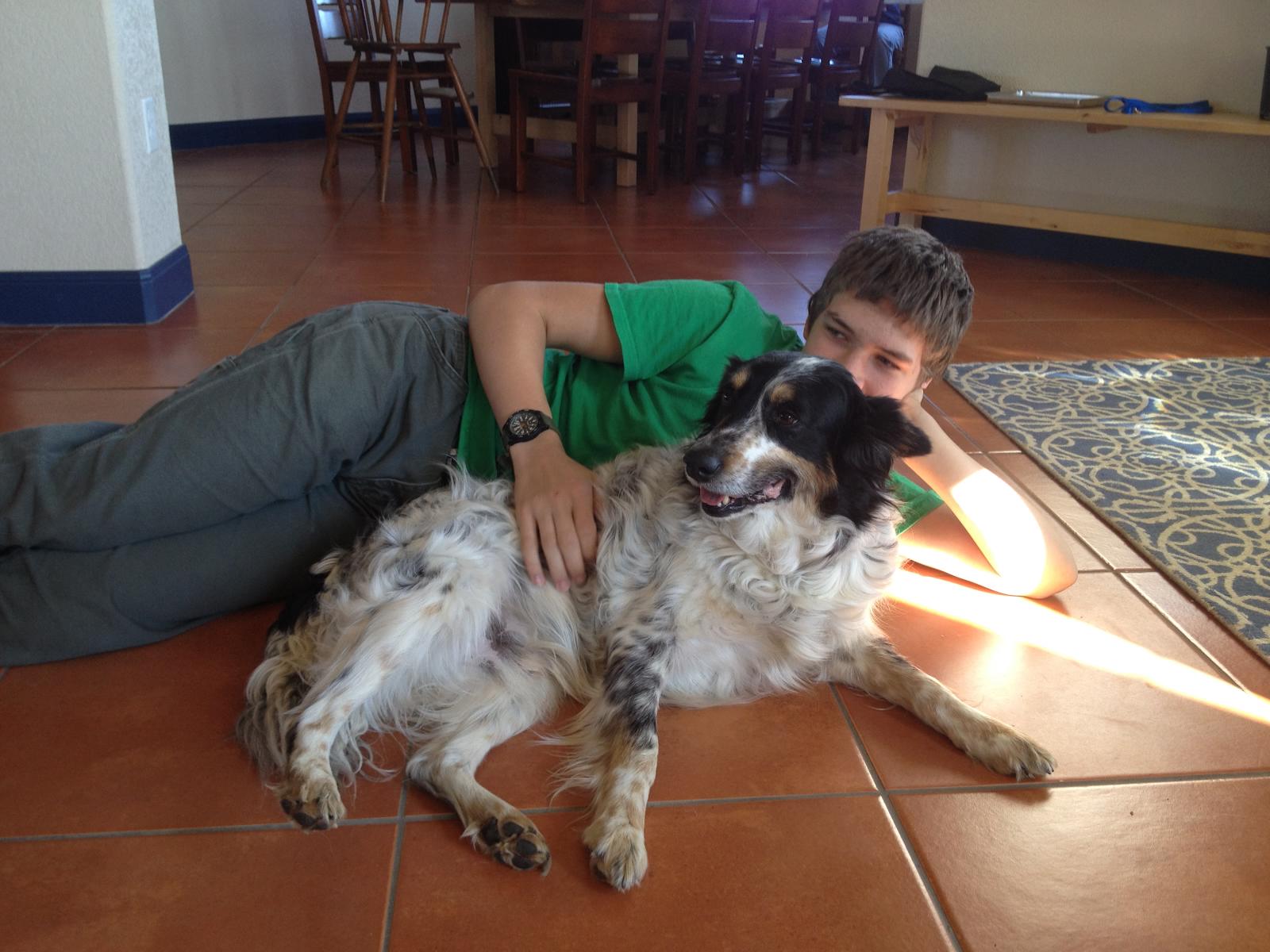
Murphy is an entirely different animal. He was a well-loved companion dog for 6 years before he came to us. His owner moved to Elgin recently, and a dog at her new place was threatening Murphy.
Murphy won my heart when he came to visit. He wagged his tail, rolled over, sat and smiled winsomely. But I knew he was the dog for us when my mother came to meet him, moving carefully behind her walker. He rose to greet her and walked ever so slowly around her, gently sticking out his nose for petting. I could tell he was a true gentleman! A perfect retreat house dog. Even the grumpy cat likes him!
Murphy is a joy to this house. And he is gorgeous. Praise be to God who "fathers forth beauty!"
Preschool Theology
I find young children to be excellent theologians. They ask honest questions. They are humble, and quite comfortable with what Piaget calls "magical thinking" which may well be our native predisposition to mysticism. Recently Clara has been exploring the doctrine of the Trinity, and that has led to some fascinating and humorous conversations.
While tucking her in bed recently, Clara told me that she was afraid to go to sleep.
"Don't be afraid," I told her. "Jesus is always with you."
To which she queried, "Did Jesus have a Jesus?"
Mom: "No. But Jesus had God the Father."
Clara:"I thought Jesus was God."
Mom: "Jesus is God but there are three persons in one God, like a family."
Clara:"Does God the Father have a God the Father?"
Mom: "No, God the Father has no father. He created everything. But God the Father has Jesus and the Holy Spirit."
Clara: "Will God the Father die?"
Mom : "No."
Clara: "But Jesus died."
Mom: "Yes, but Jesus was a man and God. And Jesus didn't stay dead."
Clara: "Does God the Father like what Jesus does?"
Mom: "Yes. He loves everything that Jesus does."
Clara: "Does God the Father like what we do?"
Mom: "It depends. God loves it when we do good things, and He is sad when we do bad things."
Clara: "What if Jesus does bad things."
Mom: "He won't."
And with that I was happy to turn the conversation back to her dolly dresses because we were now swimming in deep waters.
I am always delighted when children ask such questions and accept my answers so readily. I wonder when Clara will realize that she has plumbed the depths of my understanding of the Trinity, that we are really both young children looking into the same mystery, with all the same questions.
Lack of theological sophistication is no impediment to faith, especially when simplicity is the result of youth rather than laziness or disinterest. I remember the sincerity of my very early prayers, and I feel certain they must have been as pleasing to God as any I have offered since, if not more so.
Today is the feast of St. Agnes, said to have been martyred in Rome at the age of twelve. Sadly, Agnes is not the only child martyr in the annals of Christian history. In 1887 there were several young Christian boys burned alive in Uganda when they refused to renounce their faith. And there are many others. I would not doubt that some have joined their ranks in the past year, given Christian/Muslim strife in Africa and the Middle East.
This passage commemorating St. Agnes' feast day was written by St. Ambrose. It moves me, challenges me and spurs me to prayer for my little theologian.
Today is the birthday of a virgin; let us imitate her purity. It is the birthday of a martyr; let us offer ourselves in sacrifice. It is the birthday of Saint Agnes, who is said to have suffered martyrdom at the age of twelve. The cruelty that did not spare her youth shows all the more clearly the power of faith in finding one so young to bear it witness....All are amazed that one not yet of legal age can give her testimony to God. So she succeeds in convincing others of her testimony about God, though her testimony in human affairs could not yet be accepted. What is beyond the power of nature, they argue, must come from its creator.
Fields of Diamonds

Now may God give you the dew of the heavens, the fatness of the earth, and an abundance of grain and new wine - Gen. 27:28
After 47 years on this earth, I find that nature still has plenty of surprises up her sleeve. One need not even travel far. The trip from Austin to Elgin was enough to offer a feast of beauty I had never witnessed.
This fall we had several heavy dews. Dews which left big drops of water on the fields of hay. Some of these heavy dews coincided with bright blue skies and full sun. If you looked away from the sun, you saw green, wet grass. But if you looked into the sun, the light exploded through millions of prisms, much larger than ice crystals, blinding you with brilliant white light. It was one of the most breathtaking sights I have ever seen, all in my front yard. The picture above does not come close to doing it justice because light is living and active, and at such an intensity, even painful to behold.
These dazzling dews fell the week of the terrorist attack in Ankara. And the week of the massacre in Paris.
How is it, I wonder, that God continues to bless the world with such beauty while it is so heavy laden with pain and guilt?
Of course, the dew does not fall everywhere. Sometimes the ground is too hard, or the eye too weary to be comforted.
How does one store up beauty, or treasure hope, for those too grieved to receive it? Can we make deposits of joy in our children sufficient to sustain their hope when sorrow strikes, for it will surely stalk them all the days of their lives.
The Holy Spirit still hovers over the waters, the chaos, of this planet. If it were not so, all would be lost. Creation still nurtures, comforts, surprises us with beauty and joy. And yet, new as I am to this marvel, I cannot help but feel the world is old and weary. I want to see it as it was in the beginning - or better yet, the way it will be.
I find myself remembering C.S. Lewis' Great Divorce, believing that such a great cosmic split of good and evil, heaven and hell, is what I long for - knowing at the same time, that such a divorce would be more painful than I imagine.
Even so, Lord Jesus, come!
Blind Like Your Servant
I believe I have my verse for Advent. It came as something of a surprise - a gift and a challenge dropped into my inner ear during mass last week. "Who is blind like my servant? Or so deaf as my messenger?" Isaiah 42:19.
That is odd, I thought. A Lenten scripture for Advent. But perhaps not so strange since Advent, like Lent, is a season of preparation - a good time for examination. In this case, it seems, I was being examined. Uncomfortable, but helpful. Introspection is only as good as one's self-knowledge, and many times the sickness in our souls lies smack in the middle of a blind spot.
So what is the Holy Spirit teaching me through this verse? I suspect I will be discovering that for a long while. But here is one challenge I understood immediately - I still judge by what I see with my eyes, and I am swayed by what I hear.
That is only human, I am tempted to say. In fact, I often speak about the blessing of our earthly senses as God-designed instruments of exploration and knowledge. I still believe this is true. Glorious music, holy art, heady incense, the touch of water on our skin, or oil on our heads, or a hand laid in blessing on the head - all of these stimuli can lead us into the presence of God.
And just as easily, the senses can lead us back out again.
The fault lies not in the body, but in the soul.
I wish it were not the case that I make assumptions about people based on the way they look. But I do.
I wish that presentation could never confuse my sense of truth. But it does.
For a moment last week, I pondered doing something crazy like the Old Testament prophets. What would I learn, I wondered, if I were to walk around blindfolded for an entire year? What if I could not even see myself? Part of my heart leapt at the thought, though I knew this was not the solution God had in mind.
Jesus was not literally blind or deaf. He did not despise the flesh He willingly took on. But He had internal eyes which always beheld the Father and spiritual ears tuned into the Father's voice. Jesus interpreted what he beheld with his eyes and ears through the grid of his spiritual senses. Unfortunately, my spiritual senses are not so well developed as my physical ones.
Training these spiritual senses are part of my work this Advent. And I have some little signs of encouragement. I "heard" my Father speak the verse from Isaiah 42 at mass on Saturday evening. Then, less than a day later, I heard this familiar Advent passage read at Hope Chapel.
There shall come forth a Rod from the stem of Jesse,
And a Branch shall grow out of his roots....
His delight is in the fear of the Lord,
And He shall not judge by the sight of His eyes,
Nor decide by the hearing of His ears;
But with righteousness He shall judge the poor (Isaiah 11:1,3)
That is the kind of blindness I am after!
Conversation at 2:00 am
Thomas and I are on our fifth child. She is three years old and not a great sleeper. Thankfully, I am seasoned enough to know that someday her middle of the night visits will stop, and once I catch up on my sleep, I will miss them. So in the vein of recording memories, here is a conversation which took place at 2:00 am Tuesday morning, Nov. 24.
Clara wakes up itching from multiple mosquito bites. I try to soothe her back to sleep, but soon realize both of us will be awake until she gets some relief. I head to the bathroom for the Benadryl.
"Mama, what makes the light come on?" Clara asks.
"Electricity," I respond groggily.
"What makes electricity work?" she asks. Normally, the science teacher in me would leap at such a question. But Clara is only three and it is the middle of the night.
"It's hard to explain," I say.
Seeing this conversation is going nowhere, Clara changes course.
"Mama," she asks brightly, "Do squirrels like surprises?"
Charlotte to New York to Rome
As I feared, this blog has replaced my old handwritten journals. I simply don't have time for both. In many ways I prefer the blog because it forces me to bring some order to the thoughts rolling around my head. That is good. But sometimes I need a place to record memories - the raw material for future contemplation. Unprocessed, stream of consciousness journaling does not make good reading, but it is good for the writer - a way of "treasuring things in one's heart."
I have many memories from my trip to Rome which need remembering. Since I don't have an active journal, I will record them here on the blog in a rather raw form, expecting that the Spirit will help me understand these gifts in deeper, fuller ways in days yet to come.
I began my journey to Rome with a bit of repentance. Before I left, I wrote that I did not like flying which was true enough. But as the time of the trip drew near, I was increasingly aware of the richness of this gift - being in Rome for a week of prayer with dear brothers and sisters! I determined to be grateful for every part of the journey, even the travel. And I must say, it was by far the most enjoyable series of flights I have ever had.
Charlotte
The first leg of the trip took me from Austin to Charlotte, which was the most Christian feeling city I have ever visited. In Charlotte I overheard several phone conversations which referenced God, Jesus, or "Kingdom work." Store clerks wished customers a blessed day. But what really got to me was the bathroom attendant. Her mere presence surprised me, and her joyful service touched me in an unexpected way. "Welcome to Charlotte, beautiful ladies! You are welcome here. Do you need a towel? a mint? Have a wonderful, blessed day." My kids would have laughed to see the tears welling in my eyes.
New York
On my flight to New York I overheard an elderly woman giving some fellow passengers tips about the layout of JFK - where to eat, what trains to take, etc. One of the passengers asked her, "How do you know JFK so well?"
"My husband and I were married there forty years ago," she replied.
"Why there?" the man asked.
"Because it was the only chapel we could afford," she laughed.
That story evoked a bittersweet smile from me - happy that she spoke with fondness of a wedding and marriage forty years old. Happy that any place can become a holy place. Sad that lack of money could keep anyone out of a proper church.
Rome
The flight to Rome was undersold, granting us passengers a little leg room. The plane was old, and the entertainment system failed, which gave us another unexpected gift. There was nothing to do except to talk.
"What takes you to Rome?" asked a lady across the aisle from me.
"I am going to a conference of Protestant and Catholic Christians to pray for unity in the church and repent for sins which have led to our division." (I am not usually this forthright, but a commitment to engage my fellow travelers in any desired conversation was part of my repentance.)
"Really?" she asked. "You must be Protestant, right?"
"No, I am Catholic, " I responded. At that, her brother began to cheer. He was sitting behind me, eavesdropping. So I quickly added, "But I used to be Protestant, and I love both churches. I believe the division between Christians grieves God's heart."
This woman in her late fifties looked at me, as guileless as any child, and asked "How do you know what God feels?"
An excellent question, and a humbling one. How indeed can any human know the mind of God?
I had to think. I explained what I understood from scripture. I told her about my personal experience of God - the witness of the Holy Spirit in one's heart, dreams which I felt came from God, the testimony of other followers of Christ.
Her question reminded me of the danger of presumption, of assuming that one knows the full counsels of God. And yet, if God is entirely unknowable, what hope do we have?
Death
I have been thinking about death lately. I suppose it began with our visit to the catacombs. All the graves are empty now. The bones have been moved to prevent looters from stealing them as they sometimes did while helping themselves to marble and other artifacts. Once the catacombs held row upon row, passage after passage of bodies lying silent like seeds in the ground or cocoons in metamorphosis. Now the tombs are empty slots carved into rock - a foretaste of the Resurrection.
In death, children seem no different from adults. Their slots are smaller, but they are buried like the rest. Small seeds will sprout as surely as larger ones. I imagine Clara lying in one of those little tombs, and surprisingly, I am comforted.
Though the great majority of Christians buried in the catacombs died of natural causes, there were many martyrs among their ranks. Being in Rome, I found the humility of their sacrifice all the more moving. The signs and symbols of imperial Rome are still in evidence. Pagan statues line walks and adorn public building - young bodies, eternally strong and beautiful, sensual and powerful. The wisdom of God in forbidding graven images becomes more apparent to me. Art expresses the heart, and the Roman heart lusted for immortality.
Who were these fathers and mothers so willing to give up their lives? And did they know that their silent witness would win the day?
I think of death for other reasons. My parents are aging. Even friends begin to pass. I love life, but it is hard and full of sorrow. These words of St. Ambrose resonate with my own musings.
Death was not part of nature; it became part of nature. God did not decree death from the beginning; he prescribed it as a remedy. Human life was condemned because of sin to unremitting labour and unbearable sorrow and so began to experience the burden of wretchedness. There had to be a limit to its evils; death had to restore what life had forfeited. Without the assistance of grace, immortality is more of a burden than a blessing.
The martyrs knew this, and they were full of hope. For now at least, their hope strengthens me. I found a prayer on this trip which I have been praying for myself, for my parents, for those who come to heart. I imagine the thoughts of our fathers and mothers in the catacombs moved along similar paths, forming their prayers in Latin, Greek, Aramaic.
When the signs of age begin to mark my body
(and still more when they touch my mind)
when the ill that is to diminish me or carry me off
strikes from without or is born within me;
when the painful moment comes
in which I suddenly awaken
to the fact that I am growing old
and above all at that last moment
when I feel I am losing hold of myself
and am absolutely passive within the hands
of the great unknown forces which formed me;
in all those dark moments, O God,
grant that I may understand that it is You
(provided only that my faith is strong enough)
who are painfully parting the fibres of my being
in order to penetrate to the very marrow
of my substance and bear me away within Yourself.
- Pierre Teilhard de Chardin, SJ
Thinking of Rome ....
Today's reading from my morning prayer seems timely. It is an excerpt from a letter by Ignatius of Antioch to the Church in Rome. At the time of its writing, he was a prisoner on his way to Rome to be executed. He was an old man, a bishop. Ignatius converted to Christianity early in his life and became a disciple of the Apostle John. Like Paul, he wrote several pastoral letters during his imprisonment which helped form the faith of the early Church.
I must confess that Ignatius' courage in this letter seems unrelatably super-human to me. I get queasy thinking about death and pain. But when I read this letter, I am reminded of a more recent saint, Casper ten Boom, who in the days before WWII explained to his daughter Corrie that God was a wise Father who never burdened His children with too much responsibility. He told Corrie that faith was like the train ticket he gave to her just before they boarded. He held it until she needed it so she would not lose it.
Back in July Thomas and I visited Sr. Guadalupe in San Antonio. She was on her way to Rome at the time, a city familiar to her. We asked what we should see while we were there. Her answer - the Coliseum. At the time, I thought that was a funny choice. Today I see it is not. I will go to the Coliseum and remember that it is a holy place.
A letter to the Romans by St Ignatius of Antioch
I am writing to all the churches to let it be known that I will gladly die for God if only you do not stand in my way. I plead with you: show me no untimely kindness. Let me be food for the wild beasts, for they are my way to God. I am God’s wheat and shall be ground by their teeth so that I may become Christ’s pure bread. Pray to Christ for me that the animals will be the means of making me a sacrificial victim for God.
No earthly pleasures, no kingdoms of this world can benefit me in any way. I prefer death in Christ Jesus to power over the farthest limits of the earth. He who died in place of us is the one object of my quest. He who rose for our sakes is my one desire.
The time for my birth is close at hand. Forgive me, my brothers. Do not stand in the way of my birth to real life; do not wish me stillborn. My desire is to belong to God. Do not, then, hand me back to the world. Do not try to tempt me with material things. Let me attain pure light. Only on my arrival there can I be fully a human being. Give me the privilege of imitating the passion of my God. If you have him in your heart, you will understand what I wish. You will sympathise with me because you will know what urges me on.
The prince of this world is determined to lay hold of me and to undermine my will which is intent on God. Let none of you here help him; instead show yourselves on my side, which is also God’s side. Do not talk about Jesus Christ as long as you love this world. Do not harbour envious thoughts. And supposing I should see you, if then I should beg you to intervene on my behalf, do not believe what I say. Believe instead what I am now writing to you. For though I am alive as I write to you, still my real desire is to die. My love of this life has been crucified, and there is no yearning in me for any earthly thing. Rather within me is the living water which says deep inside me: “Come to the Father.” I no longer take pleasure in perishable food or in the delights of this world. I want only God’s bread, which is the flesh of Jesus Christ, formed of the seed of David, and for drink I crave his blood, which is love that cannot perish.
I am no longer willing to live a merely human life, and you can bring about my wish if you will. Please, then, do me this favour, so that you in turn may meet with equal kindness. Put briefly, this is my request: believe what I am saying to you. Jesus Christ himself will make it clear to you that I am saying the truth. Only truth can come from that mouth by which the Father has truly spoken. Pray for me that I may obtain my desire. I have not written to you as a mere man would, but as one who knows the mind of God. If I am condemned to suffer, I will take it that you wish me well. If my case is postponed, I can only think that you wish me harm.
The Wolf
I love the tenth chapter of John. It is Jesus' description of Himself as the Good Shepherd. When I was 13 years old, the Lord animated this passage for me in a way that I will never forget - a vision which shook me to the core. Even now, whenever I hear the words, "I am the Good Shepherd," my mind tends to gravitate back to that experience. That is what happened at mass early this summer when I recognized the opening words of the gospel reading. But as soon as I started to "check out" and get lost in my own thoughts, I heard the Holy Spirit whisper, "Why don't you listen this time? You might learn something new." And so I did.
This is what I heard. "He who is a hired hand, and not a shepherd, who is not the owner of the sheep, sees the wolf coming, and leaves the sheep and flees, and the wolf snatches them and scatters them." The wolf scatters the sheep. That was a new revelation to me. I knew that the wolf would devour sheep. But on this particular Sunday morning I realized that our enemy is after something more than filling his belly. He is out to scatter the flock because his real enemy is the Shepherd. The wolf hates the Good Shepherd more than he hates the sheep, and scattering the flock is a blow to the Shepherd.
Scattering is also a tragedy for the sheep, of course. The photo above is a vivid reminder that sheep don't fare well in a panic. Division is deadly.
Sitting in mass that Sunday morning, I felt God was giving me the message I would share in Rome -namely, that division is the enemy's strategy. It has ever been so. The serpent deceived Eve and Adam, and the immediate consequence was division. Man hid from God. Woman and man accused one another, losing the intimate partnership they were created for. In the very next generation, "sin crouched" at the door of Cain's heart, and brother murdered brother. The enemy found a crack, and the flock was scattered.
In John 10 Jesus tells us that hired hands flee from the wolf and allow it to scatter the flock. Much of the work we will do in Rome involves lamenting the hired hands who opened the door to the wolf - bad bishops and popes who cared more for status and security than for the Good Shepherd or the flock. These hired hands of Christian history are like the faithless kings and prophets of Israel. Of them Ezekiel writes, " Son of man, prophesy against the shepherds of Israel. Prophesy and say to those shepherds, thus says the Lord God, Woe, shepherds of Israel who have been feeding themselves! Should not the shepherds feed the flock? ...(The sheep) were scattered for lack of a shepherd, and they became food for every beast of the field and were scattered. My flock wandered through all the mountains and on every high hill; My flock was scattered over all the surface of the earth, and there was no one to search or seek for them."
Meditating on these verses I have begun to see the work of reconciliation in a different light. Reconciliation is a form of spiritual warfare - a counter-attack to the enemy's plan, a search for fellow sheep. I have begun to see that there is more at play in our divisions than simple doctrinal disagreement or personality conflict. There is a wolf crouching at the door, eager to scatter the flock. As a flock we are safer when we recognize the wolf. Safest when we keep our eyes on the Good Shepherd.
The Love of the Trinity - Our Hope for Unity
Sometimes I don't get Jesus. I am sure I am not alone. I trust Jesus, I trust the scriptures, but despite four decades of instruction, some of His words leave me scratching my head. Here is one well known example: A new commandment I give to you, that you love one another.
Wasn’t this commandment already part of the law? Jesus Himself quoted the Torah, You shall love your neighbor as yourself, calling this the second of the two great commands. So why does Jesus tell the disciples that He is giving them a new command?
I wondered about that for years before stumbling upon the obvious. Many Christians through the ages have expounded upon these words, and if I had read more widely I might have uncovered the answer. Jesus goes beyond Mosaic law by adding this qualifier: even as I have loved you, you also love one another. In the law of Moses, self-love is the standard. Loving our neighbors as ourselves is a lofty intention which would surely change the world. But it is not so high as the standard Jesus sets. We are to love our brothers as Jesus loves us.
Now I see why I failed to recognize the difference between the commands for so long. I simply feared that what Jesus was asking was impossible, a bar too high. To my shame, I have trouble loving my favorite people as I love myself. And even self-love is often insufficient in motivating me to do the what is best for my body, mind and soul. I think I would despair if I did not believe that God loves me more than I love myself.
Yet I do not believe that Jesus commands us to do the impossible. Rather, it seems to me that Jesus is calling us mortals into a mystery greater than most of us dare to imagine - into the very love which animates the Trinity. This whole last supper discourse in John is filled with quotes like these:
In that day you will know that I am in that Father and you in Me and I in you. (Jn 14:20)
I will ask the Father, and He will give you another Helper, that He may be with you forever; that is the Spirit of truth whom the world cannot receive, because it does not see Him or know Him, but you know Him because He abides with you. (Jn 14:16-17)
Just as the Father has loved Me, I have also loved you; abide in My love." (Jn 15:9)
This is Trinitarian language and it makes my head spin. Three separate identities eternally present in one another - one in being, unique in personality. I have always believed in the Trinity, knowing that we mortals would never be able to adequately grasp the nature of One completely transcending our experience. The more we try to explain the mystery, the more foolish we sound, and the greater risk we run of fighting childish battles over lines in the sand. For this reason, mistakenly, I have been slow to contemplate this mystery of Trinitarian love, even slower to recognize its immediate ramifications. Yet during His last hours on earth, Jesus felt an urgent need to emphasize His oneness with the Father, and His oneness with us, and our security in the Father, Son and Spirit.
Preparing for our Wittenberg gathering in Trento last year, I began to see how vital this love of the Trinity is for Christian unity. Abiding in the mystery of Oneness with Christ in the Father through the Holy Spirit is our foundation and our hope. Jesus never prays that his disciples will agree on doctrine. He never spells out how the Church is to be structured. He does not give any lessons in conflict resolution. Rather he prays this, "I do not ask on behalf of these (disciples) alone, but for those also who believe in Me through their word; that they may all be one, even as You, Father, are in Me and I in You, that they also may be in Us so that the world may believe that You sent Me."
It is possible that we Christians could work out our differences and still fall short of the unity Jesus intends. Doctrinal discussion is important, certainly. But in order for it to bear fruit, it must flow from transformed hearts and minds. Jesus is not calling us to present a united front; He is praying that we may be one even as the Father and the Son are one. He is praying for us to be drawn up into the eternal, self-giving, joyous love of the Trinity. It is a hope deeper, more wonderful and mystical than I imagined when I first felt called to prayer for Christian unity. But it is the only kind of unity which will bring glory to our Triune God.
.
The Road to Rome
When I began this blog sixteen months ago, our family was on its way to Trent. I wrote some of my first posts from the road as we visited friends, took in some sightseeing and prepared for a Wittenberg 2017 gathering. The theme I had in mind for this blog was one of pilgrimage - a broad theme indeed as our entire Christian life is a a journey. But now that our next trip to Europe approaches, my thoughts return to the nature of pilgrimage.
How is pilgrimage different from vacation or adventure, sightseeing or a move? Each of these experiences involves a change in location, and because we are spiritual beings, any journey may leave its mark on our soul. Yet we have different words because we travel for many reasons. Vacations celebrate abundance or work completed. Sightseeing springs from human curiosity; adventure relieves our boredom or need for achievement. In contrast, pilgrimage is an expression of spiritual poverty. It requires both sacrifice and hope.
This trip to Rome feels sacrificial in a way I have never experienced. Of course, all our trips to Europe have been costly - but also lots of fun. We've enjoyed sightseeing, time with friends and some delicious pastries on our Wittenberg journeys. This year is different. Frankly, the excitement of travel has worn off. I don't like airplanes. I suffer from motion sickness. I don't want to leave my children for two weeks - my youngest is already begging me to stay home. But above all these small sacrifices looms the fact that I don't want to go to Rome.
Rome scares me in a way that is hard to articulate, in a way that is perhaps unbecoming to a good Catholic. In the past when people asked me if I had ever visited the Vatican, I responded jokingly that I feared Rome would be bad for my Catholicism. There is more truth to that joke than I care to admit.
Do not misunderstand. I love the treasures of the Catholic Church - its writings, art, and history. I am grateful for the role Rome has played in preserving the unity of Catholic doctrine and discipline. I am rather in awe of the popes we have been blessed with in the past century, especially since Vatican II. They have been holy men with far-reaching influence. But I know that has not always been the case.
What has been the case, for better and for worse, is that Rome is a seat of power. I am uncomfortable in the presence of power, pomp and ceremony. Chalk it up to my blue collar, small town, low church upbringing. Though I have been a Catholic for fifteen years now, I still feel mildly panicky at the thought of kissing anyone's ring, or even speaking to a bishop in his mitre. I retain many strong evangelical sensibilities, some of which I suspect are good, and others mere cultural bias. In any case, I hate ostentation, and I suspect that is hard to avoid in Rome.
But there is a deeper reason I fear Rome. Our purpose in going there is to lament the dark periods of the papacy - the shepherds who did not tend the flock carefully, thus opening the doors for division. The unwillingness of power to reform, to renounce its love of money and monument, had tragic consequences. It pains me to look unflinchingly at the failures of my church, the Catholic church which I love so deeply. And it pains me to consider the separation of my other church, the evangelicals who first taught me to love Jesus. I feel like the child of two divorced parents, and like any child, I love them both. I know that when I see Rome, I will love her more. And I may feel angry. I will certainly be grieved in a way I cannot ignore.
This is the sacrifice. So what is the hope?
The hope is that Jesus loves my two churches, and the other Christian traditions, far more than I. My hope is that prayer, fasting, humble and contrite hearts move heaven and earth. My hope is that the Holy Spirit seems to be moving many hearts in these days to pray and work for unity. And so I go to Rome, in my poverty.
In the next few weeks I hope to write some of what I will share in Rome, along with some text and stories that have shaped this particular journey.
Buckets of Water
Today marks the 49th consecutive day without rain in Elgin, TX, and that is a problem for the 120 pine saplings we planted in January. Some have died from the heat and drought; others are struggling. Most remain green and supple, but they need a little help, and it is not coming from the sky. So for the past two weeks, my boys and I have been filling gallon buckets from our hose and lugging them across the pasture to our trees. It is hot work and time consuming, bringing life to those trees.
The labor reminds me of a lesson in prayer which I read roughly two decades ago. The teaching itself, from the writing of Teresa of Avila, is more than four centuries old. Teresa likens the soul to a garden which God plants and then beckons us to tend. Sometimes rain falls from heaven, a gift of consolation directly from God. However, God also sends dry spells which require some sweat and ingenuity on our part. Irrigation channels can be built to transport water. But when irrigation proves impossible, we must dip our buckets into the well and carry the water. It can be hard work tending the gardens of our souls, and we may become discouraged. When I am tempted to sloth, I remember my dead trees.
Martha
For all the Marthas that I know
Today is the feast day of St. Martha, a woman I love. Most people remember her as Mary's harried, jealous sister, but that is not the Martha I imagine. When Lazarus dies and Jesus comes late to Bethany, Martha is the first person he encounters. She engages him in one of the most complex theological dialogues recorded in scripture. She was a smart woman, and a true friend of our Savior.
I will go out on a limb here and guess that housework was not Martha's first love. I say that because it is not my first love either. Being a housewife for 25 years, I have learned to wield a knife and a broom with some skill. I enjoy serving guests at my table, and having a tidy room where they can stay. But in truth, I would rather be in the prayer room, or reading a book, or talking with a friend than mopping or cooking. Often I indulge these more ethereal desires even when there are dirty dishes in the sink.
And so I have a funny response when I read the story of Mary and Martha waiting on the Lord. I feel a little guilty. I apologize to Martha for leaving her in the kitchen. But maybe that shows that I am more like Martha than I realize. If Martha's first love were truly housework, then she would have been a happy clam. But judging from her conversation with Jesus at Lazarus' death, I believe she was really a theologian, a contemplative who just didn't believe such pursuits were allowed to women.
From a sermon by Saint Augustine
Martha and Mary were sisters, related not only by blood but also by religious aspirations. They stayed close to our Lord and both served him harmoniously when he was among them. Martha welcomed him as travellers are welcomed. But in her case, the maidservant received her Lord, the invalid her Saviour, the creature her Creator, to serve him bodily food while she was to be fed by the Spirit. For the Lord willed to put on the form of a slave, and under this form to be fed by his own servants, out of condescension and not out of need. For this was indeed condescension, to present himself to be fed; since he was in the flesh he would indeed be hungry and thirsty.
Thus was the Lord received as a guest who came unto his own and his own received him not; but as many as received him, he gave them the power to become sons of God,adopting those who were servants and making them his brothers, ransoming the captives and making them his co-heirs. No one of you should say: “Blessed are they who have deserved to receive Christ into their homes!” Do not grieve or complain that you were born in a time when you can no longer see God in the flesh. He did not in fact take this privilege from you. As he says: Whatever you have done to the least of my brothers, you did to me.
But you, Martha, if I may say so, are blessed for your good service, and for your labours you seek the reward of peace. Now you are much occupied in nourishing the body, admittedly a holy one. But when you come to the heavenly homeland will you find a traveller to welcome, someone hungry to feed, or thirsty to whom you may give drink, someone ill whom you could visit, or quarrelling whom you could reconcile, or dead whom you could bury?
No, there will be none of these tasks there. What you will find there is what Mary chose. There we shall not feed others, we ourselves shall be fed. Thus what Mary chose in this life will be realised there in all its fullness; she was gathering fragments from that rich banquet, the Word of God. Do you wish to know what we will have there? The Lord himself tells us when he says of his servants, Amen, I say to you, he will make them recline and passing he will serve them.
Re: 25 Years
This is Thomas hacking your blog, Amy. I pushed the like button lots of times in response to your amazingly lovely and sweet "25 Years" entry ... but it only gave me 1 Like. I will not be constrained by technology! I want you to know how much I like it, so here's some "rapid fire liking" ...
Happy Anniversary! And here's to 50 more :-)
25 Years

Twenty-five years is a good chunk of time.
A quarter of a century.
More than half my life.
It is how long Thomas and I have been married.
Thanks be to God!
Now in honesty, I must admit that Thomas is an exceptional man - a fact which biases my experience of marriage. Long before I ever dreamed that he might like me, I told myself, "I want to marry a man like Thomas Cogdell." I remember clearly that November day in high school when the thought crystallized Thomas was intelligent, creative, full of faith and integrity. He was the real deal, I could tell.
I was right. Even so, these past 25 years have been quite a journey! Many of our years have been full of adventure - travel, moves, ministry. Five years, spread across three different decades, have welcomed a new child into the family. Some years have been happy and peaceful. Others have been stressful. Some have been just plain hard. But I believe we can both say with David, "Surely goodness and mercy have followed us." There is no part of the journey, however dark at the time, for which I am not thankful today. That is grace!
The rest of the post is addressed to Thomas alone. It may not make sense to anyone else, but I offer no apologies. One of the beautiful things about marriage is the shared history of private stories and jokes known only to one other.
Looking over the past 25 years, there are many memories which give me joy, satisfaction, and hope that we will finish this race well. Most of those memories involve other people - dear friends and family, AHOP partners, Antioch colleagues, Wittenberg folk. But the memories of you I treasure most are the ones of us alone, or of us with our children. Walking in Santa Fe, making the moon rise again, folding laundry and watching football, skipping rocks with the kids, falling asleep as you tickle my back. Of course there are other private memories, too precious and personal for a blog.
It is the same way with God, the other lover of my soul. Most of the time my love for God is shaped and proven in community. And yet, there are times He speaks just to me in a language unique to us. It those private whispers to my soul which I treasure most.
Thomas, you have loved me well! I am a different, better person than I was twenty-five years ago. Married to you I move deeper into the mystery of life in the Trinity - a mystery of union and identity, of giving all and receiving enerything. I hope you feel the same. Here is to the next twenty-five!
Two Sparrows for a Penny
The other day we returned home to find our porch littered with dried mud. Further inspection revealed a few broken eggs covered in ants. Three swallow nests had their bottoms broken out - the work of a snake. It was our second snake attack. A week or two before we had found a snake in a nest. The boys shot the snake and killed it, but not before the eggs were taken. We don't know what happened to the parents.
I understand that snakes must eat, but I felt sad and angry at the sight of those violated nests. The fact that we had 30 nests still in tact was little comfort. Those birds were gone and their absence seemed to cast a hush over our whole community of swallows.
Standing there on the porch I remembered the words of Jesus. "Are not two sparrows sold for a penny? Yet not one of them will fall to the ground outside your Father’s care." I felt close to my Father that day, sharing in His care, His sorrow for those little birds. I took comfort knowing that though I would not be spared sorrow, pain, or death, and though I could not spare my loved ones such loss, we will never be alone. We will always be in our Father's care.
Those words in Matthew about the sparrows and the penny are followed by an equally surprising assertion that the very hairs on our heads are numbered. Many years ago I found myself meditating on that passage, thinking about how tender and poetic those words were when I felt the voice of Jesus interrupt my thoughts. Such interruptions are always a welcome surprise, though usually challenging.
"Amy," He asked. "Do you think I was exaggerating?"
Well, the truth was that I did. I didn't really believe the hairs of my head were numbered. I had assumed that Jesus was taking some sort of poetic license, but the tone of his query let me know I had been wrong.
It was a tender rebuke which I must re-examine. Jesus spoke those words to the twelve as He sent them out on their first ministry journey. What risks, I wonder, would I be able to take if I really believed that the hairs on my head are numbered?
When I remember our fallen swallows, I come closer to daring.
Swallows
Joy hovers under the eaves of our front porch, erupting in wing and song whenever someone opens the door.
Back in early May we were blessed with a nesting pair of barn swallows up in a corner of our portico. Every evening their friends would come to socialize which was always a welcome sight. Then after the Memorial Day storms, the visiting swallows started building. Dozens of them. This morning I counted 32 nests with more under construction.
Swallows are beautiful birds though simple and small. I love their agility, their exuberance, their happy camaraderie in the air. If I were a bird, I would want to be a swallow, "finding a nest where I might lay my young, even on Your altar, Lord of Hosts, my King and My God." Recalling those words of scripture, I cannot help but pray that this home will be a place for His presence to dwell.
The first time I heard about St. Francis preaching to the birds, the story moved my heart even while rubbing my rational sensibilities the wrong way. It smacked of pantheism to me, and I had been warned against such doctrine. I had been trained that men were the only creatures capable of reason, and therefore the only ones able to respond to the gospel. Or to use different words, men were the only creatures that needed salvation and could receive it.
Clearly, there is a marked difference between men and other creatures. We have been graced with intellects, emotions, and wills made in the image of God. But in as much as our sin caused the fall, all creation might well rejoice in news of our Savior. And in as much as we are creatures, we might take a lesson from brother and sister bird, or at least a lesson from St. Francis.
And as he went on his way, with great fervour, St Francis lifted up his eyes, and saw on some trees by the wayside a great multitude of birds; and being much surprised, he said to his companions, "Wait for me here by the way, whilst I go and preach to my little sisters the birds"; and entering into the field, he began to preach to the birds which were on the ground, and suddenly all those also on the trees came round him, and all listened while St Francis preached to them, and did not fly away until he had given them his blessing.
And Brother Masseo related afterwards to Brother James of Massa how St Francis went among them and even touched them with his garments, and how none of them moved. Now the substance of the sermon was this: "My little sisters the birds, ye owe much to God, your Creator, and ye ought to sing his praise at all times and in all places, because he has given you liberty to fly about into all places; and though ye neither spin nor sew, he has given you a twofold and a threefold clothing for yourselves and for your offspring. Two of all your species he sent into the Ark with Noe that you might not be lost to the world; besides which, he feeds you, though ye neither sow nor reap. He has given you fountains and rivers to quench your thirst, mountains and valleys in which to take refuge, and trees in which to build your nests; so that your Creator loves you much, having thus favoured you with such bounties. Beware, my little sisters, of the sin of ingratitude, and study always to give praise to God."
As he said these words, all the birds began to open their beaks, to stretch their necks, to spread their wings and reverently to bow their heads to the ground, endeavouring by their motions and by their songs to manifest their joy to St Francis. And the saint rejoiced with them. He wondered to see such a multitude of birds, and was charmed with their beautiful variety, with their attention and familiarity, for all which he devoutly gave thanks to the Creator. (From The Little Flowers of St. Francis of Assisi)
Our swallows charm me as they did Brother Francis. They stir up gratitude and freedom in my heart. They remind me of an experience I had years ago in Jarrell ,Texas while on a youth retreat with my church. During our afternoon break, I stepped out for a little fresh air and solitude. Enveloped in my own thoughts, I was unaware of the horse grazing in the pasture I passed. Suddenly the horse came very close to me, startling me and evoking a surprised prayer of thanksgiving for my fellow creature, different and yet similar to me. What a lonely world this would be, I thought, if humans were the only creatures in it.
I know that I have no idea what life eternal looks like, but I cannot imagine heaven to be populated only with disembodied human souls and angels. It would be too lonely, too boring, not in keeping with the endless creativity of God. St. Hildegard recorded a vision in which God spoke these words. "I, the highest and fiery power, have kindled every living spark and I have breathed out nothing that can die." I do not know how to interpret those words. I do not understand how Hildegard received them. But I sense in those words the great love of the Creator for all of His creatures.
Birds, Bees and Blackberries

Until the chiggers hatched and the monsoon arrived, I picked blackberries everyday. Big juicy, organic blackberries available for the taking. I did not plant them; I did not tend them. I just reaped the bounty of the land and wondered - what Goodness conceived of the blackberry? So sweet, so satisfying, so healthy. And what amazing generosity! On one twenty foot span of fence there are more blackberries than I can pick - enough for family, enough for friends, enough for the birds of the air. Surely this earth is fertile and good.
But there is a price to pay. Blackberry bushes have thorns; and despite all precautions, I inevitably return from my forays to the brambles with scratches and bites. The chiggers are just too much. Now gallons of delicious berries hang rotting on the vine.
The longer I live, the more I believe in the Genesis account of creation. To me it doesn't matter to me how literally one interprets the days of God's work - the great truth remains that creation is very good, and it is fallen. The earth bears thorns. Childbirth hurts. Men and women long for one another, though they tempt, accuse, blame and dominate. Brothers kill brothers. And still we love this planet - a miraculous island of life in the great emptiness of space.
Recently I read a book by G.K. Chesterton in which he asserts that all material things are inherently good because they are created by God. In his theology only intentions can be evil. God alone has the power to create matter. The enemy's influence is purely spiritual, belonging to the realm of thoughts, intentions, perversion.
As much as I want to believe this, I wonder if it is entirely true. I mean - is there really anything good about chiggers? Will there be mosquitoes in paradise? Or is there something about sin which has worked its way into the very fabric of things?
The prophet Isaiah writes of the reign of Messiah,
The wolf will live with the lamb,
the leopard will lie down with the goat,
the calf and the lion and the yearling together;
and a little child will lead them.
The cow will feed with the bear,
their young will lie down together,
and the lion will eat straw like the ox.
The infant will play near the cobra’s den,
and the young child will put its hand into the viper’s nest.
They will neither harm nor destroy
on all my holy mountain,
for the earth will be filled with the knowledge of the Lord
as the waters cover the sea.
How I hope this passage is literal! How I hope that the knowledge of God will eliminate all violence from the world without eliminating its marvelously diverse creatures.
Is there a lion in the heart of God that doesn't hunt? In this world it is impossible. The lion must eat meat - it cannot do otherwise. But like a child, I can imagine a different order. No, it is more than imagining. It is a strong hope that under the full reign of God there will be no need for teeth or stings or thorns. Because there will be no death, there will be no need for self-protection. Something about our very natures will change. How I hope that when I see God face to face, the sin written on my face - the shame, "the haughty eyebrow", the mocking smile - will be wiped away, that something about my deepest being will change without destroying what is essentially "me."
This summer Pope Francis will release an encyclical on the environment, and I hear rumor that climate change and the Christian's duty will be a significant theme for his visit to America. I look forward to reading this document, to praying and meditating on this theme. My thoughts are already turned this direction with the newness of life in the country.

We now have 300,000 bees living at the back of our land. Another example of the goodness and danger of this earth. Honey is sweet, and the bee has a sting.

Last week a killdeer pair built a nest in our front flower bed. We watched the nest grow from one egg to four over a period of four days. We prayed for the little birds when the water began to rise. Our friend even built a little dike to protect the nest. I find it beautifully mysterious how everyone in this house is rooting for those eggs to live, knowing that their lives will be short at best, likely ending in the teeth of some predator. Even so, life is good and worth living.
Easter

Clara planted Easter flowers around the cross by our front door.
It has been awhile since I've done any blogging. For much of April my computer was out of commission - both an inconvenience and a refreshing break. Now that it is up again, I am finding the outdoors more appealing than my desk. Ripe blackberries are calling. There is grass to plant, beds to weed, ant mounds to destroy. And the weather is still beautiful.
I wrote in March that early spring, Lent, is my favorite time of the year. This year I am discovering the joys of late spring, Easter. I once read a poem which claimed that Christmas was for children, Easter for adults. The poet was referring to the betrayal, the politics, the violence of Christ's passion. In truth, I admit to skipping over many of those bloody details with my small children. There will be time for them to experience all the ugliness of this world and come to love the Savior that stepped into our pain. But it is the joy of Easter which I believe is lost on young children because, thankfully, death is still abstract for them.
I am now of the age when the number of years ahead of me is very likely shorter than the number behind. Death is becoming a more familiar companion. I have lost a parent and grandparents in years gone by. Now friends are departing this world. Children are leaving the nest for foreign lands, and while I fully expect to welcome them home, I know that is not certain.
A few weeks ago Clara begged me to jump on the trampoline with her. Though such play is hard on my aging joints, I could not resist her charming pleas. We jumped in the warm sun and laughed and sang. She insisted on the singing. "What shall we sing?" I asked. "Oh death!" she cried. And so we sang at the top of our lungs.
Oh death, where is your sting?
Oh hell, where is your victory
Oh Church, come stand in the light
Our God is not dead, He is alive, He is alive!
We sang the song over and over again, and the more we sang, the more it felt like the triumphant taunt that Paul intended. When at last my lungs gave out, I returned indoors and took up my kitchen work. Immediately I remembered my friend Caryn who had died just a few weeks before, and I remembered her son James who had been stillborn. With a clarity that was almost vision, I realized that Caryn spent this Easter with her son for the first time, and she was full of joy.
This Easter I rejoice in fact that there is absolutely no possibility that I shall never see my son or my daughter or my grandchild again. "I shall see them with my own eyes, I and not another," because our Lord's love is stronger than death, more relentless than the grave. There is no danger, no tragedy that can take that joy from me. Or the joy of being reunited with parents and grandparents, only in a much deeper love than we have ever know. I will meet Simeon and Anna, Francis and Clare. I will embrace nieces, nephews and godchildren who never saw the light of this earth, and the joy of that day will be great. The older I grow the more tangible this hope becomes. Truly, Easter is for the adults.
Harrowing Hell
Every Holy Saturday, this ancient homily amazes me again with its beauty and depth ...
The Lord's descent into the underworld
Something strange is happening – there is a great silence on earth today, a great silence and stillness. The whole earth keeps silence because the King is asleep. The earth trembled and is still because God has fallen asleep in the flesh and he has raised up all who have slept ever since the world began. God has died in the flesh and hell trembles with fear.
He has gone to search for our first parent, as for a lost sheep. Greatly desiring to visit those who live in darkness and in the shadow of death, he has gone to free from sorrow the captives Adam and Eve, he who is both God and the son of Eve. The Lord approached them bearing the cross, the weapon that had won him the victory. At the sight of him Adam, the first man he had created, struck his breast in terror and cried out to everyone: “My Lord be with you all.” Christ answered him: “And with your spirit.” He took him by the hand and raised him up, saying: “Awake, O sleeper, and rise from the dead, and Christ will give you light.”
I am your God, who for your sake have become your son. Out of love for you and for your descendants I now by my own authority command all who are held in bondage to come forth, all who are in darkness to be enlightened, all who are sleeping to arise. I order you, O sleeper, to awake. I did not create you to be held a prisoner in hell. Rise from the dead, for I am the life of the dead. Rise up, work of my hands, you who were created in my image. Rise, let us leave this place, for you are in me and I am in you; together we form only one person and we cannot be separated. For your sake I, your God, became your son; I, the Lord, took the form of a slave; I, whose home is above the heavens, descended to the earth and beneath the earth. For your sake, for the sake of man, I became like a man without help, free among the dead. For the sake of you, who left a garden, I was betrayed in a garden, and I was crucified in a garden.
See on my face the spittle I received in order to restore to you the life I once breathed into you. See there the marks of the blows I received in order to refashion your warped nature in my image. On my back see the marks of the scourging I endured to remove the burden of sin that weighs upon your back. See my hands, nailed firmly to a tree, for you who once wickedly stretched out your hand to a tree.
I slept on the cross and a sword pierced my side for you who slept in paradise and brought forth Eve from your side. My side has healed the pain in yours. My sleep will rouse you from your sleep in hell. The sword that pierced me has sheathed the sword that was turned against you.
Rise, let us leave this place. The enemy led you out of the earthly paradise. I will not restore you to that paradise, but I will enthrone you in heaven. I forbade you the tree that was only a symbol of life, but see, I who am life itself am now one with you. I appointed cherubim to guard you as slaves are guarded, but now I make them worship you. The throne formed by cherubim awaits you, its bearers swift and eager. The bridal chamber is adorned, the banquet is ready, the eternal dwelling places are prepared, the treasure houses of all good things lie open. The kingdom of heaven has been prepared for you from all eternity.
Found in the Office of Readings on http://www.universalis.com/
|
Related links:
austinhouseofprayer.org | wittenberg2017.org | georgeandhannamiley.com |