
Your Custom Text Here
When Our Love is Charity
Two of the Wittenberg 2017 gatherings (2012 in Ottmaring & 2014 in Trento) were beautifully hosted by a mostly-Catholic community called the Focolare. The Focolare was founded in Italy in the early 1940s. The founder was Chiara Lubich.
I had heard her name often, and have long wanted to read some of her writings - and partly because the Italian name Chiara corresponds to the English name Clara. So on my current trip to Turkey with my daughter Clara, I took along one of her books, published by New City Press - the publishing arm of the Focolare.
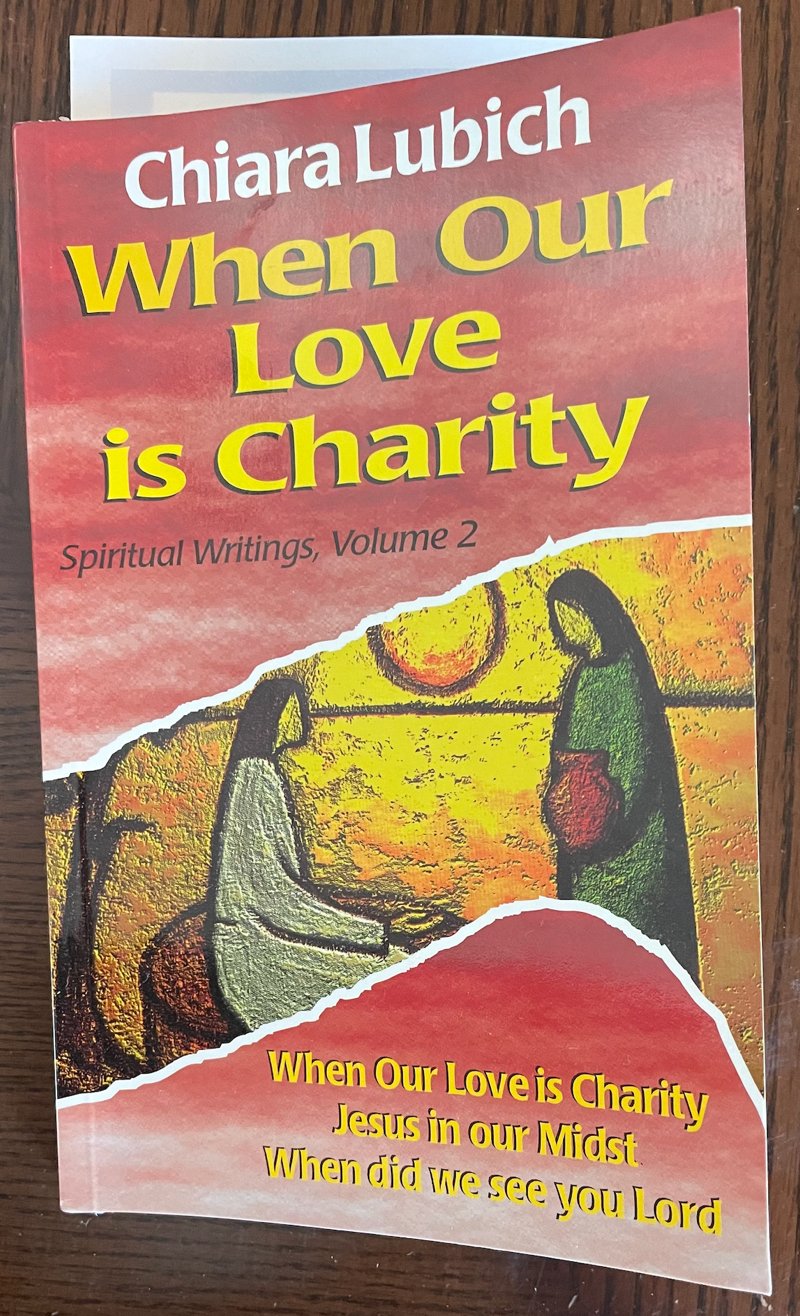
When Our Love is Charity is an explanation of one of - if not the - primary values of the Focolare community: charity. Of course, charity corresponds to love, but Chiara Lubich expounds in more detail on how to live out love in community and as a community, so it corresponds to the charity that St. Paul describes as “the greatest gift” in 1 Cor. 13.
Her writings should be of great interest to us at Christ the Reconciler, as we are being led by the Holy Spirit in the founding of our own community. Of course our emphasis on Living Out John 17 is different than the emphasis of the Focolare on Charity - but there are many overlaps as well. For example, in describing how charity leads to unity, Chiara writes:
The love God wants us to have for one another is unity in distinction. In fact, Jesus could have said “Where two or three are united in my name, I will fuse them.” but he didn’t say that. Instead he said, “I will be in the midst of them” (Mt 18:20). This means unity and distinction. Creatures are finite and cannot penetrate each other, but God can penetrate each.
One area that Chiara goes into in depth, that we have also been talking about, is the impact of charity on material goods. The Focolare do not have a full communion of goods, like the Bruderhof, yet Chiara seems to want them to be drawn in that direction. At the same time, she recognizes the practical necessity of maintaining private ownership in a community that has a variety of different “levels” of membership, from loosely-associated Volunteers to Youth, Priests, Focolarini, and the fully-devoted Focolare.
One area where I wanted to understand more, was how the Focolare relate to non-Christians. They have a history of dialogue with those from other religions, which is not something that the Holy Spirit has led us to focus on. Chiara Lubich encourages her community to walk the fine line of grace to the world and truth to the gospel:
… as they feel understood, people will desire to know what kind of love carried us to them. They will discover that it does not come from us but from God, and they will recognize the true God through our witness.
We have much to learn from those who have gone before us in the pursuit of unity in community. The Focolare are among them. I encourage you to pick up one or more of Chiara Lubich’s prolific writings, to see how they live out the love of Christ in their community.
2 Books About The Church & The Jews
Well, it’s been a while since the last book of the month. The reason for that is that it took a while to work my way through Jen Rosner’s book, which has lots of footnotes. So, to make up for it, here’s a two-for-one deal!

Jen Rosner is a Messianic Jew and a professor at Fuller Seminary. In Healing the Schism, Jen has written an important book that provides a century-long overview of theological approaches to the difficult but important topic of the relationship between the Church and Israel.
We learned of the importance of this topic during the Wittenberg 2017 initiative. We were surprised when we approached German pastors with the idea of Wittenberg 2017, and kept getting the same response - “This is a God idea - but, where are the Jews?”
Why was this? Jen offers us a clue in a quotation from Thomas Torrance: “Schism between Christians and Jews is the deepest schism and the root cause of all other schism in the one People of God.” Thus movements to heal this schism, also lead to the healing of other schisms. We experienced this directly during the Wittenberg 2017 initiative, where the involvement of Messianic Jews was one of the key graces God gave us — ultimately resulting in the Shabbat celebration that in so many ways capped the 2017 gathering.
Jen frames her entire book around a question posed by Bruce D. Marshall: “Marshall seeks an affirmation of both the universal, ecclesially mediated saving mission of Christ and the irrevocable election of Israel, which necessarily includes the ongoing practice of Judaism.” Wow! So much of life is simply finding the right question.
In Chapter 1, Jen holds up to the light of this question the work of German theologian Karl Barth; in Chapter 2, the Jewish mystic Franz Rosenzweig; in Chapter 3, a series of post-Holocaust writers including Torrance, Soulen, and Wyschogrod; and in Chapter 4, Messianic Jewish theologian (and friend of CTR!) Mark Kinzer.
Each chapter is framed by looking through three lenses: Christology; the Election of Israel; and ecclesiology. Throughout, Jen evaluates the ways in which each theologian does, and does not, meet the original criteria posed by Marshall.
Jen’s conclusion is that the progress made towards “Healing the Schism” has been substantial in the last century - praise the Lord! And yet, there is still much work to be done, both theologically and on the ground. Some of this work is being done here at CTR, and Jen’s book is an encouragement to press on … for which we should be grateful!
In the Introduction to her book, Jen Rosner has a quote about opening up “the possibility of Christians learning things from Jews about how to be Christians.” There is no better summary of Bob O’Dell’s new book, and his Root Source project, than this sentence.
As related as Bob’s book is to Jen’s, it is completely different in style! If you’re looking for a book with fewer footnotes - well, choose Five Years With Orthodox Jews. The book is organized as a series of 40 vignettes, each one short and (for the most part) self-contained … such that you could just pick and choose chapters to read that sound interesting. And all of them do, since Bob has a gift for enticing titles, such as “The Greatest Love Story You’ve Never Heard” and “Does God ever Bait-and-Switch?”
Chapter 35 is “A View Too Small: First Steps” … and those of us who have been engaged with AHOP and CTR for a while will find ourselves reading a familiar story, from an unfamiliar perspective. Bob recounts his view on the J.J. Seabrook narrative that AHOP, and of course the Seabrook Center, played an important role in. It is wonderful to revisit this God event, and learn new aspects of how the Almighty wove together a tapestry that nobody expected.
One remarkable aspect of Bob’s book is the “with Gidon Ariel” on the title page. Gidon Ariel is an Orthodox Jew, and you learn about him and how Bob met him in the early part of the book. Bob asked Gidon to respond to each chapter, so at the end of each chapter written by an Evangelical Protestant Texan, there are a series of questions to which an Orthodox Jew in Israel writes his short, witty, and often surprisingly orthogonal answers. It’s like being a fly on the wall as Bob and Gidon converse at a corner café in Jerusalem.
In fact, reading the book is very much like having a conversation with Bob. This dear friend of CTR has held nothing back as he opened up his experiences, thoughts, and musings from the past five years. Get to know him better … get to know our Jewish friend better … by reading this book!
Tear Down These Walls
In both the title and content of Tear Down These Walls, John Armstrong has penned a clarion call for unity in the body of Christ. He has spent the last several decades promoting and working for what he calls missional-ecumenism - by which he means an approach to reconciliation and unity that focuses on Christ’s mission of salvation for the world. John rightly points out that Jesus links the two in his prayer in John 17 - “May they be brought to complete unity, so that the world may know …” Here is a good distillation of his approach:
… I am persuaded this resurgence of interest in the imperative of our unity will lose its momentum if it is not vitally linked with Christ’s mission. This link can be found in missional-ecumenism, a model that brings mission and unity back together.

Tear Down These Walls began as a revision of John’s previous book Your Church is Too Small, but quickly became a new work - in many ways, a summary of his life’s work and thought. As such, it contains many stories of his journey from an up-and-coming Reformed theologian … to being confronted one day in church with his easy recitation of “one holy catholic church” … to walking away from growing fame into rejection and an uncertain career path … to finding his voice as a leading advocate in the US for missional-ecumenism.
These stories weave in and out of a careful presentation of his essential approach:
The importance of relationship first (against previous emphases on theology first)
The anchor we have in the Creeds, particularly the Nicene Creed
The problem of schismatic sectariarianism (as illustrated by the 44th-funniest joke of all time!)
The hope for a truly beautiful church to impact the world
The importance of a love for each other that is costly - “A theology of ecumenism is helpful, but love alone is indispensable”

Thomas met John Armstrong in Chicago in 2013, at the first Lasaunne Catholic-Evangelical Dialogue.
We at Christ the Reconciler should be encouraged, inspired and challenged as we read Tear Down These Walls. His practicality and emphasis on mission is a good balance to our more mystical approach that focuses on satisfying Jesus’ desire and preparing the way for the return of the Lord in glory. We have much to learn from John. I am grateful for this new expression of his life. Tear Down These Walls … Amen!
Christianity: Fundamental Teachings

By Thomas Cogdell
One week ago today, my wife Amy and I had the privilege of visiting the Alleluia Community in Augusta, Georgia. We experienced many wonderful blessings, and right at the top was to see the community - which is mostly Catholic but has a good number of Protestants as well - receive into their midst a Greek Orthodox priest, Fr. Timothy Cremeens. Praise the Lord!
The picture above shows our subsequent meeting with Fr. Timothy and his cousin Patty. The gift we gave to him, which he is holding, is a small booklet called “Christianity: Fundamental Teachings.” One reason for the gift was the connection of this book to his church, the Eastern Orthodox church.
What we told him is what I wish to highlight for you -
“This book is a miracle and a prophetic sign in the Church.”
The best way to see this is to look at the signatory page, of who contributed to and endorsed the book:

A book on Christian theology, agreed to by the significant Orthodox, Catholic, and Protestant leaders of an entire country! Take a minute, and let that sink in …
…
…
… wow!
And the topics that they address are at the very core of the faith of those who follow Jesus. Here is the Table of Contents:

Just beautiful!
And it is important to note that the book is clear on where there is agreement, but also where there is not yet agreement - in hopes that one day there will be.
We encourage you to purchase a copy of this book (available on Amazon) and read it carefully. Share it with others, widely, and encourage them to do the same! Treat it as you would a sign and a symbol - a cause for great hope. Here at Christ the Reconciler, we have set it aside from all other books in our library, in a special glass case on the wall, to draw attention to it.

In conclusion, the region that is now modern-day Turkey was where much of the New Testament was written - with all of the epistles pleading for unity against the constant threat of divisive hostility. All seven of the ecumenical councils of the early church were in Turkey. The Nicene Creed was begun in Nicaea but completed in Constantinople (now Istanbul). In 1054, the Great Schism was triggered in Constantinople, dividing East from West - a wound that is yet to be healed, and in fact was exacerbated during the time of the Crusades.
And now, from Turkey, and from Istanbul where East meets West as nowhere else, comes a book declaring to the world that the major streams* of the Church can, in unity, agree on a statement of the fundamental doctrines of Christianity.
* I would consider this to be three of the four major streams of the Body of Christ, the fourth being Messianic Judaism which does not have a significant presence in Turkey. These three are certainly the most visible and widely known traditions in the body of Christ, with Messianic Judaism just re-emerging on the world scene.
That They May Be One

Another wonderful surprise from the land of Turkey! The first was Fundamental Christian Teachings, a small book of doctrine jointly written by (wait for it) the leadership of Eastern Orthodox, Roman Catholic, and Protestants!. And now comes this book That They May Be One from Amy Ohler, a Canadian who lives and works in Turkey. In God’s providence, this amazing land which is home to both the Nicene Creed and the Great Schism is showing the way to the rest of the world regarding Jesus’ prayer for all of His followers.
Amy did not expect to write this book. In fact, she tells us early on that she never expected to write any book. But as the Holy Spirit began showing her God’s story through the lens of unity, she found herself writing down her insights. I am grateful - and we are all the beneficiaries of her faithful labor.
In the first half of the book, Amy unfolds new perspectives on Genesis, the entrance of sinful divisions, the place of judgment, and the cross. This lays the groundwork for the second half of the book, which I found to be profound and prophetic.
First, she addresses the place of Scripture, both as a unifying and dividing part of our faith. Would that we all considered the Bible to be our bridegroom’s journal, as Amy puts it!
The Bible communicates the heart of the Godhead, but unlike Jesus is not actually part of it.
After that analogy, she unpacks another very helpful image of a carving in a rock wall, drawn from a dream that God gave to her.
When it comes to considering other denominations, other traditions, and other church communities, we often begin with an attitude of criticism … It is like coming home and noticing that there is one dirty pan left in the sink but not seeing that the whole house is clean … when it comes to the things of God, when it comes to the church, criticism as a first approach is not usually particularly helpful.
Then, Amy draws from her experience in community in Turkey to show practical ways that community is both difficult and healing.
My roommates over the years in Turkey have been from a wide spectrum of nationalities (American, Turk, Swede, Fin, Romanian, South African, Iranian, Korean, Brit, and Arab-Turk). These roommates and my many coworkers over the years, have also come from very diverse church backgrounds (Charismatic, Orthodox, Non-denominational, Pentecostal, Conservative, Reformed, Presbyterian, Southern Baptist, Catholic, or newer believers who do not associate with any particular stream), or from no church background, or even from another faith.
She surprisingly but beautifully turns next to the family - mother, father, and child. Depicting this “triad” on the amazing cover illustration of the book shows how foundational it is for Amy, and the importance of its implications for the leadership of churches and ministries.
Since humanity was created to reflect the profound unity of the Godhead, we must then recognize that men, women, and children should be acknowledged as having something of value and significance to contribute to the greater whole. Frequently, two of these voices are received far less (if at all) than the other. When one or more of these voices is missing, ignored, or oppressed, it is a sad loss to the greater whole, and such communities will be (and frequently are) weaker for it.
And her final chapter has the same name as the last book of the month - On Earth As It Is In Heaven.
Given the title of the book, I expected a deep dive into John 17. Interestingly, this never came - at least not explicitly. Though John 17 is only occasionally referenced, it permeates the book - which in many ways is like a meditation on Jesus’ prayer as reflected throughout all of scripture. It is a wonderful resource for us at Christ the Reconciler, and I wholeheartedly recommend it!
I can’t help but also be amazed by the timing of reading this. I have been looking for a chance to do so for several months, but didn’t find the time until I took a trip to California to see my sister. I am so glad that I read this after Caroline’s teaching on The Accuser of the Brethren. Here is part of Caroline’s talk, next to some of Amy’s writing - as an encouragement that the Lord is speaking! Let us have ears to hear what the Spirit is saying to the church …
Caroline Owens:
Today I am going to talk about the Accuser of the Brethren. Who is this Accuser, and what is his role? He is the ‘great dragon”, that ‘ancient serpent’, Satan. The name “Satan” itself means “Accuser” or “Adversary”. His very nature is to constantly accuse us. The devil is no friend of humanity. And yet, when we look at the world, we can see his influence everywhere. The saddest place to see him working is in the church, and this is far too often. How this grieves the heart of God!
… Jesus … says to we who would harbor such thoughts or words: You do not know what spirit you are of. He is not talking about the Holy Spirit. I would say the spirit we are of, is the Accuser.
Amy Ohler:
Seeking out what is wrong in order to accuse does not generally bring life and there is good reason for this. Let’s consider for a moment where we first see accusation appear in our story. Back in the garden, the first to accuse is the second voice that speaks to humankind. Accusation is his tactic and his nature, and it is also his name - both ‘satan’ in Hebrew and ‘devil’ in Greek mean ‘the accuser’. If only we could fully recognize who we are partnering with, and who it is we look like when we accuse others, especially when we accuse others in the body of Christ! God already has one who stands before him day and night accusing the brothers and sisters. He does not need or want that from us.
Unity - On Earth As In Heaven
I was very honored to receive this book in the mail from Dan Almeter, a long-time leader in the Alleluia Community in Georgia. In the note he attached he comments that Fr. Peter Hocken wrote the foreword. Oftentimes when Fr. Peter came to visit us at AHOP / CTR, he would be coming from the Alleluia Community, which he always tried to visit on his trips to the States. It is wonderful to have this connection with them, a shared love for (and from) Fr. Peter.

This is an important book for us at Christ the Reconciler, and very timely for our current focus on “community.” Let’s study it together, and be both challenged and encouraged!
Unity – On Earth As It Is In Heaven tells the story of the Alleluia Community, which was founded in February 1973 in Augusta, Georgia. That weekend, a historic snow of 15 inches fell on Augusta, shutting the entire area down. Twelve Catholics who had been recently filled with the Holy Spirit were trapped together in a large house. As they worshipped and prayed, surrounded by the snowstorm, they began to put into action the idea they had been discussing together for a year or so – intentional community. They wrote a covenant of life together and adopted it, forming the first nucleus of the Alleluia Community.
Their community has grown to more than 700, but they still have the same covenant that the original snow-bound dozen crafted almost fifty years ago.

Though the Alleluia Community began with only Catholics, they immediately sought the Lord as to whether they should also include Protestants. They heard an immediate “Yes!” from the Holy Spirit. Today about 10% of the community is Protestant, and they have also been joined by Orthodox believers and Messianic Jews.
Dan Almeter’s book is a wonderful recounting of this journey. He mixes stories from their decades of community life with a clarion call to living out John 17 (though they don’t use that same phrase, which we have adopted here at CTR). As such, Unity includes both inspiration for us, and practical understandings of the nitty-gritty of life in an intentional community. For example:
We know that in a Christian marriage each spouse is meant to help the other grow in holiness and mutual love. They learn to do this by dying to themselves through sacrificial love. Imagine having hundreds of opportunities every day to interact with a multitude of brothers and sisters of different backgrounds, different Christian traditions, different races, different personalities, different cultures – there’s no end to our differences. If we can grow in holiness and charity within our nuclear family, then we can grow exponentially in community, where we must die to ourselves and live in charity with hundreds of other Christians on a daily basis. This has, in fact, been our experience in community. After 40 years of living covenant life with one another, holiness and love have grown to a level where mutual communion is very real and palpable. A deep conversion to the Gospel has occurred within our midst.
What a gift! As we craft our own community commitment, we can learn from what the Holy Spirit has been doing in Alleluia. Hopefully we can avoid some of their mistakes – while no doubt making new ones of our own! The leaders of Alleluia Community have expressed a willingness to walk alongside us, without trying to make us “just like them.” Oh, the beauty of the body of Messiah!
If you are interested in going deeper than the Statement of Personal Devotion and considering the Community Commitment here at CTR, it is important for you to get a copy of this book from Amazon and read it.
Here is the link:
Everyday Saints
Book Review by Amy Cogdell
The Lord first began calling me into the ministry of reconciliation through a series of dreams in the late 1990’s. In one of the dreams, I found myself in an unfamiliar church served by bearded priests dressed in long black robes. The priests were chanting in a foreign language I did not recognize. The only words I could make out were “Kyrie Eleison.”
“Greek!” I thought. “Greek Christians! They don’t seem to be Catholic. What are Greek Christians called?”
The answer, of course, is that they were Orthodox. The Orthodox Church is a branch of Christ’s Body I knew nothing about at the time. Through the dream I felt Jesus impart His love for my Orthodox brothers and sisters. Since that time, I have prayed for the Orthodox Church (which is comprised of many languages and patriarchates) and longed for a closer connection with Orthodox believers.
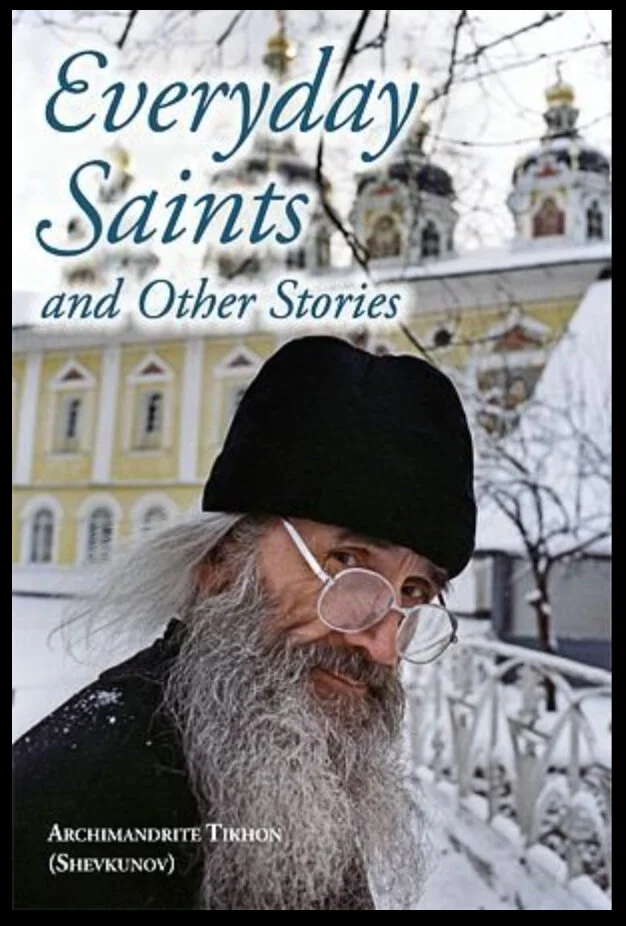
This fall the Lord gave me a gift along these lines through our friend Marianna Gol. She sent a book called Everyday Saints written by Metropolitan Tikhon of Moscow. It is the story of his conversion to faith during the Soviet era, followed by stories about the monks who formed his faith, nuns who were imprisoned during the communist years, and lay people who remained faithful to God in times of persecution. The book is engaging and easy to read. Some of the language and practices described in the book may feel foreign and mysterious, but Christ’s faithfulness to those who trust Him is the same in Russia as it is in America, as it always has been and ever shall be. I found the book to be a helpful window into a part of Christ’s body which is usually closed to our sight. I recommend it to all who might be discouraged about the darkness of our days. This stories Fr. Tikhon tells bear witness to the fact the darkness cannot overcome the Light of Christ.
Imagine Heaven
I never before realized that the Prodigal Son is one of Jesus’ parables about money. Why do I say this? Immediately after the parable, Luke 16 begins with this:
Then Jesus said to the disciples, “There was a rich man who had a manager, and charges were brought to him that this man was squandering his property …”
Squandering property … sound familiar? Just a few verses earlier:
“But when this son of yours who has squandered your property with prostitutes comes home, you kill the fattened calf for him!”
The older son is focused on money and possessions. The father doesn’t seem to regard the lost family wealth as important at all.
“…we had to celebrate and be glad, because this brother of yours was dead and is alive again; he was lost and is found.”
Jesus crystalizes the difference between these two outlooks with a single piercing phrase later in Luke 16:
“What people value highly is detestable in God’s sight.”
When I was making these discoveries in Luke’s gospel, I was also reading John Burke’s book Imagine Heaven, which catalogues and analyzes thousands of near-death experiences that have been studied by scientists and confirmed as legitimate in various ways. (For example, a blind person who was able to describe in detail the operating room that his body was laying in.)

A consistent theme from these “NDEs” (near-death experiences) stood out to me, in light of my readings in Luke. During the “life review” portion common to most NDEs, as God was presenting the person’s life to them so they could review the decisions that they had made, their actions that accumulated wealth, prestige, fame, and fortune counted for nothing. “What people value highly is detestable in God’s sight.” But their actions in service of others whom God brought them into relationship with, counted for everything. This is what God values highly.
Here is an example passage from the book, from an art professor who had a heart attack while leading students on a tour of Paris.
In my life review, I had to turn away numerous times when I saw myself treating my children in unloving ways. … The most disturbing behaviors I witnessed in my life review were the times when I cared more about my career as an artist and college professor than about their need to be loved. The emotional abandonment of my children was devastating to review. … I begged them to stop it because I was so ashamed of my failure to live lovingly and because of the grief I caused God, Jesus, and the heavenly beings. The only reason I could bear to proceed was because of their love for me. No matter what we watched me do in life, they communicated their love for me, even as they expressed their disapproval of the things I did.
And another, from a young Australian who was in a surfing accident:
Every detail of twenty years of living was there to be looked at. The good, the bad, the high points, the run-of-the-mill. And with this all-inclusive view came a question. It was implicit in every scene and, like the scenes themselves, seemed to proceed from the living Light beside me.
What did you do with your life?
This made a profound impression on me. Where have I neglected relational love and service for others? How can I live differently?
I can recommend Imagine Heaven just for the impact of this message. But the entire book Imagine Heaven is fascinating. Who doesn’t want to read about other people’s glimpses into the afterlife. John Burke’s approach comes from his background as an engineer, so he carefully presents various points of view, but explains how the evidence points to the biblical narrative as the best explanation for what is commonly experienced during NDEs.
Another very interesting conclusion he reaches is about the Biblical theophanies (when the heavenly realms are revealed, such as in Isaiah 6 or Revelation 4). He had always interpreted them figuratively. But as NDE after NDE reported seeing a heavenly city, gates made of pearl, streets of transparent gold … well, he began to wonder if these theophanies are not much more literal than he had realized. This should encourage us to gaze on “the Beauty Realm” in ever more fervent hope.
Read Imagine Heaven! Then pass it on to some friends, especially those who have doubts, are discouraged, or are afraid of death.
2 Novels
This year it’s been my pleasure to read two novels. One was very Catholic - Fr. Elijah. The other was, I would say, from a Protestant point of view - Charis Colony: The Landing. But they were connected in a certain way, because each had a unique perspective on the second coming of Our Lord. That makes them very appropriate Advent reads … and also wonderful Christmas gifts!
Charis Colony: The Landing was written by a member of the CTR Community, John Martin - his first novel. Set on another world but very much inheriting the problems of ours, Charis Colony charts Raj and Shirin’s whirlwind romance, and its consequences for each them. From the moment Shirin’s machete whistles a half-inch from Raj’s chest, I was hooked. As the fantastic story unfolded, I must admit I kept wondering, “Where is the Christian part of Christian SciFi?” And then … the end!
Enough said … buy this book and read it for yourself.

Fr. Elijah: An Apocalypse is one of a series by Michael D. O’Brien. I was first introduced to this series more than a decade ago, with Eclipse of the Sun, and was astonished to find that Catholics wrote about the end times! Who knew?
Fr. Elijah traces the path of a Catholic priest who is a Jew. He is called to the Vatican and sent on a perilous mission. The novel follows him into danger, out again, and into worse danger as the Vatican confronts evil outside, and evil within. Like Charis Colony, the book is well written and gripping. Don’t pick it up until you have a few days of holiday relaxation on the schedule!
Unoffendable

As the United States awakes to an uncertain result of a bitterly contested election, we seem more divided than any time in recent memory. Have the followers of Jesus succeeded in remaining united in love in the midst of the partisan division? The answer is “No” - Christians are publicly divided. Even more grievously, this division is marked by pride, anger, and contempt on both sides.
This month would be a good time to rediscover Paul’s characteristic of love as “not easily offended.” What if followers of Jesus were unoffendable - by each other, and by the world?
A conservative radio talk show host would seem to be the least likely person to help us here. But help us Brant Hansen does - and conservative radio talk show host, he is.
His radio show gave him a birds-eye view of the lack of maturity in the body of Christ - for example, an email sent to him that read in part:
u are a theological mess! and i could possibly get past the ‘stoner bert and ernie shtick’ and the coy flirtations with the women that call iff you ever had one intelligent or spiritual thing to say … what a shame, u have such an opportunity to help change lives, and you use it just like an apostate.
How to respond? That is the topic of this book, as Brant unfolds his journey from anger and resentment to discovering that he could choose to be unoffended. We all need to learn this lesson!
In the process, Brant tackles a number of hard questions, such as “What about righteous anger?” Clearly, he has been presenting his ideas over the air for years, and listened carefully to those who call / write him, so his responses are not theoretical but highly practical.
Throughout, Brant uses funny stories and an informal style to engage his readers.
You can purchase the book on Amazon, or the audio book on Audible.
Inside tip: Caroline Owens tells me the audio book is great, because he reads his own book - and, being a radio personality, he has a very engaging voice!
Transforming Austin: A God Story

[In] 1998 … then Mayor, Kirk Watson, called together a group of leaders to draft a “Commitment to Racial Reconciliation” in response to a racially charged police event in the city. That document declared the equality of the races and the evil of racism. [It] used much of what had already been worked through by a small group of Christian pastors and their wives in 1996 in writing the “Pastoral Covenant for Racial Reconciliation.”
…
The team consisted of Pastor Geno Hildebrandt … Pastor Rick Randall … ; Pastor [Joseph] Parker … and Ashton Cumberbatch, a lawyer, pastor, and civic leader, both of African-American descent; and their spouses. Ashton Cumberbatch described the document: “It took a year. It acknowledged that racism is a sin and set out some scriptures that supported that. It said that we have fallen short of the glory of God in that area, and it talked about things we could do in our individual congregations, and what we could do collectively to combat that. we presented our document to a larger group that existed at the time - Austin Pastors Prayer Fellowship. They thought there was merit, so we had a signing event. I think originally 65 to 70 pastors signed the document.”
This story is found in Transforming Austin: A God Story, a wonderful little book written by a friend who works for ABBA, Thana Rolph. While on a skiing trip in Colorado, she heard God invite her to write His story - specifically the story of God’s work in Austin. Thana starts with the founding of Austin but focuses mostly through the last 50 years.
Prayer and unity are two of the key themes run throughout the book - and of course these themes are dear to our heart at CTR. And the story also has so many names of people who are also dear to our heart - Dan Davis, Cindy Vana, Vicky Porterfield, Daniel Geraci, Barb Bucklin, Rick Randall, Joyce Tait, David & Bethany Martin, Steve Hawthorne, Marivel Reyes, and on, and on, and on. It is lovely to read Thana’s writing about each of them, as her affection and appreciation for each of them comes shining through.
As I read, I tried to imagine the layers and layers of God-stories beneath each sentence of Thana’s brief story. I of course am intimately familiar with the history of Austin House of Prayer - the dreams and visions, the struggles and failures, the breakthrough prayer times, the people God brought, the worship that arose, the miracles of provision. And yet I am also aware that I do not know the full extent of the impact of AHOP, because we get only glimpses of the glory in this life. This reality is true for each of the churches, ministries, movements and organizations that Thana covers - The Well, St. David’s Episcopal Church, Holy Cross Catholic, Perspectives, March for Jesus, Pastors in Covenant, Campus Renewal Ministries, ADRN, ABBA … each of them has backstory after backstory and impact after impact, mostly untold and often unknown even to those who were there. Praise the Lord for the fruit He has brought forth from cross-pollination in the city of Austin!
Most of that cross-pollination is on the Protestant side. While Thana uncovers a few Catholic stories, they are primarily ones that touch the Protestant world. It would have been a delight if Thana had turned her prodigious researching skills towards the history of the Catholic Diocese, tracing the rich legacy of those brothers and sisters. Not to mention the Eastern Orthodox! What has their contribution been? These are further steps forward in God’s story of Transforming Austin. To use one of Thana’s analogies, may these three tapestries be woven together more tightly in years and decades to come.
It seems appropriate to close this book review with the last words written by Thana in the Epilogue: “… God writes His story through the pages of our lives. It takes all of us.” Amen, and amen!
You can purchase Transforming Austin on Amazon by clicking here.
Because of Winn-Dixie
This year our Reconciliation Bridge Prayer includes this collect:
Dear God, thank you for warm summer nights and candlelight and good food. But thank you most of all for friends. We appreciate the complicated and wonderful gifts you give us in each other. And we appreciate the task you put down before us, of loving each other the best we can, even as you love us. We pray in Christ's name, Amen.
- "The Preacher" from Because of Winn-Dixie
This resulted in an email from one community member - What is Because of Winn-Dixie?
This book review is my lengthy answer to that short question! Because … Because of Winn-Dixie is a delightful and profound children’s book.
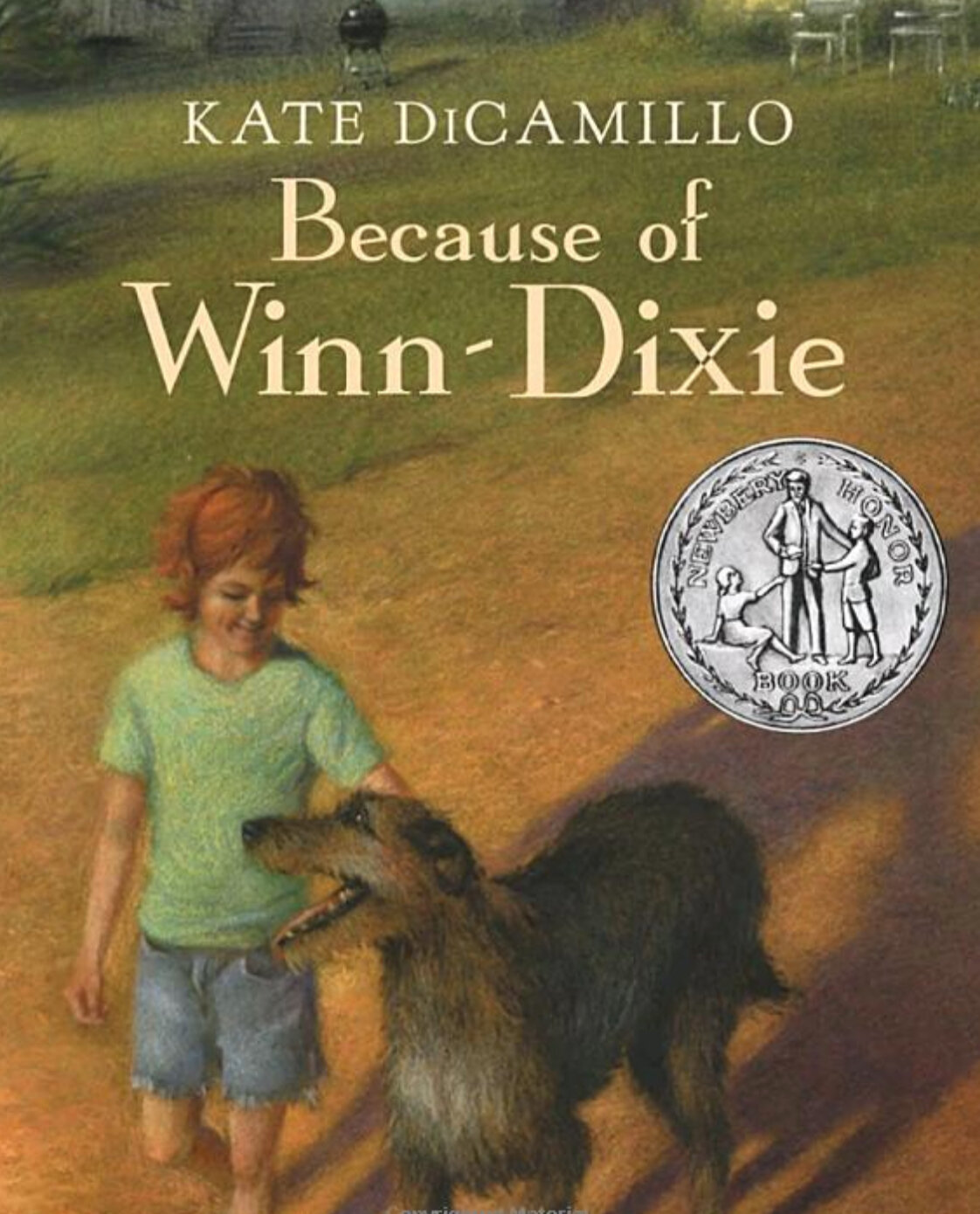
It tells the story of a 10-year-old girl named India Opal who has just moved to a small town in Florida with her father, who has taken a job as pastor of a small church that meets in an abandoned convenience store.
India’s mother left when she was a small child, and her father is wrapped up in shame and sadness - but he can’t share it with his daughter. It is locked up inside of him, and he “pulls his head into his shell, like a turtle.”
As a result, India calls him “The Preacher” instead of “Daddy” - for most of the book. But the story tells how grief is unlocked - for him, for India, and for other members of their small town. Everyone has their own private grief - and learning to make it public is “both sweet and sad”, like the famous Litmus Lozenge candies that the town used to produce. And of course Winn-Dixie, the dog that India finds, plays an important role as well.
Learning to grieve is such an important part of reconciliation. This book communicates powerfully to children and adults alike.
The book has also been made into a wonderful movie of the same name, which stars AnnaSophia Robb as India Opal and Jeff Daniels as “The Preacher.” Both the book and the movie are highly recommended!

Be The Bridge
One of the many, many good aspects of Be the Bridge are the prayer liturgies at the end of each chapter. It’s so encouraging to see a book on racial reconciliation that highlights the importance of prayer in the work of reconciliation!
Another connection of this book with CTR is that the author, Latasha Morrison, lived here for many years. In fact, her ministry Be the Bridge (same name as the book) was founded here in Austin, based on her experiences as the only black pastor at a well-known church in the city. She tells the story in the first part of the book - how her Austin experience led to the ministry, and how the ministry led to the book.
She published the book in 2019, and it won a Book of the Year award from Christianity Today - which I was so happy to see. Then 2020 happened … and after the George Floyd killing white people all across the nation went looking for books about racial reconciliation. Latasha’s book shot up on the New York Times bestseller list and went out of print! “For such a time as this …” How wonderful for a Godly, honest, well-crafted book to become a national resource in time of crisis.
Be the Bridge is also one of the best books on reconciliation I have read, period. She lays out a map for racial reconciliation that can be applied to many other contexts. For example, she focuses on the importance of shared lament - which we practiced in Wittenberg 2017. She doesn’t skip over the need for repentance, but also doesn’t stop there - moving on to cover how God can heal past wounds and make all things new. No “perpetual white guilt” can be found in this book - it is filled with hope. And practical steps that can be taken, now. And probing questions at the end of each chapter, perfect for a small group meeting or a personal examination of conscience.
If you haven’t read Be the Bridge, prayerfully consider doing it sooner rather than later.

Difficult Conversations

By Douglas Stone, Bruce Patton, and Sheila Heen
We Americans seem to have lost our ability to talk to one another!
This short book is easy to read but challenging to put into practice. It primarily addresses personal conversations (between spouses, parents & children, co-workers & bosses, etc.) - but certainly applies to online social media discussions that are so prevalent in these days where we can’t meet face-to-face.
Practical tips abound for getting to the point without offending or reacting. There are multiple examples of extended conversations, with each one broken down into the three different conversations that are taking place:
The “What Happened” conversation - what are the facts
The Feelings conversation - how do we feel about what happened
The Identity conversation - what are the implications for who we are?
Meaningful reconciliation requires conversation. This book is a great aid in having these conversations without sabotaging the relationship or making the situation worse.
A Man Called Mr. Pentecost
When Fr. Peter first visited our community (then called AHOP) in 2010, part of the discussion with him was about our library. He asked about how we chose the books in our library, and recommended that we change from “everyone’s discarded books that they drop by the prayer room” approach, to a more curated library of books we can enthusiastically recommend. Felipe asked him for books that he would specifically recommend, and one author he mentioned was David du Plessis.

A Man Called Mr. Pentecost is the wonderful and easy-to-read autobiography of this important man. David du Plessis was born into a Pentecostal missionary family in South Africa in 1905. Chapter 1 begins with a prophecy given to David du Plessis by Smith Wigglesworth in his early 30’s, that David would see the Pentecostal movement spread into the established churches (mainline Protestant & Catholic) … which was unthinkable at the time.
The first half of the book then traces his childhood, conversion, baptism in the Holy Spirit, and early ministry and leadership experiences. The chapters are short and filled with a combination of the excitement of the Holy Spirit’s activity and the disappointment of immaturity in himself and other Pentecostal leaders.
Everything turns in Chapter 18 - Revolution. God does a serious work in David’s life, that prepares him to begin to work with the mainline churches. The remainder of the book is a remarkable account of the doors that open to him in church after church, as the Holy Spirit blows through the windows of the established churches in the 60s and 70s. One highlight is the invitation from the Roman Catholic leadership to be an official observer at Vatican II.
I highly recommend A Man Called Mr. Pentecost for our community. It is important to understand the Pentecostal movement, and the history of David du Plessis is a wonderful on-ramp to this important topic, that will be highly accessible for Protestants and Catholics alike. (Note that is seems to be out of print, so you will need to search around for a used copy to purchase, or come to CTR to read the one that is in our library!)
Stories of the Saints

Stories of the Saints: Bold and Inspiring Tales of Adventure, Grace, and Courage
By Carey Wallace, illustrated by Nick Thornborrow
Review by Brie Tschoepe
“Who is a Saint? Saints aren’t born better or braver than the rest of us. Saints aren’t people who are always good and never afraid. They’re people who believe there must be more to life than just what we can see. This world may be hard and unfair, but saints believe in a God who is bigger than the world, whose law is love, and whose justice is mercy. And this faith gives them courage: to stand up to evil kings, to care for people everyone else forgets or hates…”
For years, I and others prayed with the author for Stories of the Saints, that it would become the book that God wanted to bring into the world to inspire readers with the exciting and marvelous stories of faithful ones.
The book that finally made it to publication is deliciously beautiful and enthralling. The great effort of distilling the stories of 70 saints into a coherent series that is accessible and meaningful to both young and old(er) is brightly evident.
Where the stories seem to have melded with “legend”, Carey accepts the possibility of a mysterious Truth that may not seem probable, but magnifies the nature of the God they served. As she puts it,
“Are these stories true? That depends on what we mean by true stories...just because we can’t be sure a story really happened doesn’t mean it isn’t true in another way. These stories have been told for generations, some for thousands of years...They come from many sources, but they are among the best-loved and most enduring stories in the world because of the deep truths they contain.”
She might have sought to provide “historically accurate” accounts--which no doubt would have left her scant material. Or she might have painted the most fantastical elements, as if these were merely Christian “Fairy Tales.” What she birthed is instead a melding of the two that represents the very mending of divisions our community prays toward. She maintains the Mysteries and Wonders that the Catholic church accepted and preserved, while anchoring each individual in actual place and time and culture. We can marvel that their legacies still influence our expressions of worship and knowledge of God, and yet, in Carey’s rendering, it is abundantly clear that we are invited and welcomed to join their ranks, to “bring the better world to be” by even our own faith as well.

Postscript by Thomas Cogdell
My 8-year-old daughter was inspired by this book to write a song and create a video! She read in the book about Pachomius, a saint of whom I had never heard. Below is the video that she made to describe this unusual man of God.
A Garland for Ashes (new Audio book)
The book of the month for April 2020 is Hanna Miley’s new audio book! Her powerful memoir, A Garland for Ashes, has just been released as an audio book.

Here is the publisher’s summary of the book:
Torn from her homeland...her parents murdered.... How could she cope?
When little Hannelore (Hanna) Zack left Cologne, Germany, on a train bound for London as a seven-year-old mädchen (young girl) on July 24, 1939, she had no way of knowing that she was part of the Kindertransport, an epic rescue effort that would save 10,000 Jewish children from Hitler's Nazi regime by granting them safe passage to England. In the coming years, Hanna would learn the painful truth: After being stripped of their business, forced from their Zuhause (home), and deported to endure six months of inhumane conditions in the Lodz Ghetto, her parents were gassed in a brutally efficient killing operation in a remote, forested area near Chelmno, Poland, on May 3, 1942.
Written over a four-year period beginning when Hanna was about 75 years old, A Garland for Ashes is both a gripping detective story recounting the heartbreaking process of discovering her family's fate and a poignant account of her journey from vengeful hatred to forgiveness and release from bitterness.
Here is the review I posted on Audible:
Stories from the Holocaust are so important, so as to not forget what happened, and what could happen again. But this story ... this story should be next on your list.
Why? It offers a beautiful example of how to respond when terrible events happen in our lives. Heaven forbid we have to deal with something on the level of the Holocaust again - but all of us have ways in which we have suffered loss, betrayal, and hidden darkness. A Garland For Ashes not only recounts the history in a precise and powerful manner, but lays out the process of forgiveness and reconciliation that Hanna went through as she wrestled with these memories and the powerful emotions that they evoked in her soul.
In terms of production, I haven't listened to too many audio books (I generally prefer to read visually), but this one is really good. The narrator outstanding (apparently her father also escaped the Holocaust). The violin music in the opening was like a musical interpretation of Hanna's story.
Highly recommended!